
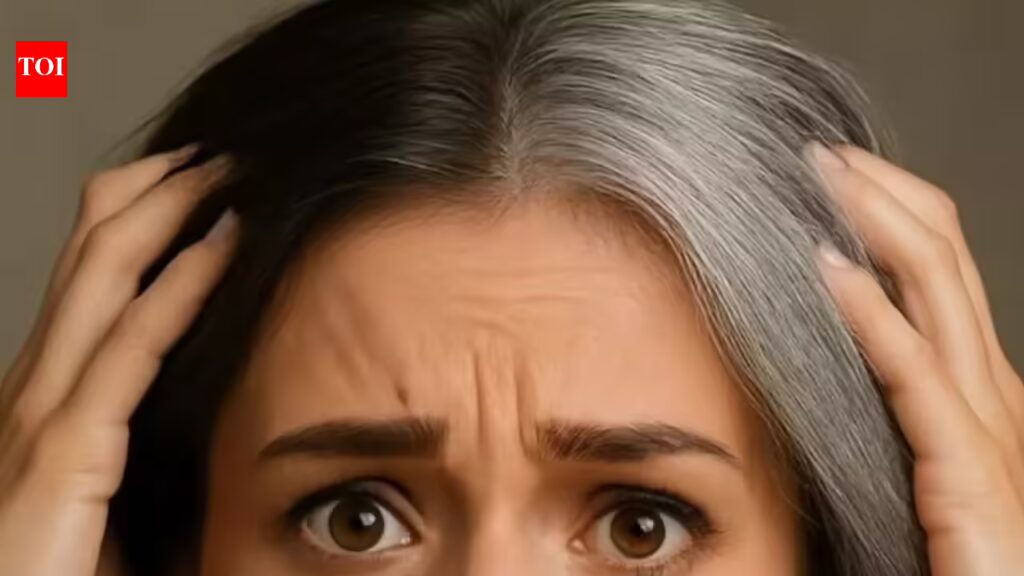
For decades, gray hair has been viewed as a sign of irreversible ageing, which people cover with dye or accept as inevitable but scientific research suggests that graying might not be a one-way street after all. Studies from top labs, including work published in Nature and eLife, are revealing mechanisms behind hair pigmentation loss and hinting at real biological paths to reversing gray hair. These discoveries are capturing global attention, offering hope that gray hair isn’t a permanent fate for everyone.
The biology behind gray hair and how it might be reversed
Historically, scientists believed that gray hair resulted simply from ageing and eventual depletion of pigment-producing cells but a 2023 research from New York University’s Grossman School of Medicine showed a deeper mechanism at work. Researchers found that melanocyte stem cells (McSCs) or the cells responsible for producing the pigment melanin are not gone when hair gray begins. Instead, these cells get trapped in an inactive compartment within the hair follicle, unable to move and become pigment-producing cells. This “jammed” state prevents hair from receiving colour, even though the cells are still present.“It is the loss of chameleon-like function in melanocyte stem cells that may be responsible for graying and loss of hair color,” said Mayumi Ito, the study’s senior investigator. The team concluded that if scientists can find a way to restore the mobility of these McSCs by getting them to move out of the “bulge” and into the pigment-producing zone of the follicle, hair might regain its natural colour.
What other studies are showing about gray hair reversal
While the NYU work focuses on cellular mechanics, other research supports the idea that gray hair might be at least temporarily reversible:
- Human Hair Reversal Linked to Stress Changes – A 2021 study published in eLife revealed that individual hair follicles can switch back to pigment production under certain conditions, especially related to stress levels. Periods of high stress were associated with hair graying, and alleviation of stress correlated with regaining pigment in some hair strands.
- Repigmentation Happens Naturally in Some Cases – Research published in Scientific American found that in a sample of people ranging from age nine to 65, some gray hairs regained dark color on their own — not just on the scalp but across body regions. Scientists linked these changes to windows of reversibility early in the graying process.
These findings suggest that not all graying is permanent, at least not early on and that biological and environmental factors like stress may play bigger roles than previously thought.
Does this mean gray hair treatments are coming soon?
Potentially but not yet. The new research does not mean that there is a pill or cream that will restore everyone’s hair to its youthful colour tomorrow. Most of the work so far has been done in lab settings or in animal models and translating these findings into safe, effective human treatments will take time.However, scientists are exploring several promising avenues –
- Stimulating McSC mobility: Finding molecular or drug-based ways to “unstick” pigment stem cells.
- Stress-related mechanisms: Since stress seems linked to both graying and repigmentation, understanding that connection may lead to lifestyle or biochemical strategies to support pigment production.
- New therapeutics: Reviews in journals like the International Journal of Biological Sciences underscore how understanding melanogenesis (pigment creation) could inspire next-generation therapies targeting hair pigment at a cellular level.
These efforts are still early, but the groundwork is being laid for a scientific revolution in how we think about aging hair.
How this changes the narrative on ageing
The idea that gray hair might be reverseable challenges long-standing beliefs about aging as a strictly one-directional decline. Instead, hair colour may be part of a dynamic biological process that responds to internal and external influences. Experts emphasise that while genetics still plays a major role, environmental and cellular mechanisms matter too. This aligns with growing scientific understanding that ageing traits often result from modifiable biological processes, not just time itself.This means:
- Not all gray hair may be permanent, especially if the cells responsible for pigment can be “reawakened”.
- Stress and lifestyle factors can influence graying and, in some cases, its reversal.
- Future treatments may emerge from cellular-level research, offering alternatives beyond dyes and cosmetic fixes.
Yet scientists caution that more research is needed before these findings translate into widely available therapies. Emerging science is turning gray hair from a symbol of inevitable ageing into a potentially reversible biological condition, at least under certain circumstances. With research now uncovering the mechanics of pigment stem cell mobility and the influence of factors like stress, the once-accepted “hair dye or resign yourself to ageing” narrative may soon give way to a new era of biological solutions for gray hair.