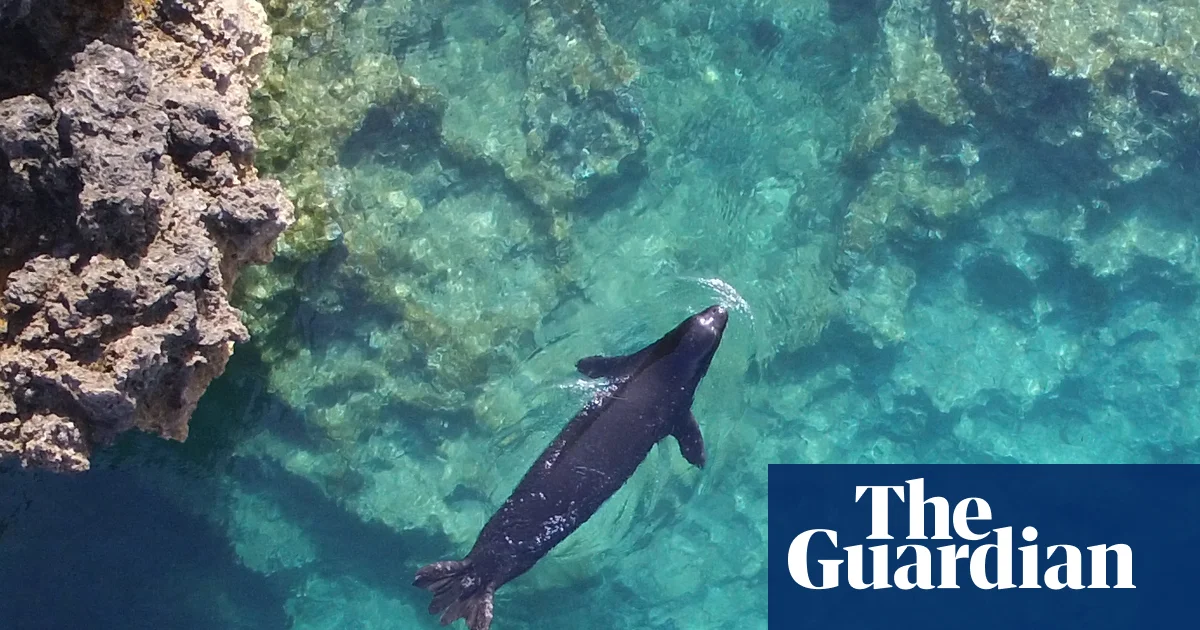
Deep in a sea cave in Greece’s northern Sporades, a bulky shape moves in the gloom. Someone on the boat bobbing quietly on the water close by passes round a pair of binoculars and yes! – there it is. It’s a huge Mediterranean monk seal, one of the world’s rarest marine mammals , which at up to 2.8 metres and over 300kg (660lbs), is also one of the world’s largest types of seal.
Piperi, where the seal has come ashore, is a strictly guarded island in the National Marine Park of Alonissos and Northern Sporades, Greece’s largest marine protected area (MPA) and a critical breeding habitat for the seals. Only researchers are allowed within three miles of its shores, with permission from the government’s Natural Environment and Climate Change Agency.
With a global population of under 1,000 individuals, Monachus monachus is listed as vulnerable on the IUCN Red List, reclassified from endangered in 2023, after decades of conservation efforts helped raise numbers. According to the Hellenic Society for Protection of the Monk Seal (MOm), Greece is home to about 500 monk seals (up from 250 in the 1990s), half of the global population, so has a uniquely important role to play in the future of these rare mammals. This seems fitting given that seals were once thought to have been under the protection of mythical gods Poseidon and Apollo and so have a special place in Greek culture.
Monk seals have been hunted in the Mediterranean since prehistoric times for their pelts, meat and blubber. While this threat has receded in Greece, others – entanglement in fishing gear, food depletion, pollution and habitat loss – have not. Now, according to conservationists, a very modern peril is growing exponentially and putting that fragile recovery at risk: Greece’s burgeoning marine leisure industry. Unregulated tourism is having a negative impact on a mammal that is sensitive to human disturbance, say .
This summer several initiatives were launched to turn this around, including Seal Greece, a national education campaign. At about the same time, the islet of Formicula, a key seal habitat in the Ionian Sea, was shielded ahead of the busy summer season by a strict 200-metre no entry zone. In October, Kyriakos Mitsotakis, the Greek prime minister, confirmed two large-scale MPAs are to go ahead. If properly managed (and so far the management structure is unclear), these MPAs could offer a lifeline to the species.
Back on the waters around Piperi, Angelos Argiriou, a freelance warden and marine biologist, points as the boat passes a shore monitored by camera. “We often see the seals resting on this beach,” he says. “The fact that they feel safe enough to haul out [rest] here in the open is a really good sign that the protection measures are working.”
Seals began to be protected in Greece in the late 1980s, with the Hellenic Society for Protection of the Monk Seal , which has rescued more than 40 orphaned or injured seals to date.
“Our rehab centre has really helped the recovery of the species,” says Mom’s president, Panos Dendrinos. “Last year, we saw a rehabilitated female with a new pup. If you save one female, she might have 20 pups in her lifetime.”
Monk seals once commonly gathered on beaches but many moved into caves relatively recently because of human pressure. Although pupping caves might have provided shelter from people, they have often proved an unsuitable habitat in which to raise young – violent surf can smash them against rocks, drown them or sweep them out to sea. And caves no longer provide reliable hiding places. Once-remote coastlines are now accessible to everyone from day trippers on hired boats to private yachts anchored in the seals’ habitat.
“A week after giving birth, monk seal mothers go fishing, leaving their pup alone for hours,” says Dendrinos. “If someone goes inside, the pup is liable to panic and abandon the cave; its mother is unlikely to find it.”
After 40 years of monitoring the Alonissos MPA, Dendrinos says his society “now see seals using open beaches systemically”.
As another key habitat for seals, Formicula will be part of the new Ionian MPA. The islet is at the heart of one of the world’s busiest sailing grounds but unlike its better-known neighbours, Meganisi and Cephalonia, it did not appear much on the tourist radar until recently.
Marine biologist Joan Gonzalvo from Tethys Research Institute explains how tourism has taken its toll on the area. “Six, seven, eight years ago we had encounters almost every day,” he recalls. “We would see five, six seals in the water at once, socialising, chasing each other.”
But with the sightings came the tourists. “What was exciting at first quickly turned into a nightmare,” he says.
The hordes came, looking for “seal experiences”, he says. Instead of studying the animals, Gonzalvo found himself recording humans chasing seals. On two occasions, people entered breeding caves, causing the separation of mothers from pups. In both cases, the pups disappeared. One day in August 2024, he says he recorded more than 50 boats around the islet’s tiny shoreline. “Nowadays,” he says, “we are lucky if we see only one or two individual seals.”
As we are talking Gonzalvo spots a seal and takes out his camera. He recognises her immediately. “Mm17003,” he says, citing the number of one of more than 40 seals he has catalogued online. As the seal rolls through the water, boats pull up and anchor in the new no-entry zones while tourists swim near the protected caves.
Unlike the Alonissos MPA, there are no wardens patrolling Formicula and it is down to Gonzalvo to politely point out to the boat’s skippers that they are in a forbidden area.
“It’s early days,” he says. “But the inactivity [of the seals] worries me. We need serious investment on law enforcement.”
In Greece, NGOs have repeatedly raised the issue of “paper parks”, with inadequate implementation. A study published last year by nine environmental organisations highlighted “only 12 (out of 174) marine Natura 2000 sites [EU protected areas] have a protective regime”, but even those were fragmented or temporary.
The hope is that the new MPAs bring patrols. “The Natural Environment and Climate Change Agency needs more boats, more people,” Dendrinos says, adding that the wardens currently report to port police, “a process that is time consuming and ineffective”.
At Formicula, Gonzalvo worries that time is running out. “If we are not capable of protecting this important habitat, a tiny drop in the middle of the Ionian Sea, for one of the most charismatic and endangered marine mammals on the planet, there is very little hope for anything else we want to protect in our oceans.”