
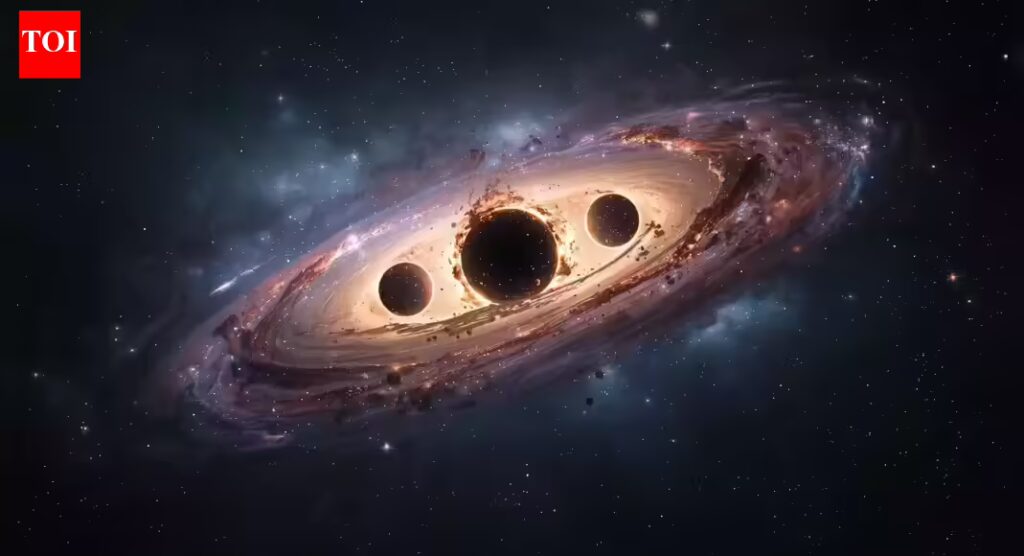
Astronomers noticed something odd while reviewing radio data from distant space. Three bright signals appeared close together. At first, it looked like a coincidence. It was not. Each signal came from the centre of a different galaxy. All three galaxies were interacting. The result stayed the same. Each galaxy contained a supermassive black hole that was active and producing radio waves. This combination has not been clearly recorded before. Triple systems exist in theory. Seeing one in the middle of a merger is rare. The finding was reported without drama, but it adds a real example to what had mostly been models. It shows three black holes feeding at once. That alone makes it worth noting.
Could three active black holes exist in one merging system
The study published in The Astrophysical Journal Letters marks that the system contains three separate galaxies. They are close enough to be considered in the process of merging. Each galaxy has a supermassive black hole at its centre.All three black holes are active. They are pulling in material and emitting radio signals. These signals made them easier to identify than quiet black holes. The observation was confirmed using radio data and follow up analysis.
Why do triple active black holes stand out
Most galaxies contain one central black hole. When galaxies merge, two black holes can end up near each other. That has been seen before. Three is different. It requires three galaxies to come together within the same region at the same time. That does not happen often.It becomes even less common when all three black holes are active during the interaction.
How were the black holes detected
The detection relied on radio emissions. Active black holes sometimes produce jets that release strong radio waves. These radio signals travel long distances and can be separated from surrounding noise. In this case, three separate radio sources were detected close together.Each source matched the centre of a galaxy involved in the merger.
What does “active” mean in this case
An active black hole is one that is feeding. Gas and dust fall inward and heat up. This process releases energy. Some of that energy appears as radio emission. Not all black holes are active. Many remain quiet for long periods. In this system, none of them are quiet.
Are systems like this expected to exist
Models have suggested that triple black hole systems could form during group mergers. Until now, evidence has been limited. This observation does not prove how common they are. It only confirms they can exist. It also shows they can be detected if the conditions are right.
What role do galaxy mergers play here
Galaxy mergers disturb gas and stars. Material moves inward. That inward movement can feed black holes. When enough material is available, black holes become active. In this system, the merger appears to have created conditions where all three black holes are feeding at the same time.
Why are radio signals important
Radio signals are less affected by dust than visible light. This matters in merging galaxies, which often contain thick dust clouds. Without radio observations, the black holes might have been hidden. Radio data allowed astronomers to separate each source clearly.
Does this change how black holes are studied
It adds a data point. It does not replace existing ideas. Most studies focus on single black holes or pairs. Triple systems introduce extra complexity. They involve more gravitational interactions and more competition for material.
What happens next to systems like this
That part is uncertain. The black holes could eventually merge. One could become dominant. Or the system could break apart. There is no clear timeline. Astronomers will likely look for similar systems now that one has been confirmed.