
- In the rainiest pocket of Pune district in Maharashtra, some villages near the mountains have historically faced a dry reality by February as water simply slides off the steep hills.
- Through communal labour, residents in the Velhe taluk (officially known as Rajgad) of Pune, are using stone structures and farm ponds to trap runoff, allowing them to look beyond rain-fed rice for a year-round income from fruits and vegetables.
- While reliance on water tankers has decreased, the region’s agricultural water security is still available only to those who can afford to take risks.
As the morning mist clears over the Sahyadri mountains, the jagged silhouette of the Rajgad Fort becomes visible to the trekkers beginning their ascent from the base village of Gunjavne. For most visitors escaping the nearby concrete Pune in Maharashtra, the landscape appears to be a lush, emerald paradise. They buy bottles of mineral water from local stores, perhaps unaware of the irony beneath their feet: scarcity amid plenty.
Velhe (officially renamed as Rajgad), the smallest taluk in Maharashtra’s Pune district, records an average annual rainfall of over 2,500 mm, the highest in the district. Yet, by February, many of its 129 villages have historically faced a dry reality, relying on water tankers for drinking and farming during the summer months. The problem is not a lack of water, but its refusal to stay in this hilly, undulating terrain. Rainwater slides off the slopes almost immediately, eroding soil, briefly filling wells and streams, then disappearing.
The art of slowing the flow
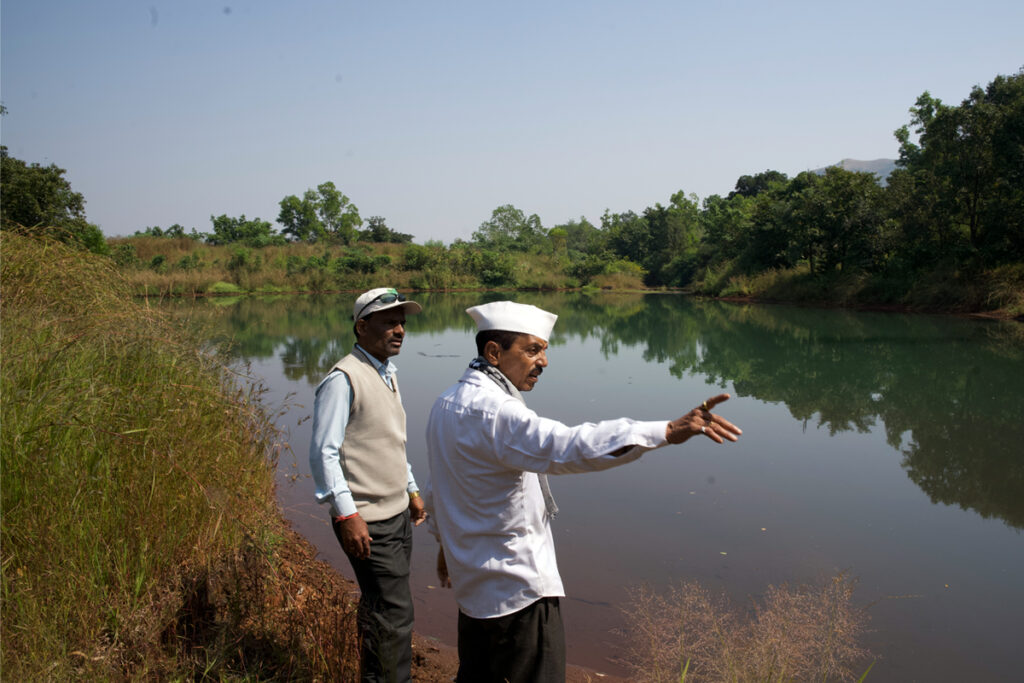
Near the base of the Rajgad trail, Laxman Rasal, Gunjavne’s sarpanch and a veteran of the gram panchayat for 32 years, walks over massive boulders that have tumbled down along the mountain stream. He points out a series of gabion structures, walls built of local stones, punctuating the stream. These are part of a deliberate “microwatershed” strategy to manage the Gunjavne river’s water.
“We should slow down running water, stop fast-flowing water, and allow stagnant water to seep into the ground,” says Raintree Foundation field officer Pravin Sanga Shetty, explaining the idea of watershed management. Because parts of Velhe’s local geology consist of dense hard basalt rock, letting water seep deep into the ground is difficult; the focus instead is on holding surface water and soil moisture.
This is a community-driven effort. The sarpanch, gram sevak (the secretary and chief executive officer of the gram panchayat), and the voluntary Village Development Committee (VDC) play a crucial role in mobilising the community to participate in watershed activities. While some labour is paid, much of the work relies on shram daan (voluntary labour). With this collective action and financial support from the non-profit organisations, the village residents also revived an old percolation tank that was once choked with silt. In Gunjavne, a village of about 1,100 people, well water levels have risen, and the benefits extend downstream as well, says Rasal. According to Raintree Foundation, the water level in the wells around the tank is one foot higher during the wet season and about seven feet higher during the dry season. The desiltation activity was carried out in 2023, and the water levels were compared between 2022 and 2024.
Maintenance has brought another advantage: the nutrient-rich silt removed during desiltation. Instead of dumping it, the silt is distributed among farmers, returning washed-away topsoil to farms.
Planning for every drop
The breeze in October and November occasionally carries a hint of Indrayani rice, Maharashtra’s signature aromatic grain, which originated in the Pune district. While rice is the primary crop in Velhe, it is a rain-fed gamble. With the least irrigated area in the district, it was also difficult to grow a second or third crop to increase income.


“Rice alone is not profitable,” says Mohammad Shaikh from Sakhar village, close to Gunjavne, standing beside neatly arranged brown bundles of harvested rice. His capital would be “stuck” during the traditional May-to-November rice cycle. Now, powered by water-saving irrigation techniques, he has moved beyond just rice. On his three acres, he uses a sprinkler system to grow chickpeas and leafy greens like methi (fenugreek) and coriander in short 45-day cycles.
But where does Shaikh get the water from?
About 400,000-500,000 (4-5 lakh) litres of rainwater are stored in an artificial pond, slightly larger than a badminton court, dug on his land. Raintree Foundation provided the technical support and about ₹75,000 for the installation, a plastic lining, and the maintenance of these farm ponds.
The non-profit has spent about 4.5 million rupees (₹45 lakhs) in watershed activities across nine villages in Velhe, says Swanand Damle, Vice President (Operations). Through the VDCs they mapped local water challenges and identified farmers who needed support. They dug ponds in 73 farms and implemented other interventions such as river desilting, percolation tank desilting, farm pond construction, water budgeting awareness. Depending on the pond’s size, the farmers spend around ₹ 30,000 on digging the ground and labour. The foundation also trains farmers to select crops suited to local conditions and to budget water for both domestic and agricultural use, explains Damle.
Mangoes and buffaloes
For farmers who can afford the investment, farm ponds allow them to pursue long-held dreams.
In Sakhar, farmer Sandeep Renuse stands on an acre of farmland overlooking the hills. For years, his father dreamed of growing hapus (Alphonso) and kesar mangoes. These trees require a high quantity of water during their first few years, a demand that was once impossible to meet in the dry season. After coordinating a team of labourers to dig a five-lakh-litre farm pond, Sandeep now successfully supports 70 mango trees with drip irrigation.
Horticulture – growing mangoes, jamun, jackfruit, leafy vegetables – has been a natural means of supplementing income in Velhe, but the inability to access water, limits its growth.
If you buy milk in Pune, it may have passed through a checkpoint near Lavhi, a village where livestock owners sell their yield every morning. For Anant Renuse, who owns 17 buffaloes, water is a matter of hygiene and health. When water is scarce, and tankers are the only option, a buffalo might get a bath only once every eight days, which affects its well-being. With the self-sufficiency provided by his wells and a farm pond, he can now bathe his buffaloes every two to three days during the dry season.
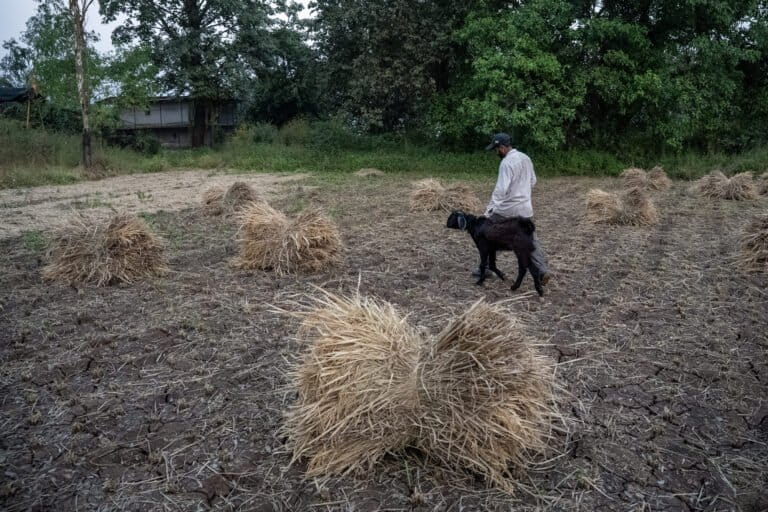
However, this level of security is not yet universal. Nazim Shaikh, a young farmer wrestling with his goats, looks at his field, which begins to lose moisture as early as December. For him, the initial investment and land required for a farm pond make the solution feel distant.
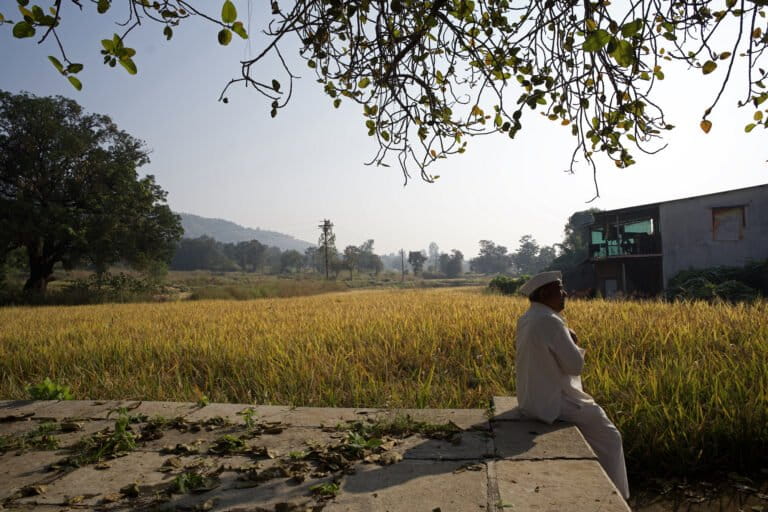
In Lavhi’s main meeting square, adjacent to an Indrayani rice field and a temple, a group of residents says that during peak summer, spending ₹1,000 for a 5,000-litre private water tanker is the norm, particularly for households with higher needs.
The paradox in Velhe’s water story
In nearby Merawane and Phanshi villages, BAIF Development Research Foundation, which works on resilient rural livelihoods, has installed a solar-powered irrigation system that brings water from the river to farms almost 1.5 kilometres away. The usage is regulated by a local operator to ensure equitable distribution, explains Akash Salunke, an agriculture field officer with BAIF. The legacy non-profit is also piloting rainwater-harvesting devices at schools to recharge borewells in areas that fall within rechargeable zones.
While monitoring well water levels each season might reveal changes, Damle of the Raintree Foundation states that it would take a 15-year horizon to measure impacts on watershed ecology. The organisation, which started work in 2018, is planning a midline survey to track changes in the watershed. The ultimate goal, he says, is for the community to fully take over the discussions, monitoring, and desiltation of watershed structures.
Meanwhile, climate change also adds a layer of uncertainty. In 2025, unusually heavy September rains damaged the rice crop, while extreme summer heat rotted mangoes, highlighting the vulnerability of even diversified farmers. Field officers also point to the spread of eucalyptus, locally termed Nilgiri, on surrounding hillsides. These fast-growing, non-native trees consume large amounts of water, further stressing local systems.
Planning watershed conservation according to local geography and situation is critical, notes Himanshu Kulkarni, founder of the Advanced Centre for Water Resources Development and Management (ACWADAM). “But shifting to water-intensive crops like sugarcane would undo much of this effort,” he warns.
There is a systemic irony to Velhe’s story. Pune district has one of the highest dam densities in the country, explains Kulkarni, and Velhe lies within a typical dam catchment of the Western Ghats. Water from such catchments is diverted to irrigation command areas, cities, and industrial zones, while the villages themselves often remain underserved. Kulkarni argues that such regions deserve compensation for the ecosystem services they provide.
By 2025, the government’s Jal Jeevan scheme had brought taps to nearly 97% of families in villages such as Gunjavne and Lavhi. The Rural Water Supply Sub-Division in Velhe notes that tanker demand has dropped sharply. But the water in the taps installed, still depends on the health of the local watershed.
Read more: As springs dry up, pastoralists see potential in rainwater harvesting
Banner image: Gunjavane’s sarpanch, Laxman Rasal (R), and Raintree Foundation field officer Pravin Sanga Shetty at a desilted and revived percolation tank that stores rainwater flowing down from surrounding hills and gradually recharges nearby wells. Image by Saumitra Shinde/Mongabay.

