
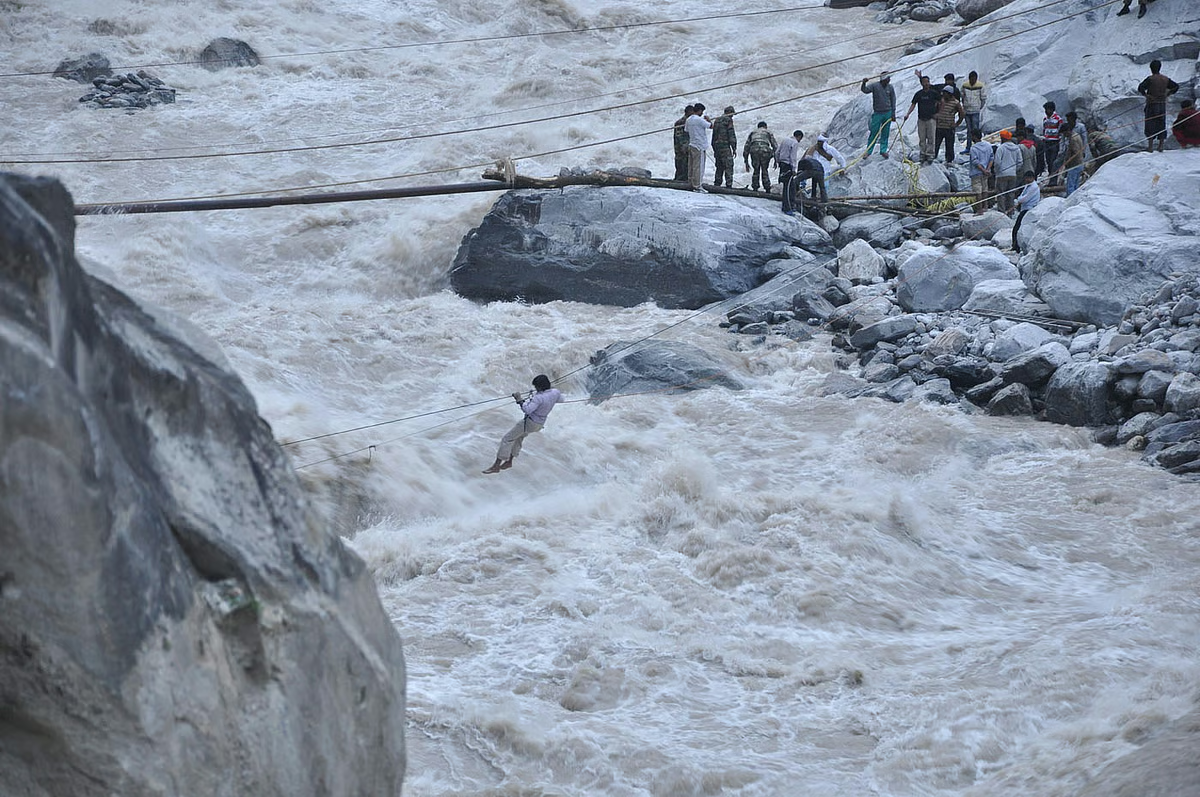
Climate change is intensifying GLOF risks. Rising rates and intensity of warming in the Himalaya-Karakoram region, especially at higher elevations because of a phenomenon called elevation-dependent warming, are driving a steady increase in the number, area, and volume of glacial lakes.
Since 1990, the number of glacial lakes in the region has risen by 53 per cent, their total area by 51 per cent, and their volume by 48 per cent. Glaciers that end in lakes are also retreating faster than those that terminate on land, creating a feedback loop that further accelerates lake expansion and glacier loss.
Despite these trends, the authors say research has not kept pace with the growing threat, pointing to limited assessments of social vulnerability among downstream communities. Generally “the analysis revealed significant gaps in GLOF research, including limited social vulnerability assessments for populations near glacial lakes, insufficient studies on the impacts of climate change on GLOF frequency, and inadequate focus on mitigation measures like early warning systems (EWSs) in the region”, the scientists wrote in the paper.
The study also points to major inconsistencies across existing GLOF datasets, making comparisons difficult, along with a lack of ground-based observations, particularly in the Himalaya-Karakoram region. “Discrepancies in glacial lake definitions and varying size thresholds have resulted in significant inconsistencies among independently created datasets for the H-K region and the broader Third Pole region,” the paper stated.
While glacial lake datasets now cover most regions of the world, the study noted that the Himalayas remain particularly difficult to assess because of their challenging terrain and harsh climate, which limit field-based glacier and glacial lake research. “Consequently, most studies in this region rely heavily on remotely-sensed data, which often suffer from limitations such as coarse spatial and temporal resolution, introducing ambiguities in understanding ground-level processes”, according to the paper.
Other issues are a lack of standardised mapping thresholds, varying definitions of what constitutes a glacial lake — including whether supraglacial and ice-contact lakes are included — and differing classification methods introduce significant uncertainty when inventories are compared across regions or over time.
“Furthermore, most inventories are static snapshots in time and do not adequately capture seasonal variability, rapid lake evolution, or short-lived lakes that may still pose substantial GLOF hazards,” the authors wrote in the study. “These findings underscore the need for more integrated and region-specific research to address the growing risks of GLOFs effectively,” they added.