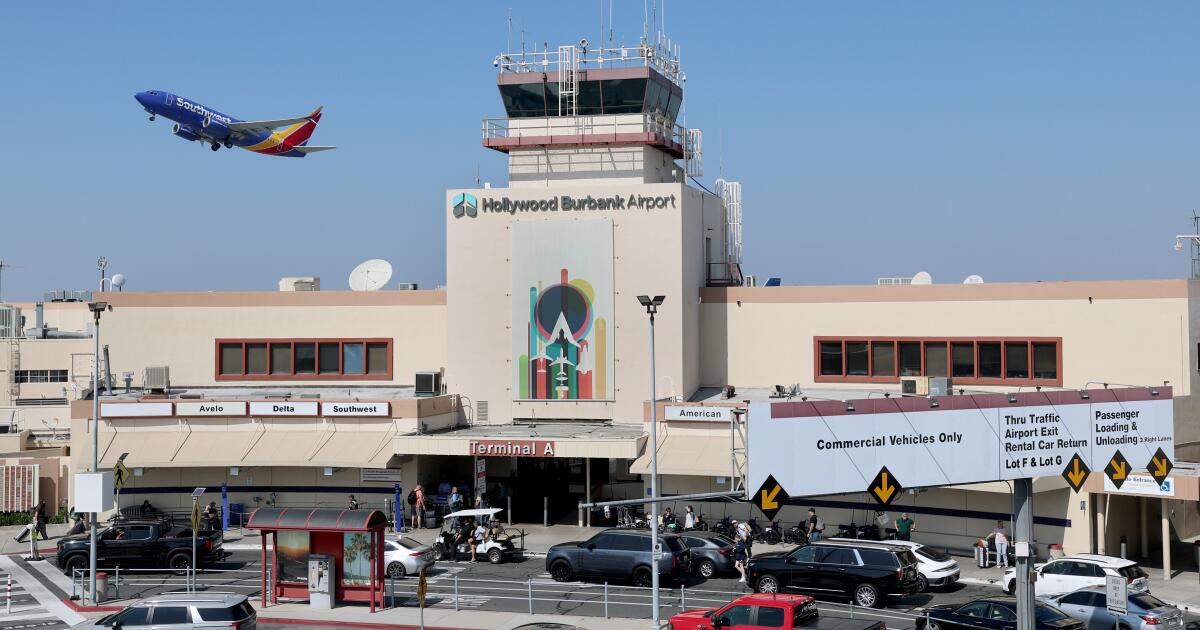
The chair of the National Transportation Safety Board called out Hollywood Burbank Airport as having a concerning risk of a midair collision and urged federal regulators to take action.
NTSB Chair Jennifer Homendy, speaking at a board meeting in Washington, said commercial airlines had warned of the risk of aircraft colliding at Burbank Airport. The airport is a busy Class C, or medium-sized, airport with short runways and a tight airspace. It is among “hotspots” with a high volume of mixed helicopter and airplane traffic, according to the FAA.
“Burbank is one where commercial airlines have called me to say the next midair is going to be at Burbank, and nobody at [the Federal Aviation Administration] is paying attention to us,” Homendy said.
She added that “whether it is involving helicopters or not, people are raising red flags, and why aren’t people listening? The FAA has to ensure safety. That is their job.”
A representative at Hollywood Burbank Airport referred all questions and comments to the FAA.
(Allen J. Schaben / Los Angeles Times)
Homendy spoke just before the first anniversary of a catastrophic crash that claimed 67 lives outside Washington, D.C. The agency revealed findings into the crash of an American Airlines regional jet and an Army Black Hawk helicopter. As Homendy laid out what she called a series of institutional failures by the FAA before the January 2025 crash, she pointed to concerns about the mixing of commercial airplane and helicopter traffic, noting that there are extensive data pointing to the danger of such a midair collision.
A representative at Hollywood Burbank Airport referred all questions and comments to the FAA.
An FAA spokesperson responded that the agency, which is responsible for the safety of the nation’s airspace, “acted immediately to improve safety” following last year’s collision outside Ronald Reagan Washington National Airport.
“In February 2025, we began using innovative AI tools to identify similar hotspots with high volumes of mixed helicopter and airplane traffic and implement appropriate mitigations,” the statement read.
The agency added that Van Nuys and Hollywood Burbank airports were among its focus areas.
“Based [on] our safety analysis, the FAA lowered the Van Nuys traffic pattern by 200 feet during an evaluation in 2025 to see if that would reduce conflicts with aircraft landing at Burbank,” the statement read. “Preliminary data indicated the change resulted in a reduction of Traffic Collision Avoidance System (TCAS) alerts for Burbank arrivals and we permanently lowered the Van Nuys traffic pattern effective Jan. 5.”
Homendy’s comments caught some officials by surprise.
While it’s not unprecedented for safety concerns to be raised at an airport, the fact that it’s happening without a recent crash or failure is definitely unusual, said Randy Klatt, a former Navy and commercial pilot who now is a flight safety officer with the Foundation for Aviation Safety.
“It’s also unusual that the [NTSB] chairperson would say that she’s heard directly from airlines,” Klatt said. “Hopefully the FAA will actually take action to help mitigate some of these hazards.”
While he was pleased that the FAA has taken some steps to reduce and modify air traffic at Hollywood Burbank, he said there needs to be more focus on improving safety at that airport and at others around the country. The airport itself has little control over these issues, but can make some changes, like limiting hours of operation, Klatt said.
“We have to put more restrictions on where and when flights can take place,” Klatt said, noting that the Hollywood Burbank airport is part of a particularly busy airspace.
Unfortunately, he said, there’s little the public can do about these concerns, but he recommended flying in the early morning hours or late at night when there are typically fewer planes in the air.
“It’s a good thing that someone is finally saying that this is a risk,” Klatt said. “Hopefully we have turned the page a little bit.”
For Dan Feger, executive director at Hollywood Burbank from 2008 to 2016, Homendy’s pleas to the FAA have a familiar tone.
“I hope that they wake up before the catastrophe that NTSB is warning about actually occurs,” he told The Times.
There have been general industry-wide aviation concerns that may have factored into the elevated safety risks.
Feger said a growing shortage of experienced staffing at the Southern California TRACON — the nation’s busiest radar approach control facility covering roughly 2 million flights annually between Burbank and the border — posed a growing safety threat, particularly for Burbank, Van Nuys and Los Angeles International.
“With all three of them converging to the same waypoints to go north or to go east, there’s not enough air traffic controllers to do that safely,” Feger said. “But they won’t say that.”
As for Hollywood Burbank itself, Feger highlighted two specific issues, leading with taxiways. The opening of the airport’s new terminal, slated for October, did not include an extension of nearby Taxiway B. Instead Taxiway A will be extended, but only after the current operating terminal is demolished.
Limited taxiway space means there will be scenarios where planes are taking off and landing and taxiing all on the same runway, Feger said.
“The Taxiway A extension will be completed some two years after the replacement terminal is opened,” Feger said. “During that two-year time interval, the operations at BUR will be even more unsafe than they currently are.”
Feger also said he petitioned for years to shorten one of the runways, No. 33, to allow for the construction of an Engineered Materials Arresting System, a sort of crush zone to stop airplanes that overshoot their landings.
There is currently a blast fence that may not be enough to stop a plane, which could theoretically smash into the nearby railroad tracks, he said.
“You could potentially have an airplane crashing into a Metrolink train,” he said. “The whole thing is bizarre.”
There have been close calls at Hollywood Burbank before.
In February 2023, a Mesa Airlines plane attempted to land on the same runway from which a SkyWest Airlines flight was taking off, and the planes came within 1,680 feet of each other.
Pilots on the Mesa Airlines flight decided that the separation between their craft and the one taking off was insufficient and initiated a go-around, in which a landing is aborted.
“The local controller did not issue a traffic advisory or safety alert, as required, to either of the flight crews immediately after [the Mesa Airlines plane] reported going around, or during the following minutes when both airplanes were in an unsafe proximity to each other,” according to an NTSB investigation report.
The investigation revealed the controller, distracted by a third plane circling the airport, delayed clearing the SkyWest flight for takeoff and failed to monitor the runway and airspace adequately.
The controller then directed the Mesa plane onto a path that risked a collision, triggering cockpit alarms in both planes. The Traffic Collision Avoidance System issued warnings and guided the planes apart.
In addition, the NTSB report stated that a lack of ground and approach tracking equipment at the airport contributed to the incident.
City News Service contributed to this report.