To sustain this fleet, charging infrastructure is scaling up gradually including home charging, public stations, and captive charging facilities. The strategic placement of these stations mandates highway coverage every 50km and fast-charging capabilities for large vehicles every 120km, alongside installations near key public facilities like malls and restaurants. Electricity supplied to public and captive stations from the national grid is billed at the general tariff category, while the final cost to consumers charging their vehicles remains market-based.
To ensure these targets are met, the government is prioritising heavy infrastructure projects. This includes the construction of EV and component manufacturing centres, an inspection centre for battery performance, and a dedicated EV Technology Park. Execution and progress are overseen by a structured hierarchy. A Steering Committee and a Technical Committee guide the initiative, while dedicated monitoring and evaluation clusters manage specific domains such as Infrastructure, finance and customs, and research and innovation.
Redrawing the cityscape and reinventing transport infrastructure
Ethiopia has a tri-pillar net-zero strategy that relies not only on transitioning to EVs but also expanding electric public transport including e-buses and high-capacity transit networks. This has begun with the deployment of 120 e-buses and over 400 Midi and Mini-electric buses locally assembled. Ethiopia is rapidly expanding its e-bus network across Addis Ababa and various regional cities. It is rolling out robust infrastructure for walking and cycling through a massive corridor development project expanding across 75 cities.
Corridor Development Project
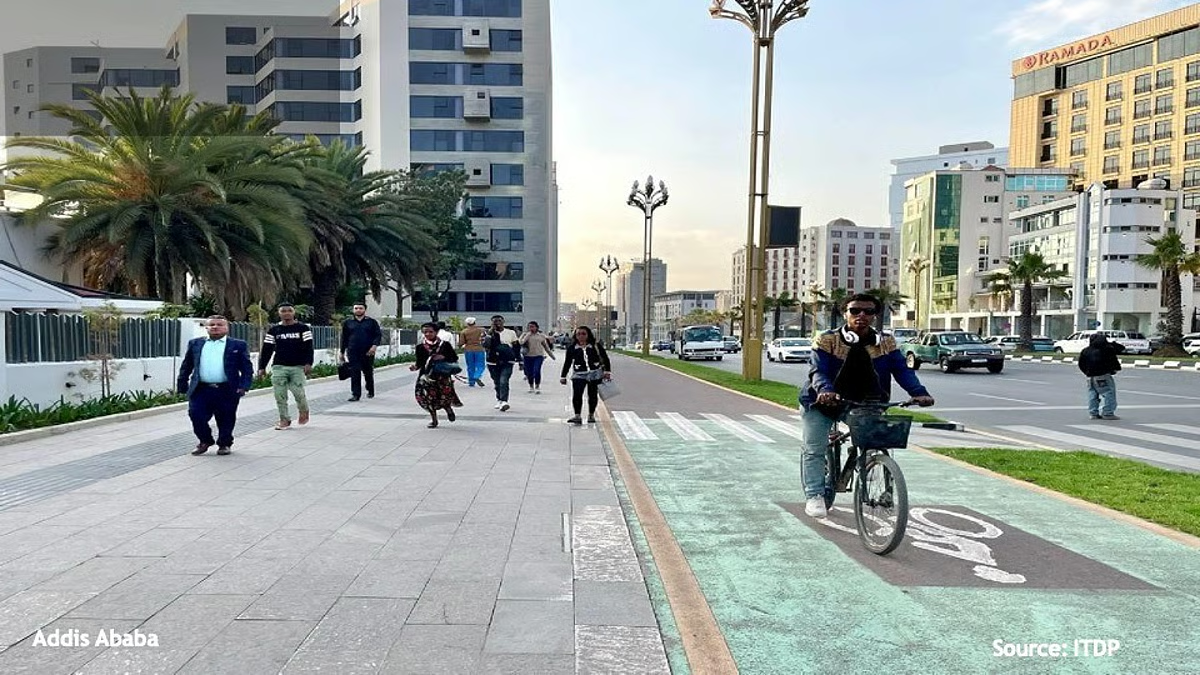
There is visible transformation of Addis Ababa city with extensive redeveloped road networks that are designed for all road users — pedestrians, cyclists and public transport users. Launched in late 2022, Ethiopia’s Corridor Development Project is an ambitious urban overhaul that began in 58 cities before targeting a phase two expansion across 75 cities nationwide.
Ethiopia purposefully integrates expansion of road networks with dedicated infrastructure for creating safe, accessible pathways for pedestrians and cyclists, public transport users while redesigning and rejuvenating public spaces and green areas.
Crucially, the project blends public transit upgrades with sweeping municipal and structural improvements. Modernised drainage systems are installed to prevent flooding, alongside upgraded street lighting, integrated telecommunication poles, integrated parking, and pedestrian walkways. Planners are actively reclaiming public space by creating over 70 green centres, rehabilitating neglected riversides, and building public squares for community events. Existing building exteriors along these corridors are simultaneously renovated.
Instead of vague policy goals, Ethiopia could adopt concrete frameworks, such as the Ethiopia NMT Strategy 2020-2029 and the Ethiopia Urban Street Design Manual. This gave local agencies the blueprints needed to build people centric road design — wide footpaths, protected bike lanes, and redesigned intersections. It involved tactical urbanism. Car-free days were organised to enable city-wide street experiments for inclusive design. This addressed the mismatch between how people actually moved and who the roads were built for. Majority in Addis Ababa walked, cycled and used public transport. The government also considered pedestrian fatalities and economic cost of congestion.
While there was technical capacity and funding support from the World Bank, UN-Habitat, UN Environment, and the Institute for Transportation and Development Policy, the critical point is that the government was willing to execute this kind of urban transformation.
However, there were concerns and media reports about the displacement of poor neighbourhoods that resulted in gentrification of the urban space.
Scaling high-capacity transit
Simultaneously, Ethiopian cities are relying heavily on expanding mass transit systems. The Addis Ababa Light Rail Transit (AALRT) system spans 34.25 km and operates with a design capacity to handle 60,000 to 80,000 passengers per hour during peak times. Concurrently, the Bus Rapid Transit (BRT) project is deploying massive infrastructure lines (such as B3 and B4 covering 36.5 km) to provide inclusive mobility to 400,000 residents with committed funding. In response to the current oil shock, Ethiopian cities are intensifying e-bus services to increase ridership.
Navigating the roadblocks
Despite rapid progress, there are several barriers that are slowing down the e-mobility transition. Key challenges include critical infrastructure limitations, particularly regarding the lack of after-sales service centres and battery end-of-life management. Financial constraints are a major hurdle; banks require collateral they are unwilling to waive, insurance companies remain suspicious of the technology, and there is limited support from international donors for local start-ups. Furthermore, there is limited land allocated for establishing charging stations and training centres, alongside significant capacity and skill gaps in EV maintenance and daily operations. Research and development focusing on technology adoption also remains severely limited
Crucially, by inter-connecting EV transition with massive investments in electric mass transit and inclusive, walking and cycling corridors, the country has prioritised equitable, pro-people mobility over car-centric planning—demonstrating exactly how developing economies can achieve energy sovereignty and sustainable urban renewal simultaneously.