
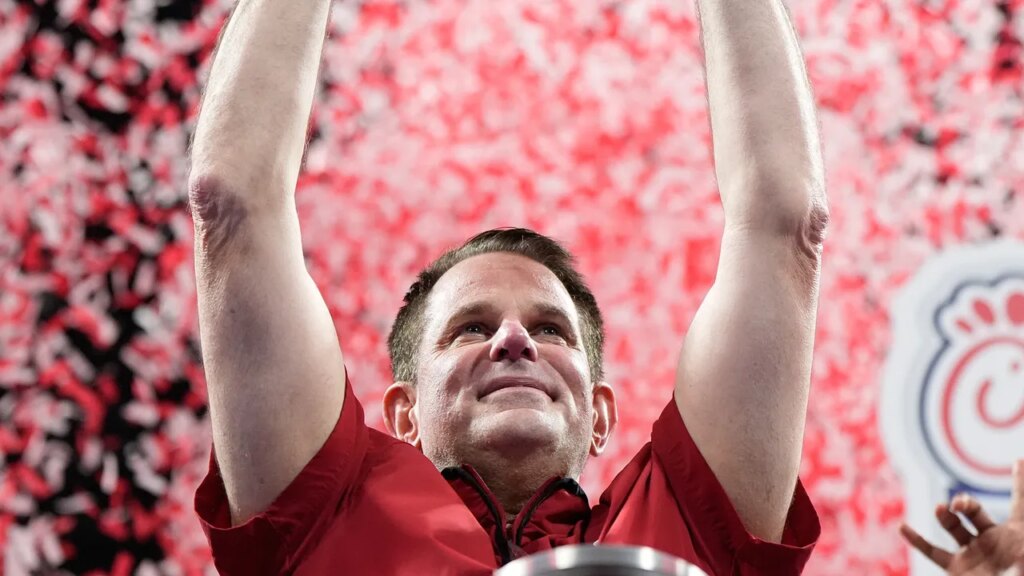
There was little reason to think that Indiana would turn into the new Alabama—or that Indiana would humiliate the old Alabama in the Rose Bowl, 38–3. Cignetti had been an assistant to Nick Saban at Alabama, but that was nearly two decades ago. He’d left Tuscaloosa for a low-paying job as head coach at Indiana University of Pennsylvania, a Division II school, and then moved on to Elon University; from Elon, he went to J.M.U. When he came to Indiana, he brought many of his assistants and the core of the team from J.M.U. with him.
He’s toned down the boasts since then. Cignetti has said that he leaned into a more arrogant persona in part to give Indiana fans—which is to say, basketball fans—a reason to talk about the football team. Now he can let his team’s results speak for him. This is the first college-football season to feature a twelve-team playoff. On its way to the title game, Indiana has beaten Ohio State, Alabama, Penn State, and Oregon (twice). It has won the Big Ten, the Rose Bowl, and the Peach Bowl, and is heavily favored to win the championship. It could become the first team to go 16–0 since 1894.
How? Everyone is trying to figure out the blueprint. Maybe it has to do with Cignetti’s attention to detail, his emphasis on execution and not making mistakes; he obsesses over things like hand placement and how many inches a player should step. Or maybe it’s the culture of the team: Indiana’s coaches tuck in their shirts, and players are expected to have solid handshakes. Or the recruiting: Cignetti used the transfer portal to build a team largely out of overlooked players by focussing on past productivity instead of raw athletic traits—except for those traits that he believes really matter, such as joint mobility. Or maybe it’s his coaching staff: Cignetti has hired coördinators and coaches who are especially good at developing players. Or it could be continuity and experience: Indiana’s starters have, on average, played more than four years of college football, and much of the coaching staff has been with Cignetti for a long time. Or is it accountability? Cignetti is known to have high expectations. Others point to faith: the quarterback, Mendoza, seems to begin every sentence by praising God. Or maybe it’s the doubt from outsiders: the players call themselves a “bunch of misfits” who are proving everyone wrong. Or possibly it’s simply common sense: practices are brief and hyperefficient, because Cignetti has the radical idea that healthy, rested players are better than exhausted, injured ones. (He could be on to something!) Maybe Indiana made a deal with the devil. (Bobby Knight?)
I like to think that it has something to do with Cignetti’s infamous expression on the sideline. It’s the same half scowl whether his team has just scored or been stuffed at the line of scrimmage. Every once in a while, he’ll pop his left eyebrow.
It serves a purpose, that face. Cignetti is not unfeeling; he is capable of enjoying a moment. After Indiana beat Oregon, an on-field interviewer took it for granted that Cignetti was already concentrated on beating Miami, until Cignetti told her, “I’m really not thinking about the next game, I’m thinking about cracking open a beer.” His game face, though, serves as a reminder to focus and move on. Cignetti has said that he asks his players to approach every play, from the first one in the first game to the hundred-and-fiftieth of the season, the same way. “I can’t be seen on the sideline high-fiving people and celebrating, or what’s going to happen, right? What’s the effect going to be?”
It’s possible, of course, that high-fiving people would have a galvanizing effect: players sometimes respond to joy, or to anger, better than they do to stoicism. Just look at Mendoza, Indiana’s quarterback, who is so ebullient that his smile seems to strain with happiness. But part of Cignetti’s power seems to stem from predictability and routine—the same expressions, the same gameday conversations, the same Chipotle order every day (rice, beans, and chicken, no toppings, side of guacamole).
“Repetition is the mother of learning,” he likes to say. Repetition makes skills automatic. It helps players improve. And the awareness that you have been there, that you have done it before—even if, really, you haven’t—is the best, perhaps the only, way to deal with the uncertainty inherent in football. “I don’t have any idea what they’re going to do,” Cignetti said before playing Oregon in the semifinal, at that press conference with Lanning. “They don’t know what we’re going to do. As I sit here right now, I know everything we’ve practiced, but I have no idea what that tape is going to look like the day after. And that’s every game,” he went on. “That’s football. There are a lot of variables.”