
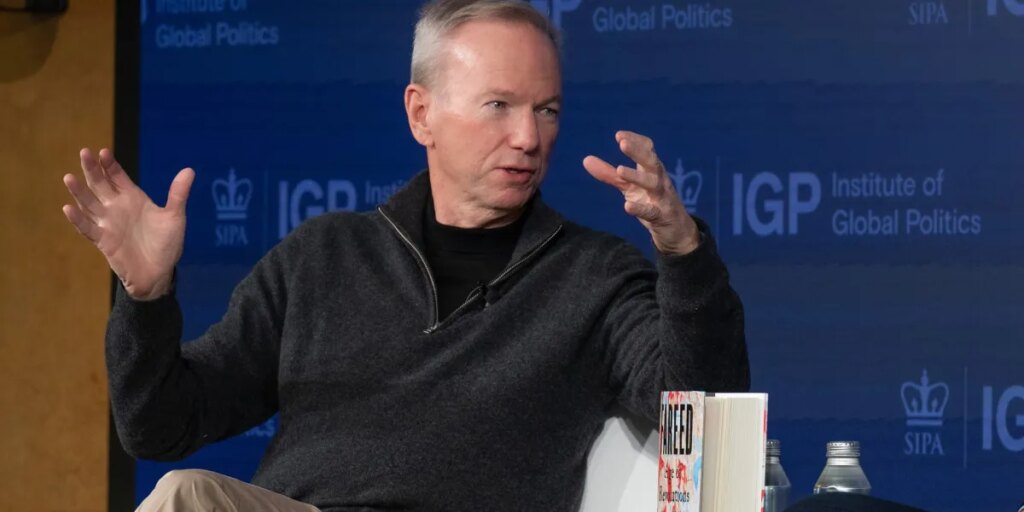
Eric Schmidt, who led Google for well over a decade as CEO and then executive chairman, could easily have retired in 2020 at age 65. But he’s stayed active as an author, CEO, and startup founder, most recently launching Bolt Data & Energy to develop power and data center campuses in West Texas.
“Meaningful work keeps you engaged and energized,” Schmidt, now 70, told Fortune in an emailed interview. “Henry Kissinger was my best friend and mentor, and he worked every day well past the age of 100.
“He believed that periods of major change demand responsibility and action, not detachment,” Schmidt said of Kissinger. “That perspective shapes how I approach AI today, making sure we stay actively involved in guiding its impact for public good.”
It’s no coincidence that Schmidt and Kissinger, the famed former U.S. secretary of state and longtime corporate adviser who died in 2023, coauthored the 2021 book The Age of AI: And Our Human Future, publishing it a full year before the launch of ChatGPT.
Schmidt and Kissinger met early on during Schmidt’s Google CEO tenure. Schmidt invited Kissinger to the headquarters, where Kissinger promptly told Google employees the company was “a threat to the world’s civilization.” They became fast friends from there, and Schmidt helped Kissinger adopt new technology, including his first iPad and his first selfie.
Schmidt is the cofounder of the non-profit that organizes the AI+ Expo for National Competitiveness. And, in March, he became CEO of aerospace manufacturer Relativity Space after buying a controlling interest in the company. Months later, he cofounded Bolt and became chairman.
“I continue working because this is a pivotal moment for AI, and I believe we have a responsibility to shape it in ways that positively impact the world. The single biggest bottleneck facing AI is not algorithms, but energy,” Schmidt said. “If we want to scale the technology responsibly and keep America competitive, we need the infrastructure to power it. That is why I co-founded Bolt. By controlling land, developing power generation, and operating data centers, we can co-locate massive power with massive compute to create a more efficient, reliable, and cost-effective ecosystem.”
Bolt will start with building natural gas-fired power in West Texas in the epicenter of the oil and gas world, but also will add in renewables with a goal to eventually develop nuclear power there.
“Our approach will also bring renewables into the equation, with a strong focus on battery storage and energy technologies that improve resilience and reduce environmental impact,” Schmidt added. “This gives us a real advantage as AI models grow larger and demand for high-density GPU clusters increases. For me, this is not just about solving a technical problem; it is about ensuring AI develops in ways that benefit humanity and reflect democratic values.”