
- More intense and frequent cyclones could alter entire ecosystems.
- Tropical cyclones can cause forest canopy changes, reshape sand dunes and erode coasts.
- Conservation and restoration strategies can help mitigate some of the ecosystem damage, say scientists.
Scientists are concerned that fiercer and more frequent tropical cyclones, intensified by global warming, will have widespread changes in the entire coastal ecosystems.
Global climate change models predict more frequent and intense hurricanes and cyclonic storms and increased coastal flood risk due to higher storm surge caused by rising seas. India’s coasts too are witnessing more frequent devastating cyclones, the most recent ones being Ditwah in November 2025 and Montha in October 2025 in the Bay of Bengal.
An assessment of the climate change and cyclone trends of nine Indian coastal states using geographical information system (GIS) tools for 2006-2020 shows that 61 cyclones occurred in nine coastal states during this period; with the three most vulnerable states being Odisha (20), West Bengal (14) and Andhra Pradesh (11). Scientists are cautioning these natural disasters will not just cause species-level changes in habitats but result in longer-term ecosystem level impacts.
Globally too, recent research has flagged concerns over the link between tropical cyclones and ecosystem damage. A January 2025 report in Nature Climate Change describes how the rapid changes in frequency and intensity of tropical cyclones triggered by climate change could alter the composition of ecosystems, due to leaf damage and changes in canopy; and degrade ecosystem services.
Earlier, a report in Annual Reviews in 2024 says climate change poses a significant threat to foundation species and the ecosystems they support. And recent research from Australia shows that tropical cyclones can significantly impact mangrove forests, permanently in some cases.
Remote sensing studies have been carried out to assess the loss to the coastal ecosystem in India, says R. Ramasubramanian, Senior Fellow, Coastal and Marine Systems, M.S. Swaminathan Research Foundation, Chennai. The Gaja cyclone in 2018 in Muthupet caused extensive damage, with loss of about three square km of mangroves, he told Mongabay-India. An assessment of the 2008 cyclone Nargis that struck the Irrawaddy Delta, an area historically rich in mangroves, estimated that about 38,000 hectares of mangroves were lost. That said, an assessment after five years showed that about 61% of the mangroves recovered, indicating substantial resilience when conditions allowed natural regeneration. The recovery of mangroves from the cyclones are being monitored globally, and several modelling studies are looking at efficiency of mangroves against cyclones and storm surges, adds Ramasubramanian.
In general, the cyclones affect vegetation health and significantly damage vegetation, explains Kandasami Kathiresan, honorary professor at the Tamil Nadu Biodiversity Conservation and Greening Project for Climate Change Response, Chennai. He cites the example of the 2023 cyclone Michaung along coastal Andhra Pradesh and Tamil Nadu, which reduced the ‘vegetation health’ — the physiological condition, vitality, growth rates, biodiversity and condition of plant communities within an ecosystem — from 5.71% to 1.3% and 40.24% of areas suffered severe vegetation damage. There was significant coastal erosion and a surge in rainfall during the cyclone. A healthy vegetation is crucial to maintaining ecosystem services and supporting biodiversity, he adds.
Similarly, the 2018 Gaja cyclone in Tamil Nadu decreased agriculture land from 34% to 30%, barren land from 8% to 6%, land with scrub from 21% to 17%, and land with salt pans from 10% to 8%. It also dramatically increased the water bodied area from 8% to 21%, says Kathiresan.
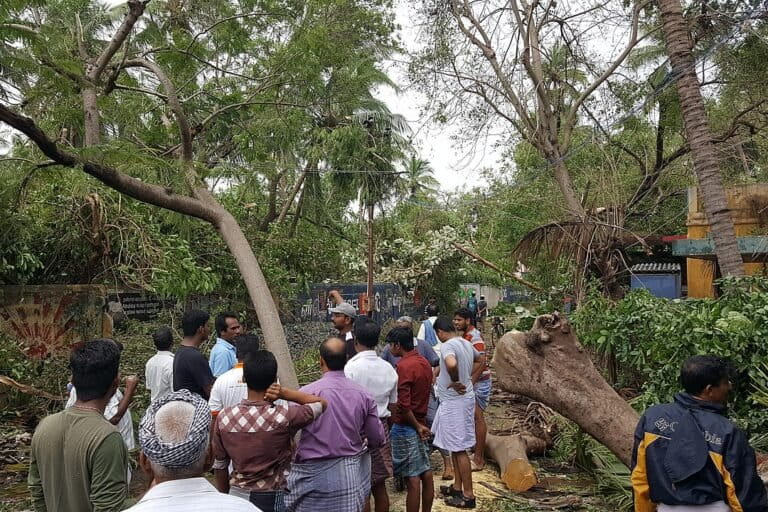
Tropical cyclones remove forest canopy as well as change the landscape near coastal areas, by moving and reshaping sand dunes and causing extensive erosion along the coast, he adds.

Global pointers to ecosystem damage by cyclones
What is increasingly evident is that ecosystem change is emerging not only from single extreme events, but also shifts in disturbance regimes, says Chahan Kropf, scientist at the department of environment system science at ETH University. Zurich. A modelling analysis by Kropf and colleagues in Nature shows that under a high-emission scenario, a combined 9.4% of the surface of all terrestrial ecosystems is susceptible to transformation due to cyclone pattern changes between 1980–2017 and 2015–2050.
Another report by Kropf’s team in Nature raises the concern that climate-driven changes in tropical cyclones could lead to substantially altered mangrove ecosystems. “From a global perspective, our work shows that many ecosystems historically exposed to tropical cyclones are now experiencing shorter intervals between storms, sometimes approaching or even undercutting their estimated historical recovery times,” says Kropf. Even ecosystems classified as resilient, meaning that they have co-evolved with frequent storms, may no longer fully recover before the next disturbance arrives, he says. “In our global analysis, the average recovery window for resilient ecosystems exposed to high-intensity cyclones shrinks from about 19 years to roughly 12 years by mid-century under a high-emissions pathway.”
Kropf also cited examples of other groups of scientists documenting similar changes. These include persistent canopy loss and altered forest structure after repeated cyclones, particularly where storms recur before regeneration is complete.
Similarly coastal ecosystem degradation, including mangroves, where storm damage interacts with sea-level rise, salinity changes, and sediment disruption, has been reported in other studies. While still other groups have reported shifts in species composition, favouring disturbance-tolerant species and reducing structural complexity.
Mangroves are a particularly well-documented examples, says Kropf. “In regions such as Southeast Asia, Central America, and Southeast Africa, observations and models increasingly align in showing that repeated cyclone exposure, combined with sea-level rise, can reduce mangrove area, alter canopy height and biomass, and in extreme cases push systems toward mudflat or degraded states from which recovery is uncertain.” The key point is that these changes are not always immediately visible after a storm, says Kropf. They often manifest years later, through slowed recovery, increased vulnerability to subsequent events, and gradual loss of ecosystem functions.


Warming, cyclones and ecosystem damage
According to the IUCN’s global assessment 2024, one-third of mangrove ecosystems will be severely affected by sea-level rise, and about 25 % of global mangrove areas could be submerged within 50 years if current trends continue, says Ramasubramanian. Loss of mangroves would reduce carbon storage dramatically, with an estimated 1.8 billion tonnes of carbon could be lost by 2050, he says. “Scientists are increasingly focused on the interaction between warming, changing cyclone patterns, and ecosystem vulnerability, rather than treating each factor in isolation,” says Ramasubramanian.
Warming oceans and a moister atmosphere provide more energy for intense cyclones, while sea-level rise amplifies storm surge impacts, says Kropf. “But the most critical ecological mechanism is that disturbance regimes themselves are changing. Storms are becoming more intense, more frequent in some regions less in others, and are occurring in places where ecosystems have little historical exposure.”
Kropf’s team’s global analysis shows that by mid-century, about 10% of all terrestrial ecosystems worldwide “could face transformative pressure from cyclone pattern changes alone, with many regions seeing frequency increases of high-intensity storms exceeding 100%. This means ecosystems are increasingly pushed outside the range of conditions they evolved under.” For mangroves, the combined effect is “especially stark,” he says. By 2100, 40%-56% of global mangrove area is projected to be at high to severe risk, depending on emissions pathways, and the most valuable mangroves, in terms of coastal protection, carbon sequestration, fisheries, and biodiversity, are disproportionately affected.
Ecologically, the triad of global warming, more intense tropical cyclones and ecosystem damage can lead to several changes, says Kropf. “The concern is not just more damage, but qualitatively different ecosystems emerging under sustained pressure,” he says.

Options to contain the damage
Scientists say it is possible to limit the damage.
Conservation of mangroves, restoration of degraded mangroves, protection from encroachments and land use changes, and enforcement of forest policies can help enhance mangrove cover, says Ramasubramanian.
Wetlands can help regulate floods, says Kathiresan. Coastal vegetation and natural features such as sand dunes and mangroves can provide protection from storm surges, strong winds and cyclones, he says.
Similarly, healthy coral reefs and seagrasses can reduce wave energy during coastal storms. Hence, coastal ecosystem restoration is a nature-based solution to mitigate the impacts of cyclones.
There is no single solution, but three principles are clear from the science, says Kropf.
One is climate change mitigation, as lower emissions pathways “consistently reduce the fraction of ecosystems exposed to the most severe and novel disturbance regimes.” This is especially important for late-century risks, he says. A second is ensuring that risk assessments and conservation planning explicitly account for recovery time and compounding events. “Treating cyclones as isolated shocks systematically underestimates long-term ecological risk,” Kropf points out. And lastly, ecosystem management needs to become forward-looking and risk sensitive. “Ecosystem risk is often underestimated because it unfolds over long time horizons,” says Kropf. Immediate storm damage is visible and measurable; slow recovery failure and cascading service loss are not so visible.
“We are likely underestimating the scale of what’s coming, not because the science is alarmist, but because many impacts emerge only when systems fail to recover, not when the storm makes landfall,” says Kropf.
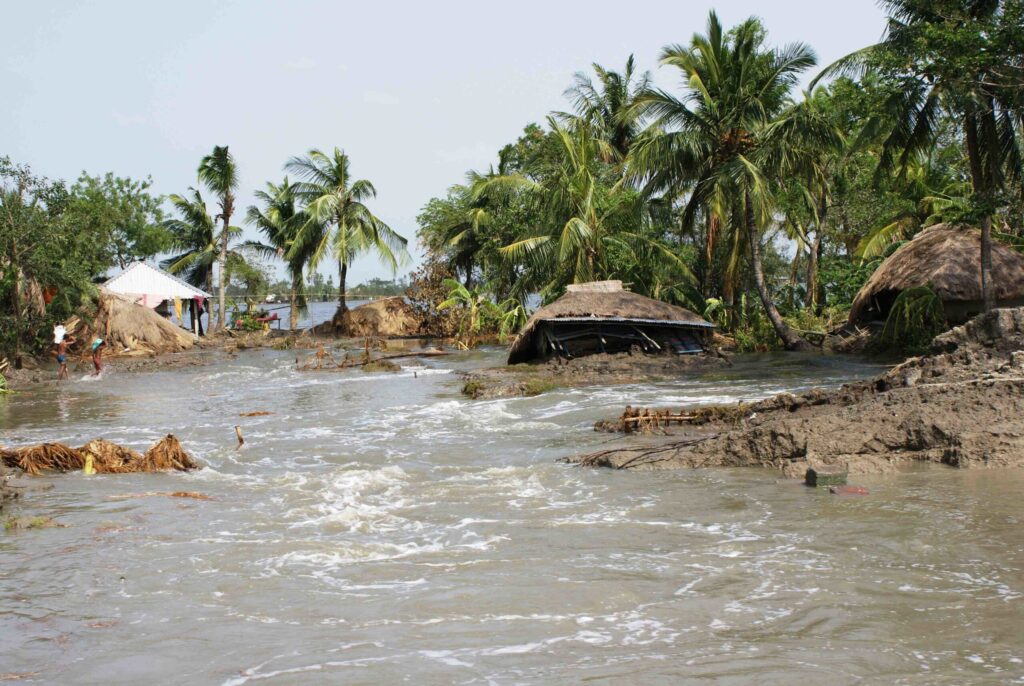
Banner image: Cyclone Alia submerges settlements in West Bengal in 2009. Image by Anil Gulati/India Water Portal via Flickr (CC BY-NC-SA 2.0).

