
MEXICO CITY — He has called Colombian President Gustavo Petro “a sick man” and Ukrainian President Volodymyr Zelensky a “dictator.” He once slammed French President Emmanuel Macron as “publicity-seeking,” and former Canadian Prime Minister Justin Trudeau as “dishonest and weak.”
President Trump is known for hurling scathing insults at world leaders.
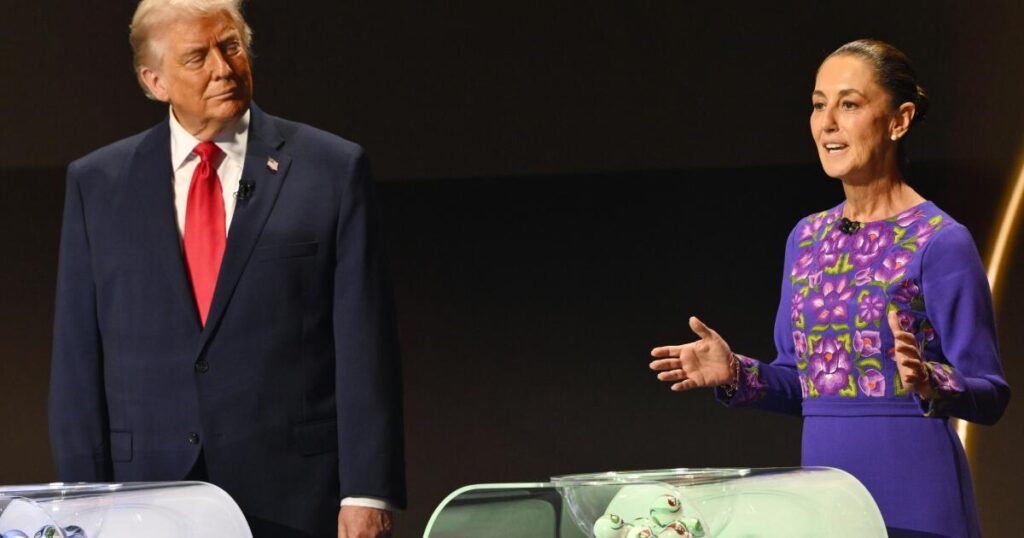
Then there’s Mexican President Claudia Sheinbaum. The U.S. president has described her, at turns, as “fantastic,” “terrific” and “elegant.”
In a social media post Thursday, he offered his most glowing compliments yet, extolling Sheinbaum as “wonderful and highly intelligent” and saying Mexicans “should be very happy” to have her as their leader.
Trump’s emphatic praise for Sheinbaum is surprising, given their marked differences in temperament and politics.
Sheinbaum, a leftist known for her patience and pragmatism, labeled Israel’s U.S.-backed war in Gaza a “genocide” and condemned the recent U.S. capture of Venezuelan President Nicolás Maduro.
She disagrees with Trump on three of his firmly held beliefs: that the U.S. should raise tariffs on Mexican imports, expel migrants en masse, and attack drug traffickers inside Mexico.
But Sheinbaum is keenly aware of how Trump’s actions on trade, immigration and security could plunge Mexico into turmoil, potentially threatening her own popularity and the legacy of the ruling party founded by her populist predecessor, Andrés Manuel López Obrador.
So she has tread strategically, requesting frequent phone calls with Trump, making concessions on issues such as security and heaping praise right back at him. She described her conversation with Trump on Thursday as “productive and cordial” and added: “I had the pleasure of greeting his wife, Melania.”
So far, her tactics have worked. Trump’s repeated threats of sweeping tariffs on Mexican goods and drone attacks on cartel targets have not yet come to pass.
Managing Trump has been one of the biggest — and perhaps most consequential — focal points of Sheinbaum’s presidency. “It’s not something that just happened today,” she said recently of her relationship with Trump. “Communication, coordination, and defending the people of Mexico … are constants.”
Sheinbaum has been quelling nerves in Mexico since Trump’s election in late 2024, just weeks after she assumed the presidency. She promised to forge strong bonds with the incoming U.S. leader, who is widely disliked here for his diatribes against immigrants. Sheinbaum vowed to emulate Kalimán, a beloved Mexican comic-book superhero known for defeating villains with “serenity and patience.”
She has sought to command Trump’s respect in other ways, holding massive public rallies that demonstrate widespread support for her government. “We will always hold our heads high,” she said at one event shortly before Trump took office. “Mexico is a free, independent, and sovereign country. We coordinate, we collaborate, but we do not submit.”
In some ways, Trump has actually galvanized support for Sheinbaum by sparking a surge in nationalism. Polls show most Mexicans approve of her handling of the bilateral relationship. According to a poll conducted by El País newspaper, her approval rating soared to 83% in May after she persuaded Trump to postpone the implementation of heavy tariffs. It now stands around 74%.
Still, some political analysts point out that Trump may like Sheinbaum because, despite her talk of defending Mexico’s sovereignty, she has actually acquiesced to him many times, particularly on issues of security.
“The list of concessions to Trump accumulated in a single year far surpasses in scope and depth those made by supposedly more ‘subservient’ governments,” wrote columnist Jorge Lomonaco in El Universal newspaper.
Sheinbaum has deployed Mexican troops to stop migrants from reaching the U.S. border. She has sent dozens of accused drug criminals to the U.S. to face trial there, sidestepping the standard extradition process to do so. She imposed tariffs on some imports from China and other countries, and her government reportedly paused shipments of oil to Cuba, signaling a possible end to what Sheinbaum had lauded as a “humanitarian” effort to aid the embattled island nation — another possible target of Trump.
“In public, Sheinbaum’s government has maintained a sovereign and patriotic rhetoric, but it is evident that, in private, it has been very docile with the U.S.,” Lomonaco wrote.
Trump’s discourse with Mexico continues to be infused with threats. While he calls Sheinbaum a “good woman,” he also said in May that she is “so afraid of the cartels she can’t even think straight.”
Many believe Trump’s decision to send U.S. special forces to arrest Maduro and his wife in Caracas could embolden him to launch a U.S. military attack on cartels in Mexico — a move that Sheinbaum would clearly see as crossing a red line, and could probably ignite a political crisis here.
“I do think there’s a real risk of a strike on Mexican soil against cartels, especially after what happened in Venezuela,” said Gustavo Flores-Macías, dean of the School of Public Policy at the University of Maryland.
Mexico, he said, is attempting “a delicate balance of keeping U.S. authorities happy without falling into this perennial game of trying to appease the White House and do everything that Trump wants.”
Trump has also threatened to pull out of a trilateral trade deal with Canada, which was negotiated during his first term. The U.S., Mexico and Canada must launch a joint review of the free trade pact by July 1, its sixth anniversary, to determine whether the nations intend to renew it for 16 more years or make modifications. Trump has called the deal “irrelevant,” but the pact is fundamental to a Mexican economy heavily dependent on cross-border trade.
Meantime, a controversy arose last week surrounding the mysterious capture in Mexico of Ryan Wedding, the former Canadian Olympic snowboarder who faces federal charges in California of running a billion-dollar drug-trafficking ring.
Sheinbaum dismissed reports that FBI agents on the ground in Mexico participated in the the arrest of Wedding, who, according to U.S. authorities, had been hiding for years in Mexico.
Sheinbaum insisted that Wedding turned himself in at the U.S. Embassy in Mexico City and, at a news briefing, displayed a photograph that she said depicted Wedding outside the embassy.
But Canadian media said the image was probably fake, a creation of artificial intelligence. Sheinbaum dodged questions about the image’s authenticity. Wedding’s lawyer, Anthony Colombo, disputed Sheinbaum’s account that Wedding turned himself in. “He was arrested,” Colombo told reporters outside the federal courthouse in Santa Ana, where Wedding entered a not guilty plea. “He did not surrender.”
Sheinbaum was able to weather the dispute, but the episode again raised questions about how far the Mexican president is willing to go to keep Trump happy.
“It would be very very concerning — and certainly illegal under Mexican law — if the FBI operated and arrested an individual on Mexican soil,” said Flores-Macías, who added: “I think there are some clear signs that this took place without the involvement of Mexican authorities.”
Special correspondent Cecilia Sánchez Vidal contributed to this report.