
The recent tragedy in Indore, where at least 21 people are reported to have died after consuming contaminated drinking water, has once again exposed deep structural weaknesses in India’s urban water management systems.
Preliminary investigations have pointed to leakages in the main drinking water pipeline in the affected area, allowing sewage to mix with potable water. Officials and engineers say this is likely due to water supply and sewerage networks running dangerously close to each other underground.
Such failures are not isolated. Similar contamination scares have been reported from cities including Bengaluru. Despite decades of investment in urban water infrastructure, large parts of India’s cities still depend on intermittent water supply systems, which experts say are inherently vulnerable to contamination.
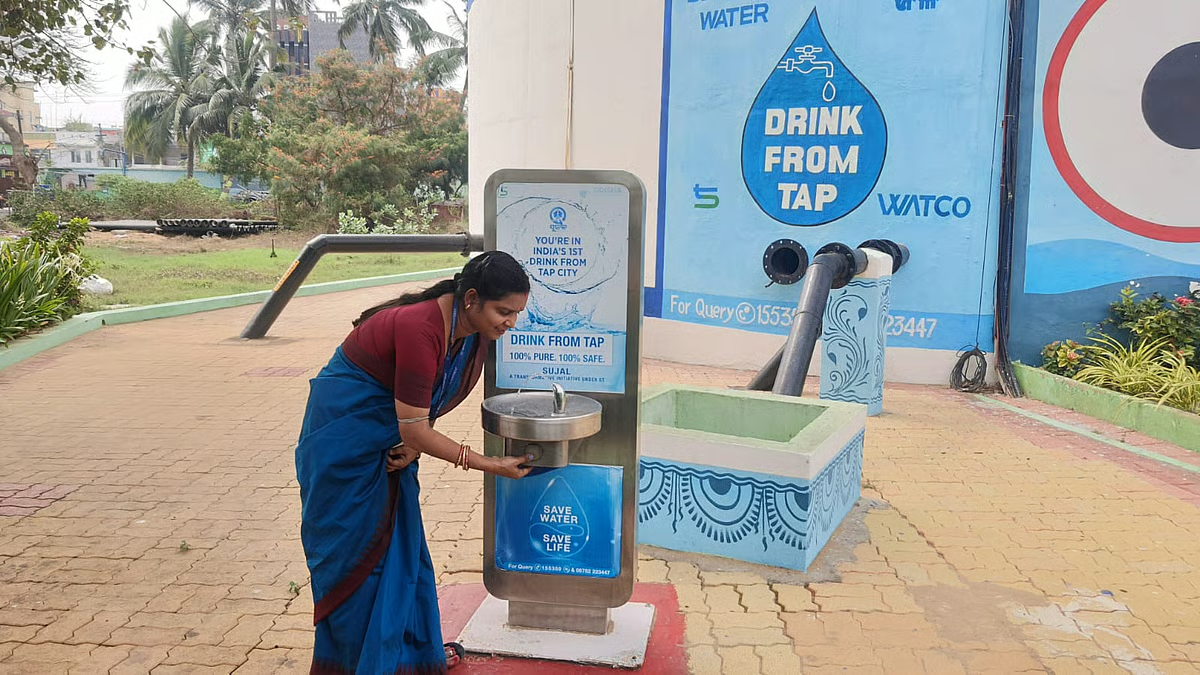
As several states continue to grapple with recurring outbreaks linked to ageing pipelines and stop-start supply, Odisha has been running an urban water programme that challenges a long-held assumption in Indian households — that tap water is unsafe to drink without filtration.
Odisha’s ‘Drink from Tap’ experiment
Under its Drink from Tap mission launched in 2017, Odisha has begun supplying potable water on a continuous, 24×7 basis across 11 cities: Puri, Gopalpur, Nimapada, Brahmapur, Champua, Rajgangpur, Birmitrapur, Rairangpur, Sundargarh, Hinjilicut and Anandpur.
According to state government data, more than 3.2 million people now receive uninterrupted tap water through over 600,000 connections. Officials argue that the programme shows continuous supply is not just a convenience, but a critical public health intervention.
Odisha says it is currently the only state in India to formally guarantee drinking water quality at household tap connections.
Sunita Mishra, a jalasathi (water friend) in Puri who works closely with households under the programme, says water-use habits in the town have changed significantly. Jalasathis are engaged by the state to read water metres, collect water charges, conduct field-level water quality tests and facilitate new household connections.
“Earlier, families without water purifiers either boiled water or bought filtered water from outside,” Mishra said. “Now, most households drink directly from the tap.”
She added that the change is visible in public spaces too, with people increasingly drinking from public taps rather than buying bottled water.
Why continuous supply matters
Officials and experts say the core principle behind Odisha’s approach is simple: Constant pressurisation of pipelines prevents contamination.
“The main task is to ensure that no external pollutants enter the pipeline. A 24/7 water supply makes that possible,” said Pradeep Kumar Swain, former chief executive of the Water Corporation of Odisha (WATCO), the agency implementing the mission.
Swain is now a member of the National Task Force on 24×7 water supply under the Union Ministry of Housing and Urban Affairs.
In cities with intermittent supply — which describes most of urban India — pipelines lose pressure during off-hours. This creates a vacuum effect, allowing contaminated water to be sucked in through cracks, joints or illegal connections.
Swain has previously told that leakages are inevitable in any city’s pipe network. In a continuous supply, despite leakages, the pipeline remains pressurised, preventing contamination. “Leakages will occur from the pipe to the outside, but outside water can never enter the pipeline. That’s the basic theory,” he said.
Many cities, he added, supply treated water of acceptable quality at the treatment plant, but due to intermittent supply, it gets contaminated before reaching taps.
“By design, intermittent water supply will create contamination,” said Chinmay Tripathi, a water management consultant who worked with WATCO until 2024.
The sewerage-pipeline problem
Continuous pressurisation alone, however, is not enough if the physical underground layout of utilities is flawed. Across Indian cities, one of the most common triggers for drinking water contamination is the close proximity — and sometimes direct overlap — of sewerage and water supply pipelines. This reflects decades of unplanned urban growth and the absence of dedicated utility corridors.
Guidelines issued by the Central Public Health and Environmental Engineering Organisation (CPHEEO) mandate a minimum horizontal separation of three metres and a vertical separation of one to 1.5 metres between sewer and water lines.
“If these distances are not maintained, contamination risk is always present,” Swain said. “In our experience, proximity of sewerage networks to water pipes accounts for nearly 90 per cent of contamination cases.”
To address this, Odisha made detailed asset mapping a prerequisite before rolling out 24×7 supply in any city. Once mapping was completed, water pipelines were realigned or relocated where necessary.
In many other cities, however, vulnerable stretches remain unmapped and unmonitored. “In most contamination incidents we examined, the water pipeline or household connection passed under a drain,” Tripathi said. “If there is a rupture in that section, contamination is almost certain.”
He explained that sewer lines are gravity-based and gradually go deeper as they move away from their origin point, while water supply pipelines typically run at a constant depth of about one metre.
This means that contamination risk is highest in the initial few stretches where the two systems are side-by-side or near each other. “For example, when the sewer starts at the first house, let’s say it’s 1 metre below, next house let’s say 1.05 metres below, then 1.06 metres below, and like that it goes till 7-8 metres deep. Whereas the water pipeline runs exactly 1 metre below for every house,” Tripathi explained.
In older and densely populated cities such as Kolkata, relocating pipelines can be technically complex because of space constraints, traffic movement and existing construction.
Independent water quality surveillance
Odisha has also restructured how water quality is monitored, beyond engineering and policy reform. To address concerns over conflict of interest, the state created an independent Water Quality Assurance Cell under the Department of Housing and Urban Development, separating water quality surveillance from supply operations.
Previously, laboratories reported to agencies responsible for water delivery — either WATCO or public health engineering units — raising questions about data independence, said Tripathi.
“To maintain the sanctity of water quality data, laboratories were moved out of the supply agencies and placed under a separate cell that reports directly to the principal secretary,” he said.
The cell also works with Indian Institute of Technology (IIT), Bhubaneswar for technical support, whose laboratory conducts independent tests as part of the surveillance framework. Water quality is tested at multiple levels — city, regional and state laboratories — with third-party verification by IIT Bhubaneswar. Testing covers up to 69 parametres, around 50 of which are routinely monitored depending on city-specific risks such as heavy metal contamination.
While the frequency of testing reduces at higher levels, officials say the layered system improves accountability and early detection.
According to Tripathi, the model has strengthened early detection and response. “Some cities are fully stabilised, others are operating at 70-80 per cent stability, and issues do arise,” he said. “But the difference is that the surveillance system flags problems early, and operational teams are mobilised.”
Changing household behaviour
The Odisha model also seeks to eliminate household-level contamination risks that are common in intermittent supply systems — particularly underground sumps and overhead storage tanks. “In a 24×7 system, underground sumps and overhead tanks are discouraged,” Swain said. “We advise households and apartment complexes to remove them because they can become contamination sources.”
But this approach requires building public confidence in the continuous supply system first. “People will only remove storage once they trust the system,” he acknowledged, adding that regulation, including inspection and cleaning requirements, may also be needed.
In Puri, the shift has been significant. Swain said that about 85 per cent of households have voluntarily removed their storage tanks.
Experts caution, however, that infrastructure upgrades alone cannot transform water safety without sustained behavioural change. In cities accustomed to intermittent supply, practices such as water storage, reliance on standposts and domestic filtration systems are deeply ingrained responses to unreliable services. Trusting water directly from the tap, especially amid frequent reports of contamination elsewhere, remains a gradual process.
The Odisha experience is now shaping national policy discussions. Under the AMRUT 2.0 mission, the Union government is encouraging states to adopt the model to move towards continuous, pressurised water supply. Officials and water experts argue that, in the long term, 24×7 pressurised supply is the only structural solution to prevent sewage and other pollutants from entering drinking water pipelines — and to avoid tragedies like the one seen in Indore.