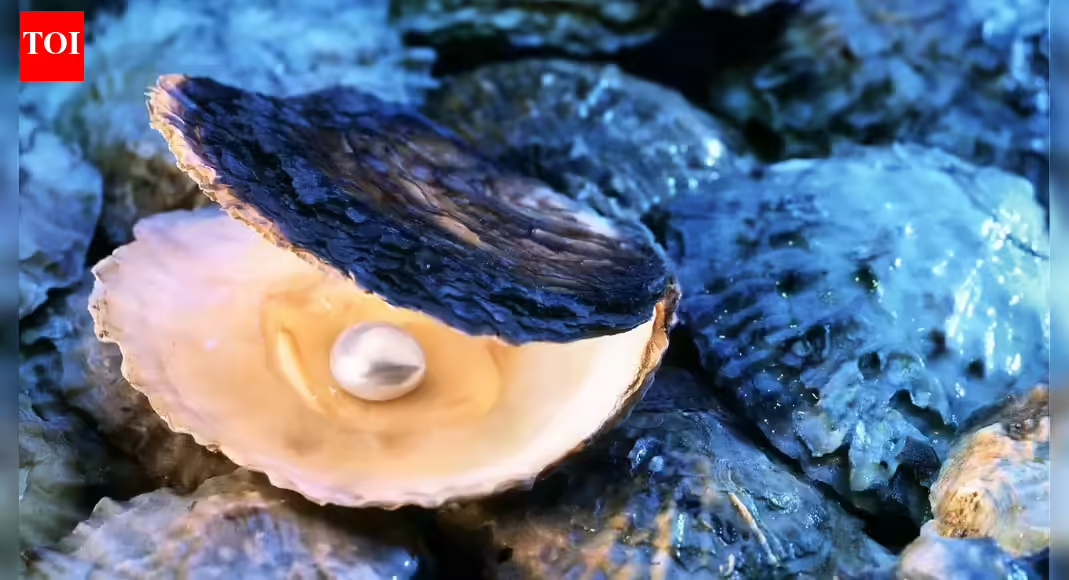
A pearl does not begin as something precious. It begins as a problem. Inside an oyster, a tiny particle slips in and settles where it does not belong. It might be a parasite, a rough fragment, or debris carried by water. The oyster cannot force it out and cannot escape it either. Instead of reacting aggressively, the oyster responds quietly by covering the irritant rather than fighting it.This response is slow and deliberate. A peer-reviewed study published in Science Advances explains that the oyster releases a smooth substance that coats the intruder just enough to reduce discomfort. Then it repeats the process again and again. Over time, this defensive reaction becomes the foundation of a pearl.
How oysters make pearls through a controlled biological process
Pearl formation is not random. Scientists studying molluscs have shown that oysters follow a tightly regulated process when they begin making pearls.Oysters control how minerals and proteins combine to form nacre, ensuring that layers settle in an organised way rather than building up chaotically.This control is what allows an oyster to turn irritation into a stable structure. What looks like beauty on the outside is actually the result of careful biological regulation happening inside the shell.
How oysters build pearls layer by layer over time
Once the irritant is isolated, the oyster’s mantle tissue takes over. Thin layers of nacre made from calcium carbonate and protein are deposited gradually. Each layer settles gently over the previous one. Nothing about this process is rushed.Pearls grow in uneven stages. Changes in water temperature, food availability or stress can slow or alter nacre deposition. These interruptions become part of the pearl’s structure, which is why no pearl is ever perfectly uniform when examined closely.
How oysters give pearls their natural colour
Colour does not sit on the surface of a pearl. It develops from within. Different oyster species naturally produce different shades because their nacre chemistry varies. Some oysters form pale, silvery pearls. Others produce darker or warmer tones.The thickness of nacre layers and the way light passes through them influence colour as well. Even trace minerals in the surrounding water can affect undertones. This is why two pearls from the same region can still look entirely different.
How oysters are influenced by water and diet while making pearls
The environment around an oyster plays a quiet but important role. Salinity affects mineral balance. Temperature influences how quickly nacre is laid down. Diet shapes protein structure. Over time, these factors subtly change how a pearl develops.Small differences accumulate over the years, shaping colour, lustre and surface texture. This is why pearls from different waters often carry distinct visual identities.
How oysters make pearls in cultured conditions
Most pearls sold today are cultured, but the biology remains the same. Humans may insert a nucleus to trigger pearl formation, but after that, control ends. The oyster responds exactly as it would to a natural irritant.Farmers can manage water quality and oyster health, but they cannot dictate the outcome. Shape, colour and lustre still depend on the oyster’s natural response and environment.
How oysters determine the quality of pearls
Pearl value is often misunderstood. Size alone means very little. Thick nacre matters more than diameter. Smooth surfaces reflect light better. Deep lustre signals healthy, consistent layering.Some irregular pearls are prized precisely because they show visible signs of natural growth rather than perfection. In pearls, character often outweighs symmetry.
What oyster pearl formation really represents
Oysters do not make pearls for beauty. They make them to survive. What begins as irritation becomes protection through patience and repetition. Layer by layer, discomfort is sealed away rather than resisted.Every pearl carries a quiet record of adaptation hidden inside its layers. Understanding what really happens inside the shell turns a pearl from a decorative object into evidence of how nature responds when escape is not an option, only adjustment.Also read| What is the colour of water, and why does it look clear in a glass but blue in the sea