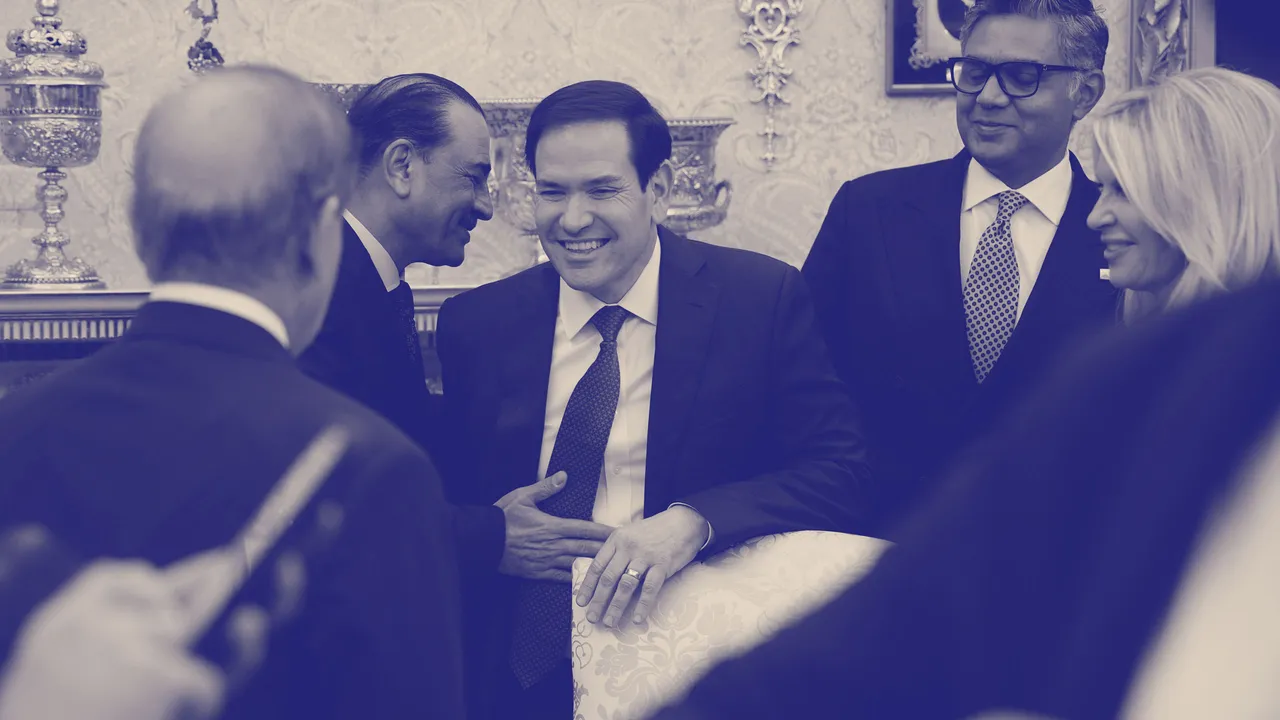
Since the United States and Israel began attacking Iran, in late February, Pakistan’s government has emerged as a surprising broker of ceasefire negotiations. In addition to helping communicate some of Donald Trump’s demands to the Iranians, Pakistan has offered to host peace talks between the two countries, in Islamabad. It’s all part of the surprisingly warm relationship between Trump and Asim Munir, Pakistan’s Army chief, who, despite the veneer of “civilian supremacy,” is the most powerful man in the country. Munir has led the Pakistani state’s charm offensive, while cracking down on domestic dissent, and Trump has reacted positively. (The President’s relationship with Narendra Modi, the Prime Minister of Pakistan’s biggest adversary, India, has cooled since Trump’s first term.) But can Pakistan really help broker peace, and what does its recent conflict with the Afghan Taliban, its onetime client, mean for the region?
I recently spoke by phone with Aqil Shah, the author of the book “The Army and Democracy: Military Politics In Pakistan,” a professor of political science at McDaniel College, and a visiting faculty member in the security-studies program at Georgetown University. During our conversation, which has been edited for length and clarity, we discussed how Pakistan’s military won over Trump, how the military consolidated so much power in Pakistani politics, and what the collapse in relations between the Taliban and Pakistan’s military says about the country’s foreign policy.
How has the Pakistani military establishment been so successful at wooing the Trump Administration, and how has it inserted itself into negotiations to potentially end the war in Iran?
Historically, the Pakistani Army has been a fulcrum of U.S.-Pakistan relations. But the Pakistani-American relationship has waxed and waned over time. During the Biden Administration, Pakistan had become a virtual pariah in Washington, or had been reduced to a nonentity, as the United States left Afghanistan and saw India as a means of countering China. But I think it was really the Pakistan-India crisis in May of 2025, when Pakistan and India engaged in limited armed conflict, that changed things, because Pakistan openly embraced Trump’s mediation of the fight, whereas Narendra Modi and company bristled at it. India said there was no role for outside mediation because the Indian approach to the Pakistan-India conflict was that it was a bilateral issue. Whereas Pakistan, under Munir, cleverly tapped into Trump’s need for adulation and praise, and the Pakistanis called him a global peacemaker, and publicly nominated him for the Nobel Peace Prize. Trump has brought this up several times. He likes to say that Munir is the best field marshal, and he says that Munir told him that he saved millions of lives. So they basically, at the expense of India, have achieved something unexpected.
In terms of the conflict with Iran, Pakistan has always seen itself as a sort of leader of the Muslim world. And so it has used this opportunity, because of its relationship with Trump or privileged access to Trump, and the fact that it borders Iran and is also fifteen to twenty per-cent Shia, to try this balancing act. It has been done with deft diplomacy of some sort, but it’s really flattery as foreign policy.
The military has been the central power in Pakistan since the country was founded in 1947, but over the past few years it has imprisoned the former Prime Minister Imran Khan and taken an even more central and autocratic role. To what degree has that allowed the military to seize the initiative with Trump?
At the time of the India-Pakistan crisis, the military’s public reputation and legitimacy was quite low. There was an economic crisis, and there was naked repression. There had been a rigged election before that, and they had jailed Khan, Pakistan’s most popular leader. But the conflict last year was where Munir pitched himself or projected himself as the victor of that war. And that revived the Army’s, or at least Munir’s, legitimacy as the solid leader and national hero who had saved Pakistan. The vast majority of Pakistanis think Pakistan won that war. So in that sense the crisis helped Munir consolidate his power. They were able to curb some of the dissent around Khan. They’d already crushed his party, but the criticism faded away, somewhat.
And I think the military has used that confidence that it gained from the war, both domestically, to further consolidate its power, and externally. After the crisis, Munir was promoted to field marshal, and he was then elevated to the new office of the Chief of Defense Forces, which basically gives him control over the entire military. And it was also that crisis in which they were able to really effectively endear themselves to Trump by anointing him as the global peacemaker.
Is there any danger for the Pakistani military in being seen as too close to a leader whose dealings with the Muslim world are probably not that popular in Pakistan, or has the distaste that Trump’s shown recently for India and Modi outweighed that?
I would say that, as far as domestic dissent is concerned, or the unpopularity of Trump is concerned, it seems like the military’s been able to mute much of the dissent. The India angle likely trumps that card, as does the idea of Pakistan as this indispensable power that is trying to help solve this U.S.-Iran war. The P.T.I., Khan’s party, has criticized Munir for cozying up to Trump, but at the end of the day foreign policy is the exclusive preserve of the military. And I think the military has really successfully pitched itself to the Pakistani public as this leader of the Muslim world—that it’s really Pakistan that’s the pivotal player in the region with the capacity, the willingness, and the power to punch above its weight at the expense of India.
One interesting aspect here is Pakistan’s relationship to Saudi Arabia. Despite the fact that Pakistan has nuclear weapons, and Saudi Arabia does not, Pakistan is a much poorer country and has, for a long time, looked to Saudi Arabia for financial assistance. How much do you think Pakistan’s relationship with Saudi Arabia dictates what Pakistan is trying to do here in terms of negotiations with Iran?
It’s crucial because, as you know, Pakistan and Saudi Arabia signed a defense agreement or defense pact, which, at least from what we know, establishes that if Saudi Arabia were attacked, primarily by Israel, Pakistan would defend it. And Pakistan has extended or will extend its nuclear umbrella to Saudi Arabia. So Pakistan is already in an awkward position because the Saudis are being attacked. And I think the worst nightmare would be for Pakistan to have to do something militarily for Saudi Arabia against Iran. I don’t think that’s going to happen, but I think they want to avoid that and keep this relationship with the United States, but also try to make sure that this region is not unstable. They also don’t want to have to take sides in the Saudi-Iran conflict, in part, because of the population of Shia Muslims domestically.