
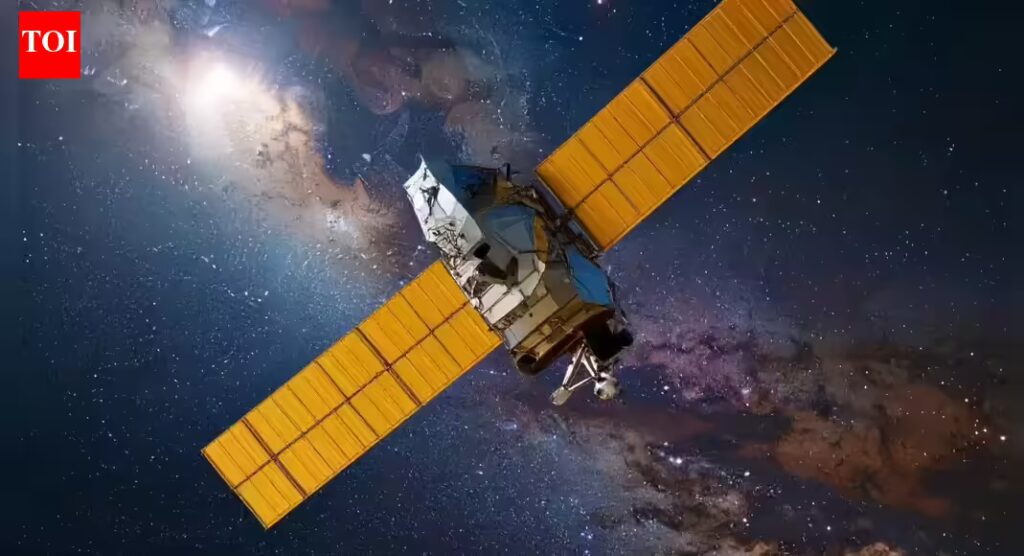
Earth’s orbiting satellites are commonly regarded as if they were suspended in mid-air. It is a fact that they actually experience a state of continuous free fall. This implies that they fall toward Earth continuously, but since they move at a very high speed, they never actually reach the ground.Nowadays, there are more than 13,000 satellites revolving in the orbit of the Earth, which include communication, weather observation, navigation, and research satellites. In order to comprehend why satellites do not fall from orbit, it is important to grasp satellite orbit physics.
How satellites stay in orbit the balance between gravity and speed
The principle that holds satellites in their orbit is a balance between the pull of Earth’s gravity and the horizontal component of their speed. Earth’s gravity is constantly pulling satellites toward Earth’s center. A stationary satellite would directly fall to Earth.Nevertheless, satellites have speeds that are very high. Low Earth orbit satellites, for example, have speeds of approximately 28,000 kilometers per hour. The speed of satellites makes it experience an outward force which resists the pull of gravity. Due to this phenomenon, satellites orbit Earth in a curvilinear fashion and not in a manner that makes them collide with Earth.This was exemplified by Isaac Newton through his cannonball example. A cannonball shot horizontally from a mountain with the correct speed would orbit the Earth instead of falling on it. Satellites work on the same principle of falling while moving forward at a high speed that prevents them from hitting the Earth’s surface.
Satellites in orbit experience microgravity and weightlessness
Satellites experience what is called microgravity or weightlessness. This does not mean that gravity is absent. Instead, both the satellite and everything inside it are falling at the same rate. This creates the sensation of floating.Astronauts aboard the International Space Station appear to float, although they are well within Earth’s gravitational field. Once launched to the correct speed and altitude, satellites maintain their motion without engines, with gravity bending their trajectory into a circular or elliptical path.
Different satellite orbits and how altitude affects their stability
Satellites are launched at different orbit levels based on the type of satellite and its application. Low Earth orbit satellites, including the ISS at an orbital altitude of 400 kilometers above the Earth’s surface, take 90 minutes to complete a single orbit. At this orbital level, there exists atmospheric remnants with enough drag.To compensate for this issue, satellites often include thrusters that periodically increase the satellites’ altitude. If satellites were not subject to these corrections, they would end up re-entering the Earth’s atmosphere and burn up.Geostationary satellites have orbits of 35,785 kilometers above Earth’s surface. In this orbit, there are no drag forces from Earth’s atmosphere. This type of satellite orbits Earth in a stationary position above a given spot on Earth, which is useful in communications and meteorological observations.
Controlling satellite speed and avoiding collisions in orbit
Even in Low Earth Orbit, there is a small amount of atmospheric drag on satellites. This slows down the satellite with the result that it has to be corrected occasionally in order to be in the correct orbit.Without any kind of upkeep, satellites could enter Earth’s atmosphere unchecked or crash into other space objects. This shows the relevance of monitoring and management of orbits in space. Due to the increase in the number of satellites, space orbits have become congested. This serves as a potential threat of collisions between space satellites or space debris in megaconstellations such as Starlink, launched by SpaceX. Everyone knows that NASA, ISRO, or the European Space Agency tracks satellite orbits to avoid collisions.To keep satellites in operation or ensure that space is a safe arena for scientific or business endeavors, there is a need to comprehend orbital mechanics, velocity, and drag.