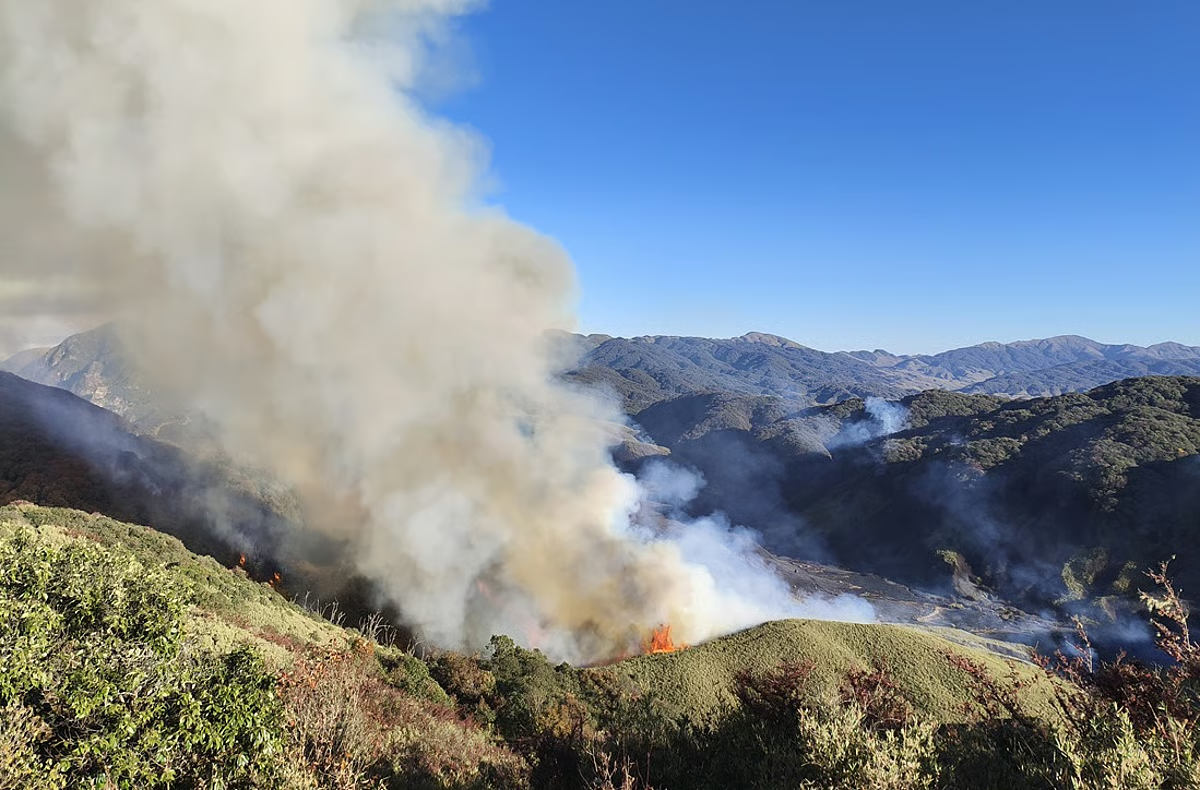
North Bengal has always been a place where forests, wildlife and humankind stood undisturbed. Humans have never been hostile, barring a few incidences of killing as what we witness today. For generations, tea gardens, small villages, and dense jungles have shaped a landscape where humans, elephants and leopards were never in a confrontational mood; But in recent decades, this harmonious relationship has begun to crumble. What once looked like coexistence has slowly turned into conflict — not because either side has changed its nature, but because the ground beneath their feet has changed.
Today, both human communities and wild animals are drifting into danger, pushed by forces they neither created nor can fully control. The forests are shrinking, food sources are declining, and migration routes long used by animals are blocked by highways, towns, rail lines, and constructions. The result is a cycle of fear, loss, and anger on all sides.
The heart of this tension lies in the Dooars, a lush green belt of about 5,200 square kilometres stretching between the Teesta and the Sankosh rivers. Spread across Jalpaiguri, Alipurduar, and Cooch Behar, this land holds the famous Buxa Tiger Reserve, Gorumara National Park, and Jaldapara Wildlife Sanctuary among other age-old forests. Once a continuous forest corridor, it has now fractured under expanding tea gardens, new settlements, and endless highways. Elephants that once wandered unhindered from Bhutan to Assam now find themselves cut off by rail lines or trapped between human establishments. Leopards that once hunted silently in deep forests now slip through tea bushes, backyards, and the edges of villages in search of prey and shelter.
This shrinking of safe spaces explains why North Bengal today sees frequent encounters and frequent tragedies. Leopards slip into paddy fields and tea gardens not out of aggression but out of hunger, while elephants enter villages drawn by the smell of ripening paddy. Agricultural expansion and monoculture plantations have replaced jungles with uniform tea bushes — ideal cover for leopards but offering no natural prey. Rivers run thinner, water holes dry early, and forests echo with the noise of human activity. Villages, with their easy sources of food and water, attract wild herds, while harassment by frightened people — shouting, firecrackers, stones — turns many encounters into violence.
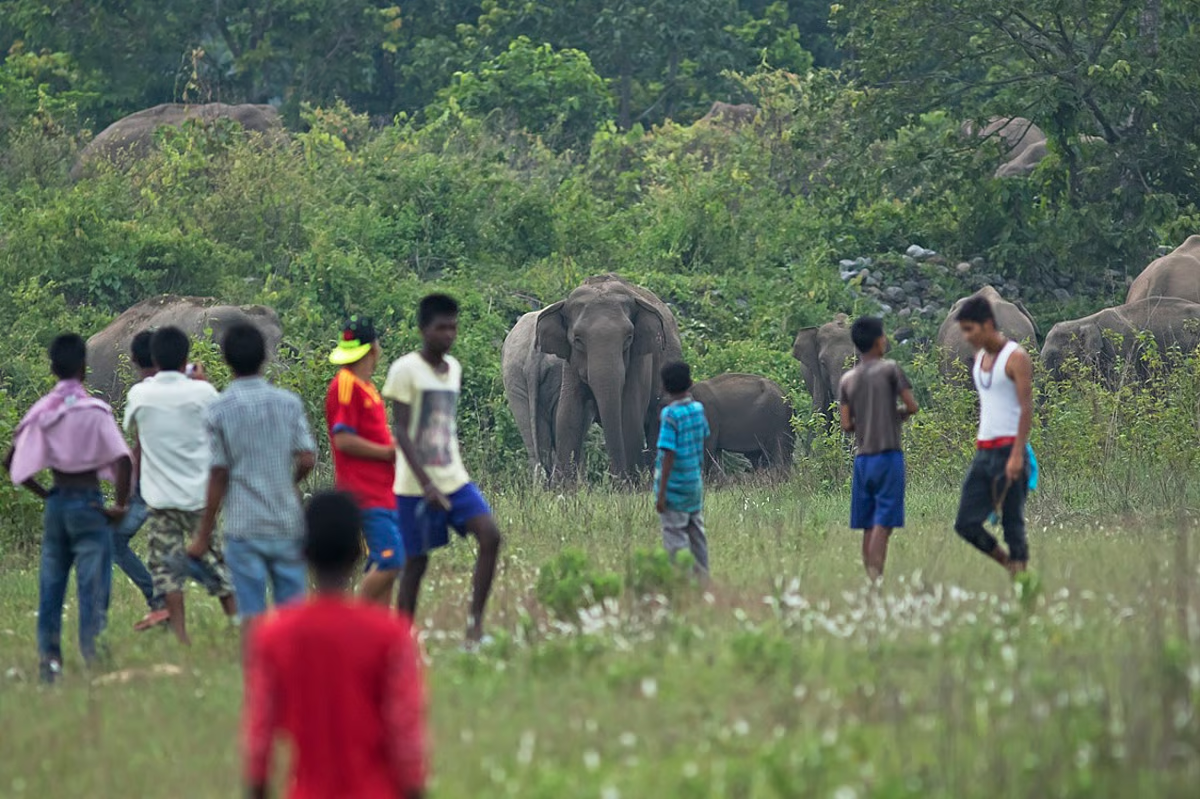
The consequences of these ruptures are reflected in the disturbing incidents emerging every week. In Bairagirhat of Mathabhanga, an 18-year-old girl cutting paddy with her mother was mauled by a leopard that had been hiding just a few feet away. In Falakata’s Kadambini Tea Garden, workers found the body of a leopard lying among the bushes in what appears to be a natural death but triggered added fear among labourers. In Chalsa and Banarhat, tourists rushed dangerously close to a lone elephant at the Murti river before forest guards intervened. In Lataguri, village residents sleep on a school rooftop to protect it from elephants that have repeatedly damaged the building at night.
Some events are steeped in quiet tragedy. In Shalbari near Chalsa, a young woman died of shock after suddenly seeing a massive elephant on her morning walk. In Nagrakata’s Changmari Tea Garden, the birth of a wild elephant calf drew hundreds of eager onlookers, turning a moment of joy into a risky crowding around a nervous herd. In the Tukuriya region, entire herds of 60 to a hundred elephants had to be pushed toward Bagdogra because shrinking forest patches no longer offered water or grazing.
The shadow of fear runs long in Nagrakata, Malbazar, Binnaguri, and Banarhat, where nights throb with the anxiety of unseen movement in the bushes. Leopards, once elusive spirits of the forest, now step boldly through courtyards and footpaths, turning the most ordinary spaces into zones of dread.
The tragedies involving children are the most unbearable. On August 27, 2025, 12-year-old Mohammad Karimul Haque was dragged away by a leopard from outside his home in Khutabari. On July 17, 2025, three-year-old Ayush Kalandi was taken from the courtyard of his house in Kalabari Tea Estate and later found dead in a tea section. Earlier, on October 19, 2024, 10-year-old Sushila Goala was snatched from her yard in Kherkata. In July 2024, an eight-year-old child was killed in Totapara while picking vegetables. In September 2023, nine-year-old Sunny Oraon was attacked in Dhekalapara Tea Garden. Each incident tells the same story — a child playing near home, a sudden leap from the bushes, and a life lost in seconds.
Not only children suffer. On September 15, 2025, 72-year-old Champa Karjee of Khauchandpara in Alipurduar was attacked in her courtyard and fought the leopard for eight terrifying minutes before surviving with severe injuries. And on September 16, 2025, 13-year-old Asmit Roy of Kherkata village under Angrabhasa-1 Gram Panchayat was dragged from outside his house and later found dead at Sulkapara Rural Hospital, plunging the village into grief and rage.
The destruction is not limited to predators on land. The railway tracks slicing across elephant corridors have become even deadlier. The North Eastern Frontier Railway region records one of the highest elephant death tolls in India, with animals being killed in collisions across Dhupguri, Mahananda Sanctuary, and Khalaigram. Injured elephants often stagger into nearby forests, while their terrified herds scatter into human settlements, multiplying risks for everyone.
These recurring conflicts devastate human lives and wildlife alike. Farmers lose the year’s harvest in a single night of an elephant raid. Homes get crushed under panic-driven herds. Children walk to school with fear whispering behind every step. But elephants and leopards too are living beings pushed into desperation — stripped of habitat, food, and safety. Elephants raid crops because forests no longer feed them. Leopards attack livestock and sometimes children because their natural prey has vanished. Crowds of tourists provoke animals with recklessness, and frightened village residents react with anger. The cycle tightens until tragedy becomes inevitable.
The way forward cannot be built on capturing leopards or driving elephants away each time they appear. North Bengal urgently needs wildlife-sensitive land planning, restoration of broken elephant and leopard corridors, and reforestation around vulnerable forest edges. Night traffic must be controlled across known animal routes. Tea gardens must adopt early-warning systems and strengthen their collaboration with forest divisions. Railways must deploy real-time monitoring, speed restrictions, and thermal sensors along critical passages. Above all, the communities who bear the heaviest brunt require compensation, rapid-response support, and awareness programmes that prioritise both safety and empathy.
North Bengal can still restore its delicate balance, but only if both people and animals are treated as rightful residents of the same land. Coexistence is not a luxury — it is the only path to survival on both sides of the forest line.