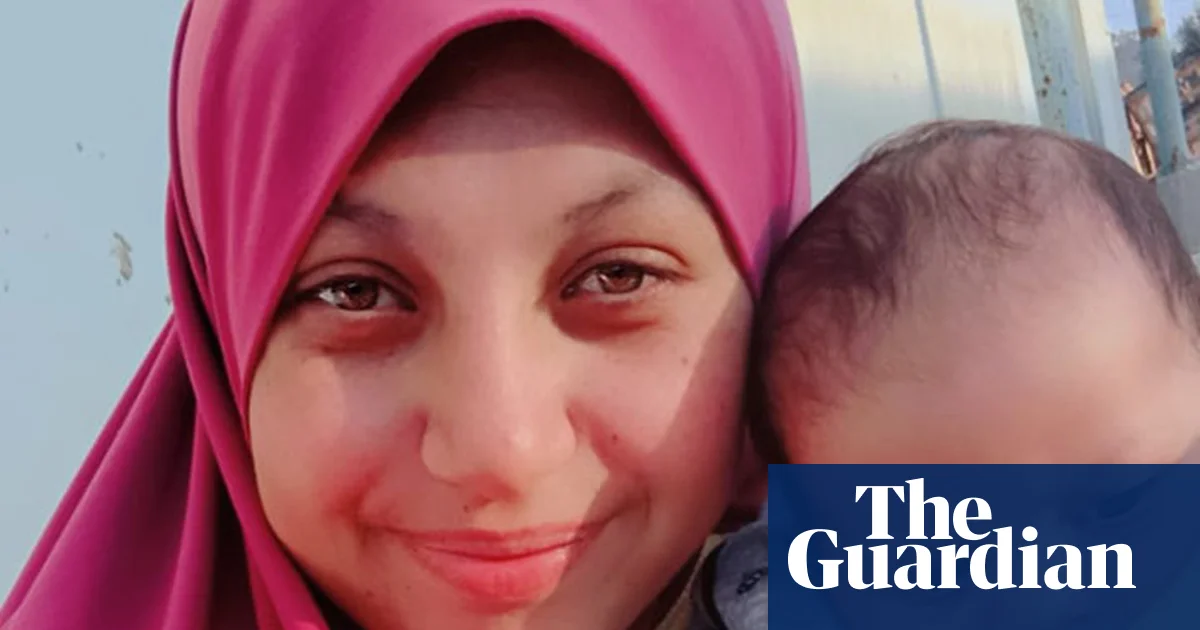
Hadeel Al Gherbawi was seven months pregnant when the war started in October 2023. Up until that point the 26-year-old had meticulously prepared for her son’s arrival. She visited her doctor twice a month because the pregnancy was high risk, had regular ultrasounds and took vitamins. “I love the details,” she says.
Living on the east side of Gaza City, close to the border with Israel, and knowing that being pregnant would make moving fast difficult, she decided to go to her parents in the west of Gaza City that first day. “I thought it was just going to be a few days and I would go back.”
The family has since been displaced 13 times and the house she shared with her husband has been destroyed.
In late October, about five weeks before her due date, Al Gherbawi was near a massive Israeli strike on a residential building in Gaza City. “It felt like an earthquake,” she remembers. She fled to al-Shifa hospital, where displaced people filled every space. Using a bathroom was nearly impossible.
“I can’t forget the horror of that night,” she says. There was a place for unidentified bodies and a barrel for body parts. The strike had reportedly killed more than 100 people. Al Gherbawi remembers the smell. “I couldn’t take it. I was pregnant. I felt sick … may God have mercy on those who were killed.”
Al Gherbawi and her husband decided it was safer to go south to have her baby. In displacement camps, using the bathroom remained a nightmare. She would wake someone to accompany her frequently during the night.
Too scared to go into labour naturally, because finding transportation, especially during the night, would be difficult, she asked doctors at Nasser hospital in the city of Khan Younis to induce her. When the nearby building was struck while she was in labour, she feared panic and chaos could lead to her baby being mixed up with another and asked her mother to keep watch. She describes feeling “fear, unbearable fear”.
After Jawad was born, Al Gherbawi moved to a rented flat, sleeping in a room with 30 people. She couldn’t find painkillers for her stitches and quietly endured her pain at night so as not to wake others. She believes she also had postnatal depression. “My face was pale, I was weak, frail and my hair was falling [out].”
A few months later, they moved to a tent. “It was the first time that I lived in a tent,” she says bitterly. “The sand, the insects.” She worried constantly that Jawad would be stung. She hugged him at night and woke frequently to check he was still alive: she had heard about newborns freezing to death.
Then, when Jawad was nine months old, Al Gherbawi found out she was pregnant again. “At first I was shocked and upset,” she says. “How am I going to bring another child into this world while living in a tent?”
The January 2025 ceasefire brought brief hope. “I can’t describe how happy I was,” she says. Despite being in her first trimester and against everyone’s advice, she insisted on walking back north to her flat. She and her husband spent a cold night sitting on the pavement of the coastal road waiting for the checkpoint to open. Finally, they reached their home, with Jawad’s blue room and the decorations she had hung before the war.
They spent six weeks there and started preparing for the delivery. On 18 March, Israel broke the ceasefire and they had to move again. Their house would later be destroyed.
Her pregnancy proved far harder than the one before, with all nine months of it during the war. She says the starvation was the worst. “There would be whole days where all I had was one cucumber.” She worried about her unborn baby and her heart broke watching Jawad cry for food. “Nanna, nanna,” he’d say, his word for food. Whenever there was food, she gave him her share. “There was nothing else I could do.”
“The strikes, the lack of safety, the lack of privacy, being in a tent – all of this was hard, but famine was the hardest thing,” she says. “You’d be sleeping and crying because you’re hungry and you can’t find anything to eat.”
The United Nations has found that Israel’s actions in Gaza, with mass civilian casualties and life-threatening conditions intentionally imposed, are ‘consistent with the characteristics of genocide’, including ‘using starvation as a method of war’.
Closer to her due date, she decided to move back in with her parents, near a hospital with incubators. She asked to be induced as before, but the hospital was overwhelmed with urgent cases and doctors reassured her she could deliver naturally.
One night, her contractions started. Not wanting to disturb the others who “did not eat all day” and were sleeping, she called an ambulance before waking her mother. Her husband was in the south. With contractions every five minutes, she walked down five floors. The building had no power for the lift. She delivered a baby boy, Fares, in the ambulance minutes later.
Fares weighed just 2kg (4.4lb). Al Gherbawi attributes this to the starvation and says he remains small to this day.
At the hospital, there was blood on her bed. The nurse told her there was no anesthesia, they would have to stitch her without it. She says “the pain was unbearable”.
The hospital needed the bed. Al Gherbawi, exhausted and in pain, had to sit on a chair until the observation period was over. Finding transportation back to her parents’ flat proved difficult. They finally found a bus that could take them halfway. Five hours after giving birth, Al Gherbawi walked back to her parents’ home and up the five floors.