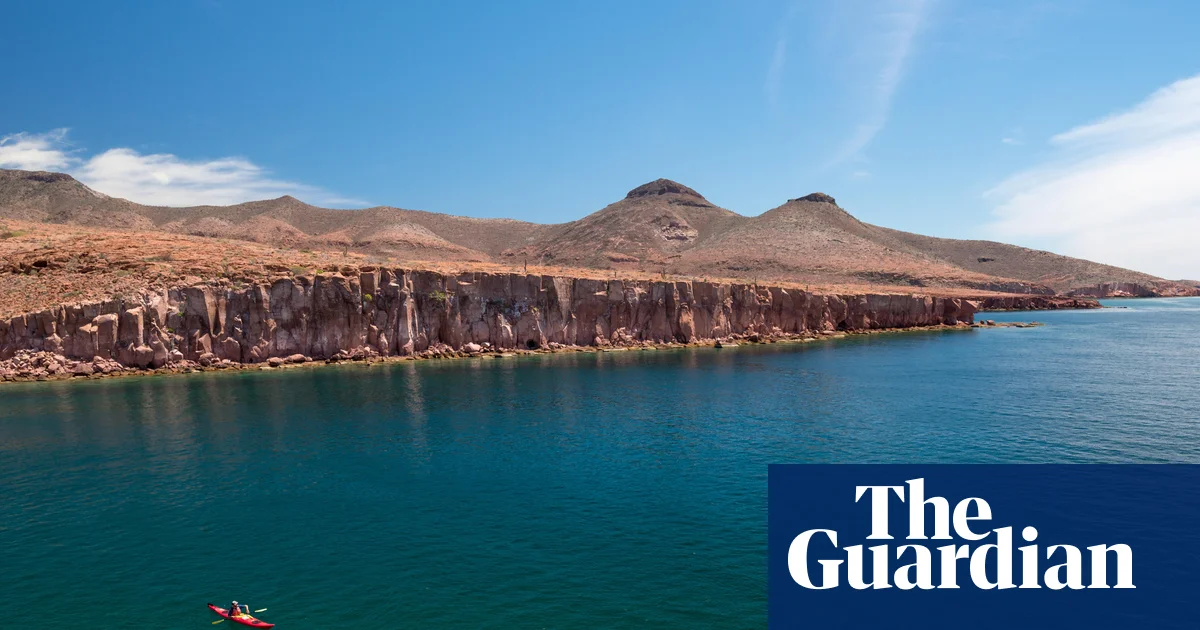
On a clear day over the Sea of Cortez, Espíritu Santo looks untouchable. Turquoise water laps at the shores of the island’s rocky coves; whale sharks cruise past snorkellers; seabirds caw over ancient cliffs. The pristine island and its Unesco-protected surroundings – informally called “Mexico’s Galápagos” – are a cocoon of biodiversity.
Yet an increase in tourist numbers has led to growing unease among the island’s longstanding stewards, as environmentalists report a decline in the area’s marine life and call for stricter regulations.
Espíritu Santo is no stranger to conflict. In the 1990s, the island, roughly the size of Manhattan, was a potential goldmine. Developers were reported to have plans for a casino. The fight to save it, led by grassroots activists and a local billionaire, was an early example of private conservation. Three decades on, those involved warn of its fragile legacy.
The allure of Espíritu Santo for developers in the 90s was obvious, with its secluded, uninhabited beaches and privileged location near the Baja California peninsula.
Although nature zones had some protections, the island had an unusual legal structure that made it particularly vulnerable. It was ejido land – a type of communal agricultural property with roots in the 1910-17 Mexican revolution. It was controlled by a group of about 30 landowners (ejidatarios), each of whom owned a small plot.
That created a legal grey zone around construction, says Exequiel Ezcurra, former president of the Mexican Institute of Ecology. “Even a threat in Mexico can be very, very real,” he says, pointing to the country’s historically lax approach to conservation.
“We believed that if Espíritu Santo fell, others would fall too,” he says, adding that this posed a wider threat, given the “immensely important role in global ecology and conservation” that islands play.
It was an American conservationist who sounded the alarm. Tim Means, who had spent decades ferrying ecotourists across the Sea of Cortez, learned of developers’ ambitions and began asking some of Mexico’s most influential philanthropists for support.
Among them was the billionaire Manuel Arango. At the time, he was one of Mexico’s most prominent businessmen, overseeing Grupo Cifra, a retail company that introduced Walmart to the country; he was also an ardent environmentalist.
Fears mounted when one of the communal landowners built a series of illegal, rudimentary bungalows at the turn of the millennium. “We said, ‘what a travesty. This is going to continue,’” remembers Arango.
The group devised a plan to buy the island directly from the landowners and transfer it to the Mexican government. It was a novel concept called “an agreed expropriation”, says Ezcurra.
“I never imagined we could buy an island,” Arango says. “But if the ejidatarios remained as the owners … it would have been a disaster.”
Negotiations with the landowners took several years before a majority agreed to sell the island’s 10,000 hectares (24,700 acres) for an estimated $3m (£2.27m).
Arango started a unique fundraising campaign. About a third of the funds came from local people, contributing as little as 100 pesos (£4.15) each. Arango donated about half a million dollars and philanthropic foundations covered the remainder.
“We wanted it to come from many people. We wanted the island to feel like theirs,” he says, insisting it felt like a local effort among the people of La Paz, who saw the island as their responsibility.
Enrique Hambleton, an environmental educator and author from La Paz who joined the campaign, says it was a historic event for Mexico. “It was the first time that conservation of a place was agreed with the participation of government, stakeholders, sailors, fishermen – everyone.”
Once the island had been bought, the coalition sought to ensure that the government assumed stewardship and implemented robust legal protections. Arango used his political connections to mobilise key figures around the then-president, Vicente Fox. In January 2003, Isla Espíritu Santo was declared federal land, which prohibited development.
“If we’d known all that [this battle] would take, we might not have started it,” Arango says, adding that Means, who died in 2019, deserves the main credit. “Means was the real motor behind everything.”
Further protections followed. In 2005, Unesco designated 244 islands, islets and coastal areas in the Gulf of California, including Espíritu Santo, a world heritage site. Then, in 2007, Mexico named the Espíritu Santo archipelago as a national park. The Sea of Cortez, often called the “aquarium of the world”, is recognised as one of the most biologically diverse marine areas in the world.
Residents say the fight inspired other communities in Baja California Sur to band together to oppose mega-developments years later, including the Cabo Cortes project, the El Mogote sandbank plans, and developers’ plans for a cruise ship facility off La Paz.
The campaign also served as an early model for private conservation, which is on the rise in Mexico today. Between 2012 and 2023, the number of privately protected hectares in the country increased by 44%, according to the local body of the National Commission of Natural Protected Areas (Conanp).
A similar trend is also emerging globally. In the 1990s, privately protected areas (PPAs) worldwide were still on the fringes of conservation; today, tens of millions of hectares are voluntarily protected by private owners, according to estimates by the International Union for Conservation of Nature (IUCN).
Yet, concerns about the future of conservation in the Mexican Gulf remain. Among the crucial issues facing Espíritu Santo is how the Conanp authorities should handle the surge in tourists and the many licensed businesses that serve them.
In recent years, authorities have been withdrawing permits that once allowed tour agencies to operate permanent camps on the island, where visitors could stay overnight. They argued that these were damaging important habitats and polluting the dunes, according to Irma González López, the national park’s director between 2014 and August 2025.
Mike Lever, owner of Baja Expeditions, believes stricter restrictions are necessary. “This beautiful island is now under threat by mass tourism,” he says.
“Beautiful beaches and the quiet of this desert island … has seen the arrival of day boats carrying bus loads of tourists from Cabo, loud music, heavy drinking, crowded beaches, garbage and influencer opportunities.”
The marine life around Espíritu Santo is already under enough pressure, says Octavio Aburto, a professor at San Diego’s Scripps Institution of Oceanography.
“Over the 30 years that I’ve been [visiting], I’ve seen it degrade more and more. They forgot about the marine life,” he says, arguing that protection of the island’s terrestrial environment has taken priority.
Scientific studies indicate that human activities and the climate crisis are contributing to the decline of endangered species throughout the Baja California region. Other threats include overfishing, illegal fishing, rapid population growth, mining projects and the slow implementation of environmental policies, according to the reports.
Conanp’s Dilia Rebeca Meza says she is considering tighter visitor controls, and recently introduced stricter monitoring on the island – which some locals dislike.
“You can’t fix this overnight. It will take years,” she says, noting that the island is the area’s “crown jewel” and an environmental priority. “The mission is to preserve it in the long term, not just for this generation, but also for future generations.”
For long-term residents such as Hambleton, it is local activists who will protect Espíritu Santo. He says the local community has regular meetings to discuss how to defend the island. “People complain, and that forces the authorities to act.” Conservation, he stresses, has to come before profit.
Arango, who has carefully documented the island’s legal protections, hopes that future generations will defend it if they are ever challenged. He is all too aware of the economic and political pressures.
“The legal locks we put in place are fragile,” says Arango, now in his 80s. “What really protects the island in future is the people who defend it. We need the community to be the guardians.”