
Immigration was a winning campaign issue for Donald Trump in 2024 and undergirded his approval ratings early in his presidency. But what had been a source of political strength may now be turning into a liability for the president – and, potentially, for Republican lawmakers who back his hard-line policies on sending federal agents to cities to hunt for immigrants with statuses under scrutiny.
The ongoing tumult in the Minneapolis-St. Paul area, where an Immigration and Customs Enforcement (ICE) officer fatally shot a resident in her car in disputed circumstances, has further eroded Mr. Trump’s poll standings. While his approval rating on immigration is still higher than that of Democratic President Joe Biden in the final year of his presidency, some 6 in 10 voters now express disapproval of Mr. Trump’s approach, according to a batch of recent polls.
A Reuters poll taken after the shooting found a 41% approval rating for Mr. Trump on immigration, down from a peak of 50% in February 2025. Likewise, a new New York Times-Siena poll released Thursday found that 58% of voters disapproved of Mr. Trump’s performance on immigration, and 61% said ICE’s tactics have “gone too far.”
Why We Wrote This
Voters still broadly favor securing the southern border, and they give President Donald Trump credit for that. But as Immigration and Customs Enforcement continues to show up in force in cities across America, that appears to be reframing the issue, with 6 in 10 voters now disapproving of the president’s handling of immigration.
Voters are still broadly in favor of securing the southern border, and many give Mr. Trump credit for achieving that in the first months of his presidency. Notably, while the president’s ratings have dropped, Republicans in Congress still hold an 11-point edge over Democrats on handling immigration, according to a Wall Street Journal tracking poll. (The GOP advantage on border security is a whopping 28 points.) And Democrats only hold a 5-point lead in the New York Times-Siena poll’s generic matchup of congressional candidates, which is hardly insurmountable for the GOP as the party looks toward the 2026 midterm elections.
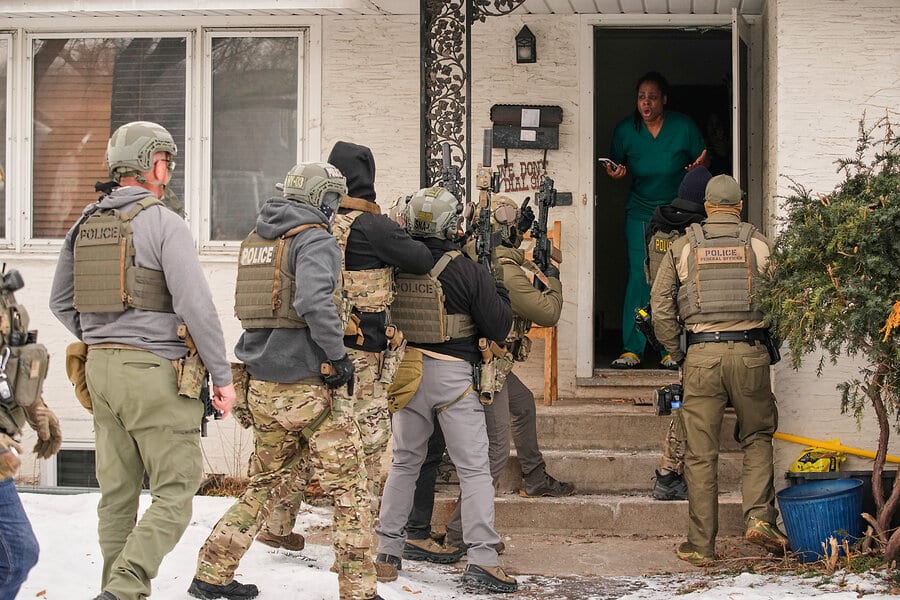
But as federal agents continue to surge in cities far from the southern border, the violence around deportation-related arrests appears to be reframing the issue for many voters.
Even some people who support a tough line on deportations have growing concerns about how federal agents are acting, says Dante Scala, a politics professor at the University of New Hampshire. The widely circulated videos of the shooting of Renee Good, a mother whose car had been partially blocking a street in Minneapolis, may be a turning point in how voters think about immigration policy, particularly as it affects their own lives.
“Looking at what’s happening in Minnesota, [voters are being] confronted with the idea that this force called ICE appears to be deployed against them, or people like them, and that, I think, changes things,” says Professor Scala, who studies presidential voting patterns.
An “unjustified” shooting in most voters’ eyes
Polls show that Americans are divided over the noisy and at times disruptive protests that have erupted in cities where ICE and other federal agencies are deployed. An Economist/YouGov poll of adults taken Jan. 16-19 found 47% approval and 44% disapproval.
A majority of respondents, however, say that the shooting of Ms. Good wasn’t justified, according to a Quinnipiac poll of registered voters. Eight in 10 respondents said they had watched videos of the shooting: Fifty-three percent found it unjustified, 35% said it was justified, and 12% didn’t express an opinion. Views were largely aligned with party affiliation: Seventy-seven percent of Republicans said the shooting was justified.
Podcaster Joe Rogan, a political independent who has in the past expressed support for Mr. Trump, was scathing about ICE’s conduct in Minnesota, comparing it to the Gestapo. “You don’t want militarized people in the streets just roaming around, snatching people up, many of which turn out to actually be U.S. citizens that just don’t have their papers on them,” he said.
Mr. Trump has rejected criticism of ICE and its agents. He says that ICE is removing “murderers and other criminals” from U.S. cities, which is why crime rates are falling. (Data on immigrant arrests in major cities shows, however, that many have no criminal record.) And he argues that voters would “support the Patriots of ICE” if they knew “the facts.”
Homeland Security officials say protesters are making it unsafe for federal agents to operate and are impeding lawful immigration operations. Vice President JD Vance, in Minneapolis on Thursday, pleaded for more cooperation from local officials. “It would make our lives a lot easier, it would make our officers a lot safer, and it would make Minneapolis much less chaotic,” he said.
Civil rights groups say citizens are exercising their constitutional rights and have been harassed and assaulted by the agents they seek to monitor.
Last week, a federal judge in Minnesota blocked federal agents from arresting, pepper-spraying, or retaliating against peaceful protesters and observers. On Wednesday, the 8th U.S. Circuit Court of Appeals lifted those restrictions, at least for now.
To Michael Brodkorb, a conservative from Eagan, a town south of Minneapolis-St. Paul, the recent fatal shooting of Ms. Good by ICE was deeply concerning. “I’m actually surprised that more people haven’t gotten hurt,” he says.
While ICE should remove the “worst of the worst,” he says federal enforcement operations in the Twin Cities don’t seem to reflect that priority. Instead, Mr. Brodkorb thinks the street-level show of force is “meant to show the power of the presidency, above anything else.”
Mr. Brodkorb, a podcaster and former deputy chair of the state Republican Party, says the optics are becoming politically costly for his party. “I’m trying to figure out how, when all is said and done, there is any path for Republicans in this state to succeed,” he says. “I just don’t see it.”
Other Republicans note that the party recently recruited a top-tier candidate to run for the state’s open Senate seat this fall. And they say the state’s ongoing multibillion-dollar fraud scandal will give them a strong issue to run on.
Still, for Republican lawmakers seeking to defend a razor-thin House majority in November’s midterms, a backlash against Mr. Trump’s immigration policy could be damaging.
GOP leadership has largely backed the Trump administration’s immigration enforcement operations and echoed its assertions that ICE is deporting criminals and that its agents are acting lawfully. Last year, Congress authorized tens of billions of dollars for ICE to expand its detention facilities, hire more agents, and buy more equipment.
“That’s not who we are as Americans”
Matt Wylie, a Republican strategist based in South Carolina, warns that his party could lose the narrative over public safety as voters watch more videos of masked agents dragging people from cars and sowing fear in communities. “That’s not who we are as Americans,” he says.
Before the Minnesota deployment, the administration could claim it was delivering on what most voters say they want: secure borders and the deportation of violent criminals, says Mr. Wylie.
But that might not hold up in November. “This will be a case study in how to screw up a winning issue and make it so toxic that it will be hard for Republicans to win.”
Pushback from voters against what they perceive as an administration’s excesses is a familiar “thermostatic” pattern, says Matt Grossmann, a political scientist at Michigan State University who directs the Institute for Public Policy and Social Research. Under President Biden, voters responded negatively to what they saw as a lack of border security. But now, it is the Trump administration’s approach that’s giving voters second thoughts.
Public opinion “usually reacts against the direction of policy,” says Professor Grossmann. “The public often says, ‘Things have gone too far.’”
During the first Trump presidency, polling showed a backlash against immigration enforcement when migrant children were being held in what critics described as “cages” at the border, he notes. That backlash helped Democrats win back control of Congress in the 2018 midterms.
Last month, Marcus Penny, a progressive who lives in St. Louis Park, a Minneapolis suburb, began volunteering to escort kids from class after he learned of federal agents near his children’s elementary school. He says classroom windows are now covered to shield students from viewing federal agents across the street. (School officials in another suburban district said this week that the government has detained four students.)
There’s a “larger and larger circle of people who feel unsafe around ICE, myself included,” says Mr. Penny, a parent-teacher organization member. He’s not against all immigration enforcement, he says, but the aggressive, widespread enforcement – seemingly beyond targeted arrests – is interrupting students’ access to public school.
“They deserve to be learning. They deserve to be kids,” he says.
Sarah Matusek reported from Minneapolis, and Simon Montlake from Boston.