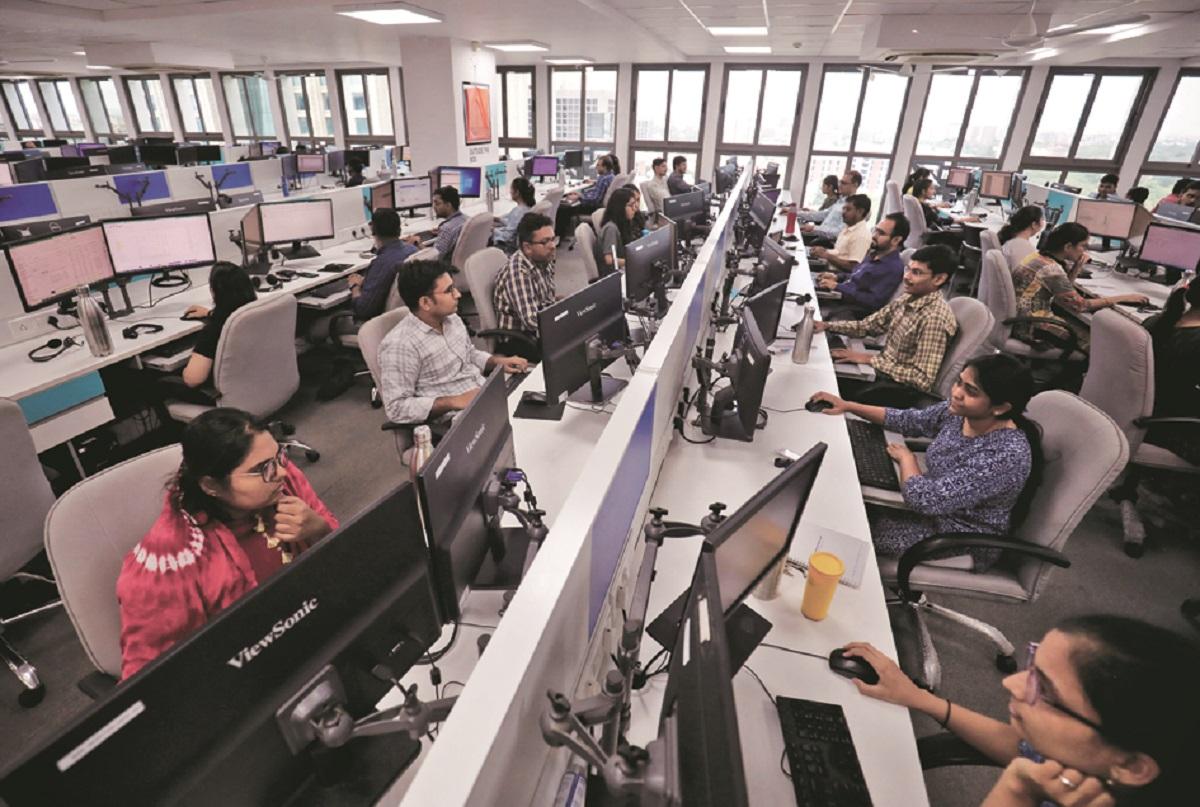
Yet, even as many agreed with this prediction, the sector delivered one of its biggest surprises in years: Capgemini’s $3.3 billion acquisition of WNS. The deal has forced a rethink of the future of business process management (BPM) — not as a low-margin, labour-heavy adjunct to information-technology (IT) services but as a business being repositioned for an AI-led operating model.
Explaining the rationale behind the acquisition, Capgemini Chief Executive Officer (CEO) Aiman Ezzat said BPM remained one of the fastest-growing segments.
“It is interesting to see that a business many assumed would eventually die is the one growing the fastest,” Ezzat said in an interaction with Business Standard. “For us the big opportunity lies in the complete transformation of end-to-end processes. For instance, take the claims process in insurance. You can redesign the process end-to-end and embed AI, GenAI (generative AI), and agentic AI. Such a transformation is complex and requires defining processes at a granular level. WNS gives us that capability,” said Ezzat.
The year 2026 is a year when the industry crosses the threshold from traditional BPM to intelligent operations powered by AI and driven by humans in the loop.
For decades, this industry — just like IT companies — depended on headcount–based delivery, fixed pricing models, and labour-intensive operations. But the impact of AI and GenAI is changing that play.
“This industry will look different in the next two years. BPO providers need to invest heavily in agentic AI and those are the ones that will survive,” said Saurabh Gupta, president, research and advisory, HfS Research.
“They have to reinvent themselves with technology providers coming into the BPO space as well. CommoditiSed BPOs will be hit the hardest and the ones that provide contextual services tailored to the needs of customers will survive.”
The BPM industry, worth $54.6 billion in 2024-25, according to the Nasscom data, continues to count the United States as its largest market, which is contributing about half its top line, with Europe adding another 30 per cent.
Banking financial services and insurance (BFSI) provides about 30 per cent of the revenue while hospitality and telecom contribute about 20 per cent each.
While the industry last year grew 4.7 per cent, its trajectory will depend solely on how fast it is able to adapt to the new technology. Many BPM companies have moved on to providing process optimisation and are delivering end-to-end solutions on process transformation rather than process management services. They are also moving beyond traditional pricing models to outcome-based pricing, often adopting a hybrid model depending on the specifics of each engagement.
“This transition is reshaping work. As workflows become more autonomous and data-rich, people will move into higher-order roles that demand judgement, orchestration, and strategic decision making, unlocking a level of performance previously out of reach. At industry level, this will accelerate consolidation because only organisations with true scale, deep domain depth, and strong platforms will be capable of leading the AI-enabled Digital BPS market,” said Keshav Murugesh, group CEO, WNS.
This shift is visible in how BPM firms are redesigning their offers. Companies such as Genpact have launched “account payables as an agent”, decoupling from traditional services and focusing more on expertise, innovation, and outcome-driven solutions. Such moves may cannibalise their existing revenue but analysts say they need to adopt it to be an agentic company rather than a pure-play BPO.
“These agentic solutions are taking hold with new clients who are net new to Genpact or are net new to that particular agentic solution,” Genpact CEO Balkrishnan Kalra said in a call with analysts in November.
This means traditional BPOs, which will continue to provide legacy services in finance and accounting, payroll management, contact centre, and supply-chain management, need to reinvent or get acquired because clients would not be ready to pay for the huge workforce.
Gaurav Vasu, founder of UnearthInsights, said: “Pure-play BPOs will find it hard to survive. We will see technology plus people plus industry domains come in and they will provide the business capability.”
Biswajeet Mahapatra, principal analyst at Forrester, said: “Now we have humans and agents, which are AI-assisted, working together. From here, we will move to AI-only transactions with no human interaction.”