
Mukesh Jaji calls himself a “writer, storyteller, dream weaver” on social media. Around 50 km north of Delhi, India’s capital, he sits on a charpoy, leaning against a wall in his farmhouse-cum-music studio on the outskirts of Sonipat. Green fields of prosperity surround the 32-year-old bespectacled lyricist, who writes Haryanvi songs.
Mukesh Jaji (seated) with his nephew and singer Aman Jaji at Jaji village in Sonipat district of Haryana.
| Photo Credit:
SHIV KUMAR PUSHPAKAR
Confined to a wheelchair for a decade following a road accident, he speaks about the rapid growth of Haryana’s music industry over the past decade. “Pehle Haryana mein shadiyon mein dus gane Punjabi to ek Haryanvi bajta tha. Ab ulta ho gaya hai! Ab dus Haryanvi to ek Punjabi bajta hai, (Earlier in Haryana, at weddings, 10 Punjabi songs would play for every one Haryanvi song. Now it’s the other way around! Now 10 Haryanvi songs play for every one Punjabi song),” he says.
Five years ago in the middle of the pandemic, two Haryanvi chartbusters ‘52 Gaj Ka Daman’ (52-foot skirt) and ‘Chatak Matak’ (a smart woman) were released. To date, both, sung by Renuka Panwar, have more than 1 billion views on YouTube. Mukesh, who wrote ‘52 Gaj…’, says there is a shift in the State’s regional music landscape.
Also read | From mofussil towns to a World Cup stadium: witnessing the silent rise of H-pop or Hindutva pop
The music video featured Pranjal Dahiya, a Haryanvi actor and social media influencer, while ‘Chatak…” featured Sapna Choudhary, an actor and performer. Both have over 5 million followers on Instagram, while Mukesh has written about 120 songs, 40 of which have crossed the 1 million mark streams.
Both music videos feature women wearing traditional shin-length gathered skirts and shirts, with dupattas covering their heads. Now, major music players like Saregama India Limited, T-Series, and Sony Music are producing and distributing Haryanvi tracks on streaming platforms like JioSaavn, Spotify, Gaana, and Apple Music.
Pop music and money
This boom has led to local musicians earning anywhere from 10 to 100 times what they would have 5-10 years ago. Mukesh himself charges up to ₹10 lakh for writing a song. “Earlier, artists from Punjab looked down on those from Haryana. Now, they’re eager for collabs,” he says, using social media speak for collaborations.

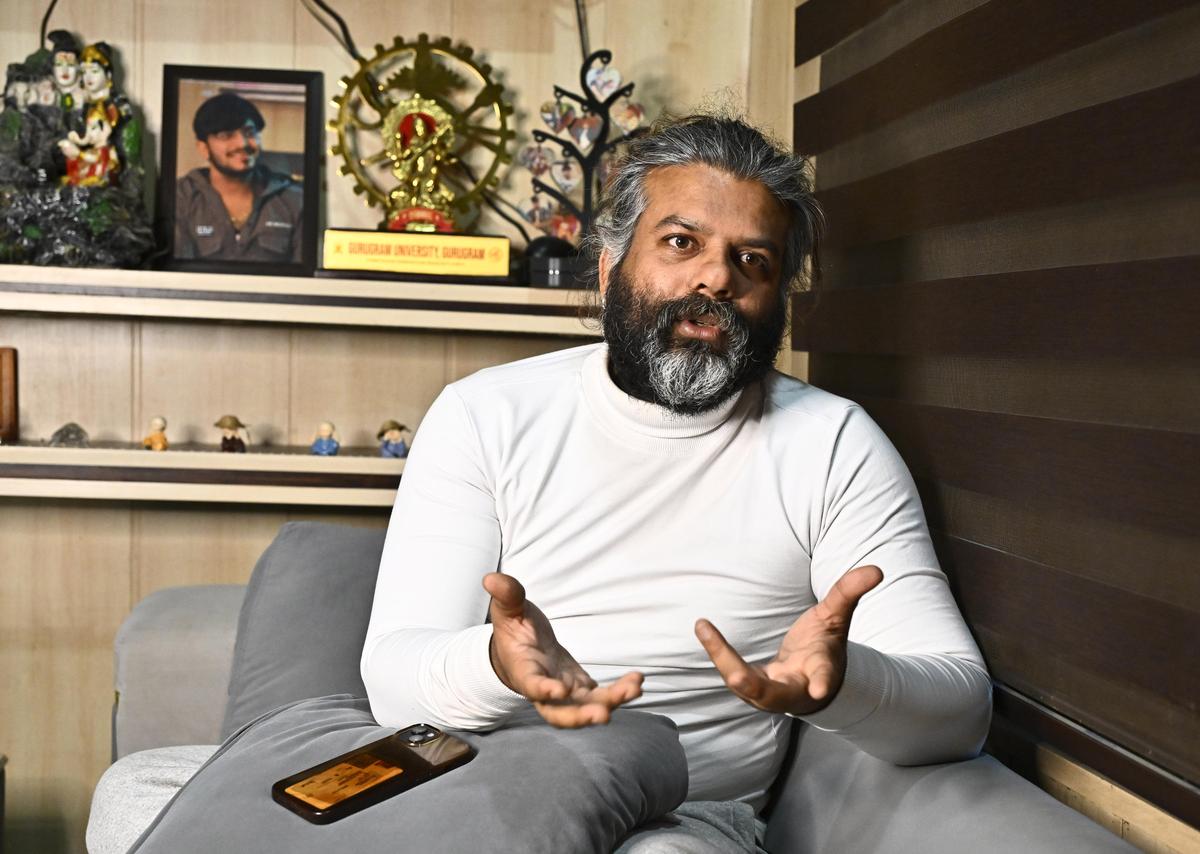
Kuldeep Rathee, a music video director.
| Photo Credit:
SHIV KUMAR PUSHPAKAR
Kuldeep Rathee, who has directed songs like the 2019 hit ‘Rx 100’ featuring muscular men, reveals that song shoot budgets have jumped from ₹20,000 to ₹20 lakh.
“We used to shoot at one spot with basic cameras. The actors brought their own costumes. Now, we’re going big: multiple locations, 2-3 day shoots, Bollywood-level cameras with rent as high as ₹35k per day, costume designers, and choreographers. It’s a whole production,” he explains. “The cash influx is drawing in top talent. Qualified pros are joining Haryanvi music; the industry is thriving,” Rathee says.
Musicians also wear Haryana on the sleeve. Shiva Choudhary, for instance, sings ‘Belong to Haryana’, glorifying its agrarian, rough culture: “We belong to Haryana and are Jats. We only believe in the rule of khaps (community leaders), and are not scared of anyone. We are in this world just to have fun. We are not scared of police stations and posts. We drink freely and don’t measure pegs,” she sings. Her songs feature prominently on VYRL Haryanvi that has playlists of artists who sing in the language.
With this generational shift, guns, gangs, and hooliganism are part of the songs. Ten songs by Masoom Sharma, one of the most popular Haryanvi singers, including ‘Chambal Ke Daku’, ‘Tuition Badmaashi Ka’, and ‘Jailer’, have collectively hit over 100 million views. ‘Illegal’ by Dhanda Nyoliwala amassed over 2.2 million views within a few days of its release in 2024. Despite the success of the genre, the glorification of violence in music has invited criticism.
The storyline and lyrics of some tracks present the police and judiciary in poor light, while portraying the larger-than-life main protagonists as more powerful than law enforcement agencies. ‘Tuition Badmashi Kaa’, for instance, depicts a woman police officer smitten by the protagonist, a wrestler-turned-criminal. Each time she and her force try to catch the male lead, he tricks her and escapes.
The video of another controversial song, ‘Court Mein Goli’, released in 2022, shows a dramatic scene where the protagonist shoots a witness inside the court room in the presence of the police and the judge, who hides behind the bench. In 2023, a public interest litigation was filed in the Gujarat High Court claiming that the song “targeted the integrity of the justice system” and called for it to be pulled from YouTube.
Multiple incidents of firing inside court complexes, including in Bhiwani, Ambala, Hisar, and Gurugram, have occurred over the years. This has raised concerns over the impact of the songs that seemingly glorify violence and gun culture.
In 2019, a Punjab and Haryana Court order, in response to five writ petitions filed, observed: “The court can also take judicial notice of the fact that glorification of liquor, wine, drugs and violence in the songs in the States of Punjab, Haryana and Union Territory, Chandigarh, has increased in recent times. These songs affect children of impressionable age.”
In a 30-page order, the court directed the Director Generals of Police in the two States and UT to “ensure no songs are played glorifying liquor, wine, drugs and violence… even in live shows”.
Murder at a wedding
Panditrao Dharennavar, 51, an associate professor of sociology at a Chandigarh government college, moved the court against songs promoting violence after the murder of a 23-year-old woman dancer at a wedding in Punjab’s Bhatinda in December 2016.
Dharennavar, originally from Karnataka, was posted in Chandigarh after his appointment through the UPSC examination more than two decades ago. He was gradually drawn to the local language, literature, and culture.
“I felt very sad about this incident. Being a teacher, I thought this could not be true Punjabi culture: a woman dancing at a wedding at night and being shot dead by a guest in excitement, while the Diljit Dosanjh song ‘Shraab Wargi’was being played,” says Dharennavar.
He prepared the petition on two grounds: noise pollution and the subject matter of songs. All three governments — Haryana, Punjab and Chandigarh — were made party to the case. “More than 15 hearings were held for three years, before the judgement came in 2019,” Dharennavar says. “A question was raised about vulgar songs being played on online platforms as well. Though the court in its ruling did not particularly mention an online or offline ban, the spirit of the order is that such songs should not be played anywhere, whether at live shows, on the internet, or on any other platform.”
Songs taken down
Over the past two years, the Haryana police asked YouTube and other social media platforms to take down about 60 songs that allegedly promoted violence and gun culture, says Inspector-General of Police, Special Task Force, Satheesh Balan. This was part of an effort to de-glorify crime in Haryana.
While the impact of such songs is hard to quantify, Balan notes that some may be influenced by content that fuels aggressive masculinity.
In 2025, two concerts, including one in Gurugram, were halted midway for playing these songs. The action, however, prompted strong protests from the music industry, and some artists accused the police of targeting a few singers. Masoom Sharma appeared on different platforms saying there were hundreds of songs promoting violence but the police had asked for six songs sung by him to be taken down. He hinted at a conspiracy.
Social media content creator Rakhi Lohchab, with over 6 lakh followers on her Instagram account, also came out in support of the singer and posted videos demanding that the police act in an unbiased manner.
In the Monsoon Session of the Haryana Assembly in 2025, the Congress’s Shahdara MLA Ramkaran Kala sought a statement from Chief Minister Nayab Singh Saini on the “excess” of song deletion against three singers: Masoom Sharma, Narendra Bhagana, and Ankit Baliyan. Social Justice Minister Krishan Kumar said these singers had “done a lot for the pride of Haryana” and asked the CM to take a sympathetic view.
However, many of the ‘deleted’ songs are still available online. Dharennavar says the police deletes the songs from the original accounts of the singers and the production houses but appears helpless in removing them from multiple other accounts. “For the songs reposted from multiple other accounts, it is the social responsibility of the people to lodge a formal complaint with the police or the authorities concerned seeking action,” he says.
He speaks about how FM radio channels in and around Chandigarh would continue to play banned songs despite the court orders, prompting him to write to the Ministry of Information and Broadcasting. The Union government then issued an advisory in 2022.
Dharennavar says there is both violent and vulgar content in songs across Haryanvi, Punjabi, and Bhojpuri. “After some MPs and representations from organisations received these references, the Ministry of Information and Broadcasting wrote to Online Curated Content Publishers and self-regulatory bodies of OTT platforms, to adhere to Indian laws and to follow the Code of Ethics under the Information Technology (Intermediary Guidelines and Digital Media Ethics Code) Rules, 2021,” says Dharennavar.
The Special Task Force has held meetings with the music industry to highlight the risks of promoting violence, not just to society but to the artists themselves.
Balan says some artists who gain fame through such content end up as victims, receiving requests — or threats — from gangsters to create songs praising them or sell them content at low prices, which is then posted for profit on benami channels owned by the gangsters.
“A few months after the meeting with the police, lyricists avoided such content but the trend has resurfaced. Now though, the storyline is tweaked to show that the truth and the good prevail at the end,” Mukesh notes. He has written several reflective songs, including ‘Maa Babu’, as well as compositions on themes like cows, the army, and inter-caste marriage. However, these have failed to gain traction with audiences. “I write two or three such songs annually. My peers do too, but it’s largely for personal fulfillment. These songs don’t generate an income. It’s the high-energy tracks, with provocative lyrics and themes of indulgence and aggression, that resonate with the youth,” he says.
“Jo thali chahiye parosani padegi, nahi to koi restaurant mein nahi aayega (We will have to serve a plate the customer wants, otherwise no one will come to the restaurant),” says Mukesh.
ashok.kumar@thehindu.co.in
Edited by Sunalini Mathew