- Thirty people so far have been found dead after an explosion at an illegal coal mine on February 5, in the East Jaintia Hills district of Meghalaya, resurfacing concerns over unsafe, unregulated mining in the region.
- Rat hole mining has been banned in Meghalaya since 2014. Rat hole mining is an illegal method of coal extraction in which miners crawl through very narrow tunnels to reach and remove coal seams.
- Those working in the illegal mine where the incident took place are from Meghalaya, Assam and Nepal, most coming from circumstances of extreme poverty.
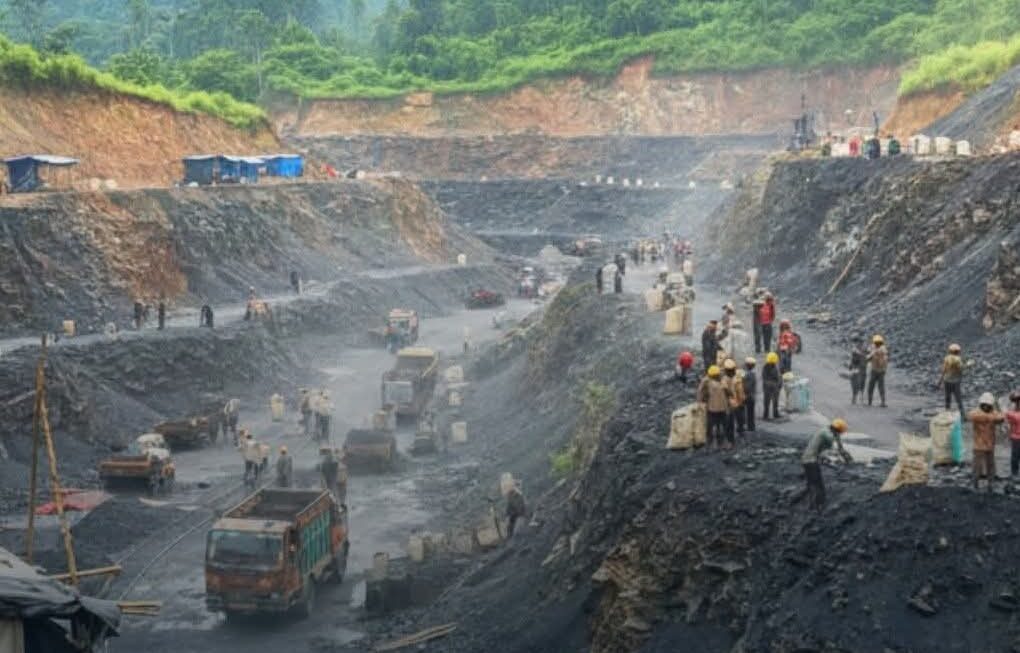
Meghalaya saw one of its worst mining disasters when a dynamite explosion took place in an illegal rat hole mine in Thangkso area of East Jaintia Hills district on the morning of February 5. The blast ignited a fire which trapped the miners working in adjacent pits. As of February 10, 30 bodies have been recovered while nine people were injured. While the identity of all the victims has not been confirmed yet, the district administration shared that the deceased miners were from Meghalaya, Assam and Nepal.
Reacting to the incident, Meghalaya Chief Minister Conrad Sangma, who also holds the mining portfolio, shared in a post on social media: “Profoundly saddened by the tragic coal mine incident in East Jaintia Hills. My deepest sympathies are with the families who have lost their loved ones in this unfortunate tragedy. The Government of Meghalaya has ordered a comprehensive inquiry into the incident. Accountability will be fixed, and those responsible will face strict legal action. There will be no compromise when it comes to the safety of lives.”
Sangma has ordered a judicial probe to look into the tragedy. He announced an ex gratia compensation of ₹200,000 (₹2 lakhs) for the families of the deceased while Assam Chief Minister Himanta Biswa Sarma announced ₹500,000 (₹5 lakhs) for victims from his state.
Demanding Sangma’s resignation from the position of mining minister, Sanjay Das, General Secretary, Meghalaya Pradesh Congress Committee told Mongabay-India, “We want the Chief Minister to step back from the position of Minister-in-Charge of Mines by accepting moral responsibility and allow an independent and impartial enquiry into the tragedy.”
Meanwhile, speaking to media, Union Minister for Coal and Mining, G. Kisan Reddy said, “There is no coal mine operated by the government of India in Meghalaya. Not even one block of coal mine has been auctioned till date. Illegal coal mines run by the mafia are operating there. We have written to the state government to stop these illegal mines.”
The National Green Tribunal (NGT) had imposed a ban on rat hole mining in Meghalaya in 2014, citing environmental damage and safety risks, also restricting illegal transportation of coal.
A disaster in the making
The recent mining accident took place in a mine in Mynsyngat, a village in the Thangkso area, which is around 22 kilometres from Khliehriat, the district headquarters of East Jaintia Hills.
Speaking to the media, Vikash Kumar, Superintendent of Police (SP), East Jaintia Hills said, “The search operation began on February 5 and currently National Disaster Response Force (NDRF), State Disaster Response Force and Special Rescue Team are present on the site. On February 5, we recovered 18 bodies from the mines, seven more on February 6 and two on February 7.”
Justice B.P. Katakey, a former Judge of the Gauhati High Court, who is part of the single-member committee appointed by the Meghalaya High Court in 2022 to probe illegal mining and transportation of coal in the state, and recommend measures, visited the site of the incident at Thangkso on February 5. Speaking to Mongabay-India, he said, “There were three adjacent mines but the blasting took place in only one. Interestingly, nothing happened in the pit where the dynamite was detonated but the miners working in the adjoining pits were engulfed by the fire as methane gas present in those pits were ignited by the blasts.”
Serial blasts have been reported from the illegal mines in Thangkso area since the last two months, which have resulted in casualties. Activist Agnes Kharsiing, who has been vocal against illegal mining in Meghalaya told Mongabay-India, “On December 23, 2025, there was a blast in Mynsyngat, Thangsko, which killed two people. On January 1, this year, a 34-year-old miner named Ashok Tamang was admitted in Civil Hospital, Shillong where he passed away from burn injuries. He was injured in a blast in a mine in the Umpleng area. On January 14, one person from Assam died in a blast in a mine in Thangsko. On December 12, 2025, there was a major fire at Lad Rymbai Dongwah market because of a blast in a nearby mine. I had written to the Central Bureau of Investigation seeking an Investigation in the matter. The letter was forwarded to the Meghalaya Chief Secretary.”
Katakey, who filed the 35th Interim Report, a status report on illegal coal mining in Meghalaya, in January this year, noted these incidents in the report and recommended actions for the district administration.
Now, following the incident on February 5, Justices Wanlura Diengdoh and Hamarsan Singh Thangkhiew of Meghalaya High Court summoned the Deputy Commissioner and SP of East Jaintia Hills and reprimanded them for failing to curb illegal mining in the district.
Following the summon, police arrested two owners of the illegal mines. The accused duo were produced before High Court on February 6 and have been sent to three days of police custody.

A hotbed of illegal mining
The recent incident is not the first time a mining disaster has taken place in the East Jaintia Hills. In 2018, 15 people were trapped in a flooded rat hole mine in the Ksan area of the district.
Justice Katakey told Mongabay-India that though illegal mining takes place in many districts of Meghalaya, it is most rampant in the East Jaintia Hills. “There are more than 22,000 illegal mine openings in the district and many of them are still active. Illegal mining never stopped in East Jaintia Hills,” he said.
Kharsiing said that the people in the district were mainly farmers but they were forced to give their land to the coal mafia. “In 2017, local people had told me how they were being terrorised by the mafia. In fact, back in 2007-08, coal barons used notorious hired killers to burn people’s houses and forcefully take their land,” she said.
She and her companion Anita Sangma have also been attacked by goons hired by the coal mafia in 2018 in the Sohshrieh area of East Jaintia Hills.
Commenting on why the mines in East Jaintia Hills see frequent accidents, Sarat Phukan who teaches Coal Geology at the Department of Geological Sciences at Gauhati University told Mongabay-India, “Coal seams in East Jaintia are thin, barely three to five feet which makes extraction difficult. East Jaintia Hills have the lowest deposit of coal but highest intensity of mines. The coal found here is highly acidic but they are in demand in the coke factories in Byrnihat along with cement plants and brick kilns in both Assam and Meghalaya. Earlier coal from East Jaintia was sent to states like Punjab and Haryana which stopped following the NGT ban on these mines,” he said.
Following the recent incident, on February 6 and 7, East Jaintia Hills administration conducted an enforcement drive against illegal coal mines in the district, seizing more than 6,900 metric tonnes of illegally mined coal. The drive also seized tools and equipment and dismantled hundreds of makeshift camps made for labourers. On February 8, they seized 176 metric tonnes of illegal coal from Rangad village in the district. They also seized a stockpile of 204 gelatin sticks, used as explosive cartridges for blasting rocks, which indicate both environmental violations and potential breaches of explosive regulations in the region.
A vicious cycle
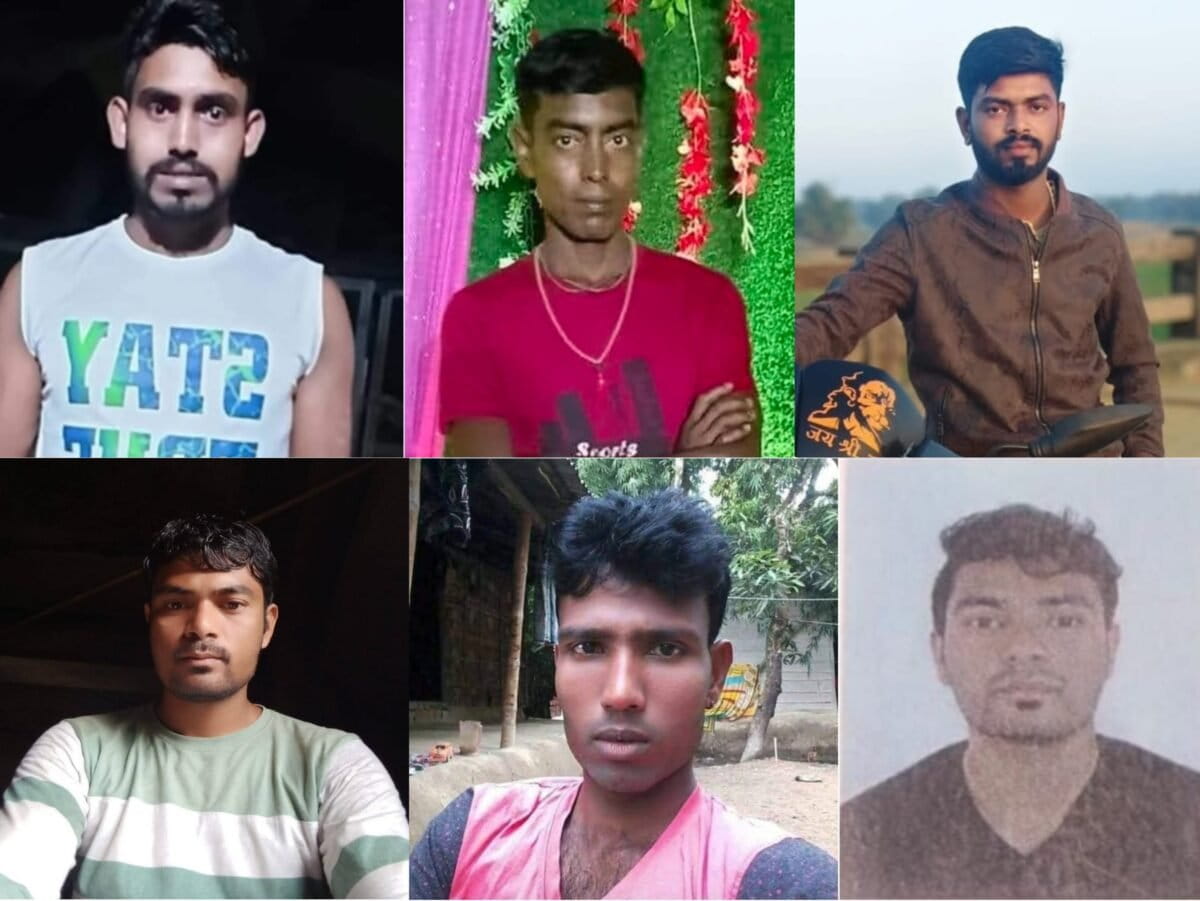
Among the 30 deceased, eight are from Katigorah, an assembly constituency in the Cachar district of the neighbouring state of Assam. They have been identified as Dilwar Hussain (37) and Anwar Hussain (36) from Sarishkari, Faruk Ahmed (32) from Bihara, Puranjay Baishnab (36), Nikunja Baishnab (29) and Krishna Baishnab of Gumra, Ramchandra Baishnab and Nimaruddin.
Iqbal Ahmed, who is the cousin of brothers Dilwar and Anwar told Mongabay-India, “We got a call from their fellow miners around 6.30 a.m. on February 5 about the accident. We left for the site that morning and reached there around 7 in the evening. Dilwar’s body had already been found and identified. However, we had to identify Anwar’s body from a heap of around 25 bodies. We heard that the mines went down almost 200-300 feet deep and there will be about minimum 30-40 bodies lying inside.”
“These two were working in the coal mines of Meghalaya for the past 15 years. Dilwar has two sons and two daughters while Anwar has one son and one daughter. All the six kids are below 10 years. They have an elder brother named Eklakh who drives an auto in Katigorah,” he said.
Sandip Das, a social worker from Katigorah who is also the General Secretary of Congress in Cachar said lack of employment opportunities in their area compels people to work in the illegal coal mines of Meghalaya. “About 70% of the families in Katigorah earn their bread from these illegal coal mines in Meghalaya. People from here go to work there mostly as miners and also as drivers. Katigorah is a perennially flooded area with a third of the area remaining under water for most of the year. This makes agriculture difficult. There are no other industries or businesses in this area. Earlier, people got work when the Cachar Paper Mill was active. But after it was shut down, that window [of work opportunity] also closed,” he told Mongabay-India.
As per information received from 24 Ghanta Nepal, a digital media platform in Nepal, two people from Nepal also died in the incident. They were identified as 27-year-old Purna Bahadur Khapangi Magar and his younger brother, 24-year-old Surendra Khapangi Magar. Apart from that Nar Bahadur Khapangi Magar, Bam Bahadur Khapangi Magar and Karna Bahadur Khapangi Magar were injured, with Nar Bahadur and Bam Bahadur’s condition said to be critical. Another mine worker Tarabar Magar only escaped unhurt and he informed the families back home. All these miners were from Barahapokhari, a rural municipality in the Khotang district in eastern Nepal who reached Meghalaya on December 18, last year.
Kharsiing said that the miners working in Meghalaya are mostly hired from outside the state by recruiters known as sardars. “The miners are made to work in absolutely deplorable conditions. They get around ₹800 for filling up one wooden cart with coal. In this way, they can earn more than ₹2,000 in a day which is big money for them considering most of them come from families below the poverty line.”
However, there is rampant human rights abuse in these mines with zero safety protocol being maintained, she argues. “As these are illegal mines, there is no register maintained which makes it impossible to know how many people go down the mine in a particular shift. What goes around there is nothing but human trafficking,” she said.
Read more: Miners trapped as a rat-hole coal mine floods
Banner image: The pit in Thangkso in East Jaintia Hills where the accident took place. NDRF personnel carrying out their operation. Image via NDRF.