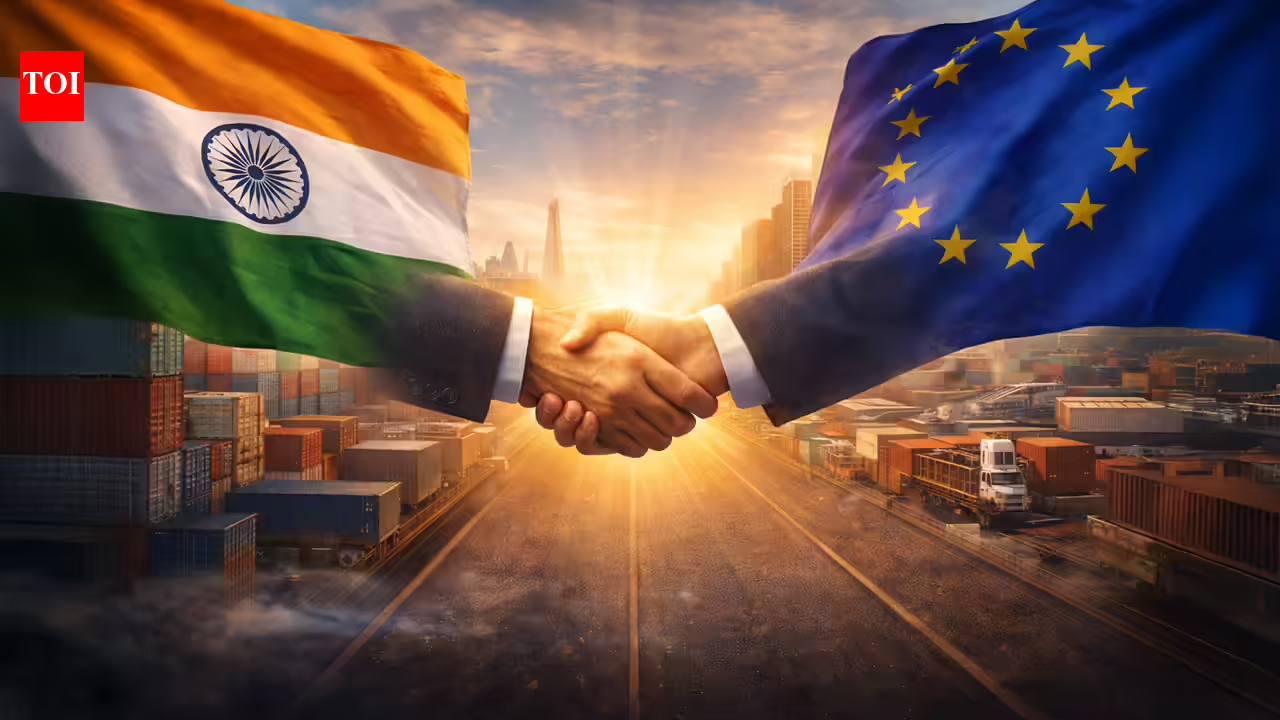
India-EU Free Trade Agreement (FTA), being hailed as the ‘mother of all trade deals’ was finalised on Tuesday, and after a legal framework is in place and the European Parliament passes it, the FTA will be signed. The EU as a bloc is India’s largest trading partner, while the US is the largest trading single country partner.The India-EU FTA comes at a time of heightened trade uncertainty due to tariff threats by US President Donald Trump. Negotiations stretched over nearly 18 years, largely due to the European Union’s firm stance on a range of so-called non-trade concerns. Momentum picked up more recently in the wake of the tariff-driven trade policies pursued by US President Donald Trump. The agreement is expected to provide a boost to exporters on both sides as they seek to diversify markets and reduce exposure to global trade volatility.Welcoming the conclusion of the pact, Prime Minister Narendra Modi said, “This is not just a trade agreement. It is a new blueprint for shared prosperity.”
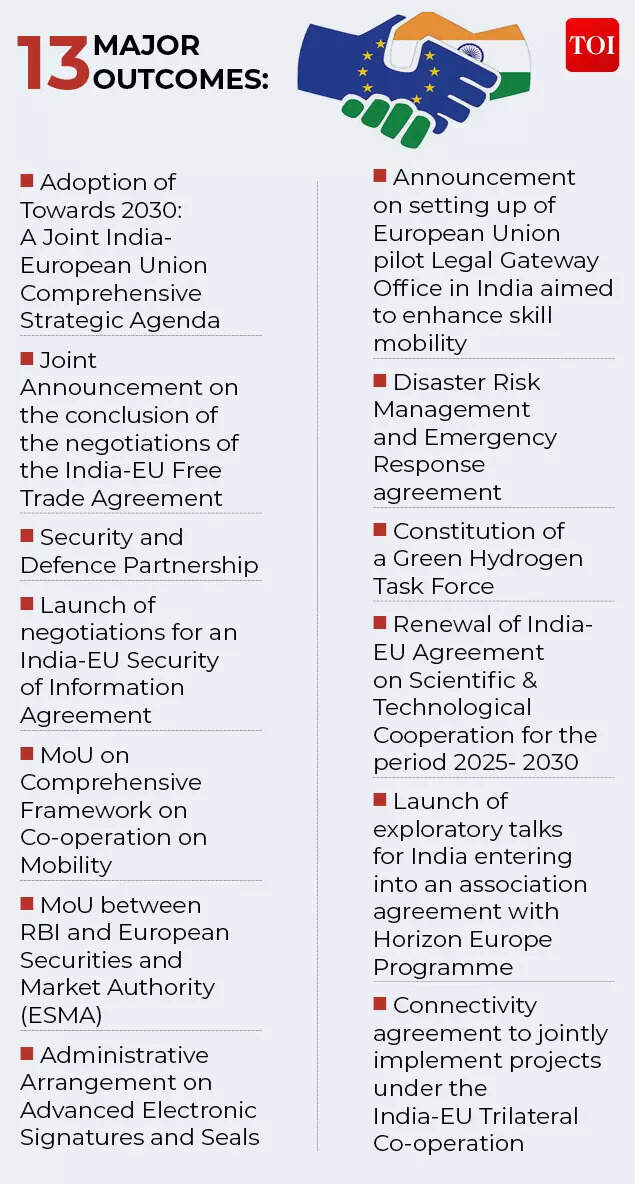
Major outcomes
“We have created a free trade zone of two billion people, with both sides set to benefit…We are not only making our economies stronger — we are also delivering security for our people in an increasingly insecure world,” European Commission President Ursula von der Leyen said.As India has wrapped up trade agreements with the UK, New Zealand and Oman, the European Union has pursued its own set of pacts with partners such as the Mercosur bloc in South America, Indonesia, Mexico and Switzerland. These agreements reflect a broader push by countries to diversify export markets and lower reliance on the United States, which many now regard as an increasingly unpredictable trade partner.
India-EU FTA: Top Points & Charts
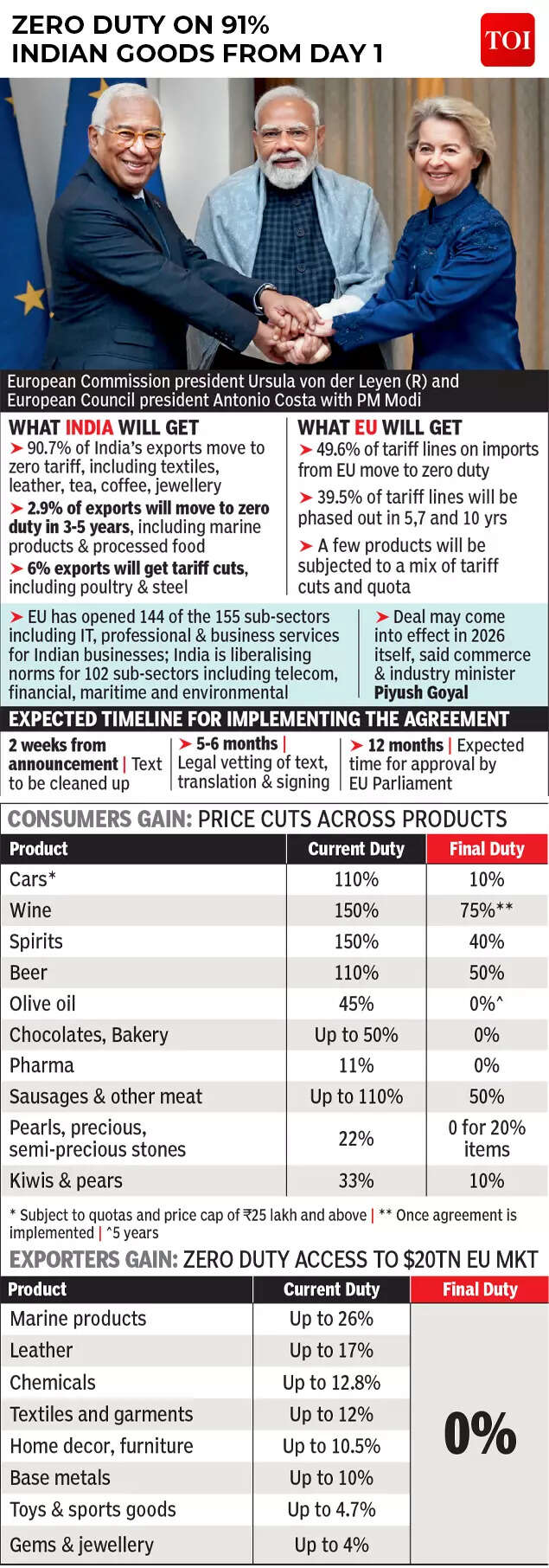
Under the FTA, tariffs will be progressively lowered on about 96% of exports in value terms, while sensitive sectors such as cereals and dairy products have been excluded from the pact.Under its terms, 99.5% of the EU market, measured by trade value, will be progressively opened over seven years, with 90.7% of goods shifting to zero tariffs from the outset.
Zero Duty
India, in turn, will liberalise 30% of its market once the agreement comes into force, followed by phased openings at three, five, seven and ten years, eventually removing duties on 96 per cent of goods by trade value. At the same time, the government has included safeguards that tie certain elements of liberalisation to social security agreements to be concluded with individual EU member states.
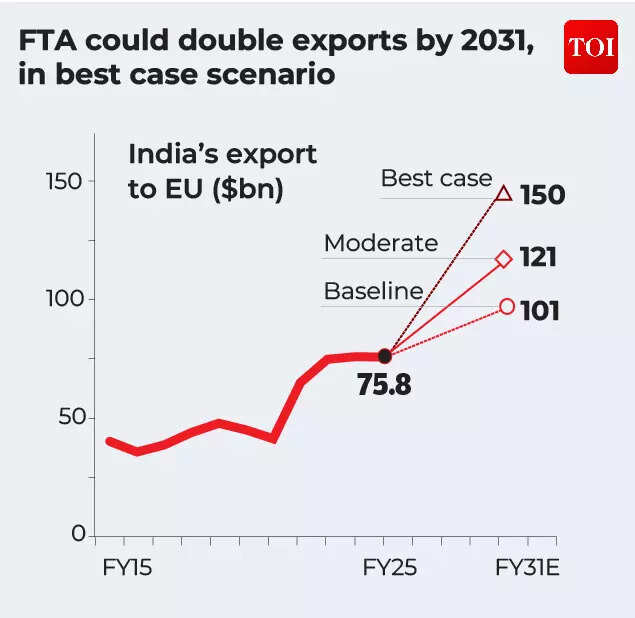
FTA could double exports
For Indian consumers, the FTA is set to translate into lower prices for products such as chocolates, olives, premium cars priced above Rs 25 lakh, as well as wine, vodka and beer. Cuts in duties on automobiles and wine, long-standing demands from the EU, will see car tariffs reduced from levels exceeding 100% to as low as 10%.These concessions will apply to a capped number of vehicles each year and will be rolled out gradually. “Small cars, the bulk of the market, have been protected,” an official said.
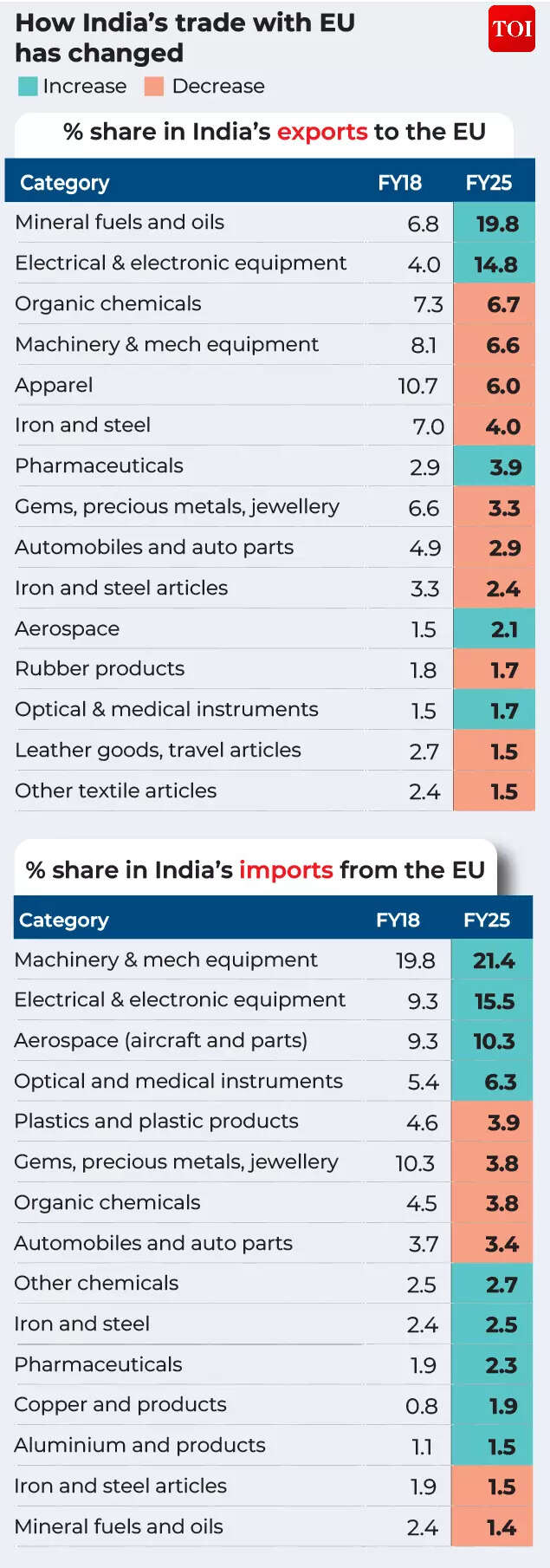
How India’s trade with EU has changed
Under the deal, Indian sectors such as textiles, marine products, leather and footwear, gems and jewellery, toys and sports goods will gain duty-free access to the EU market. This is expected to improve their competitiveness against rivals such as Bangladesh, which currently enjoys a 12% duty advantage in garments and textiles, and Vietnam, which benefits from preferential access in footwear, apparel and electronics under its own trade agreement with the EU.European firms will be able to set up manufacturing operations in India and ship their output overseas while benefiting from zero-duty access across a wide range of products, a move expected to give fresh momentum to the Make in India programme.
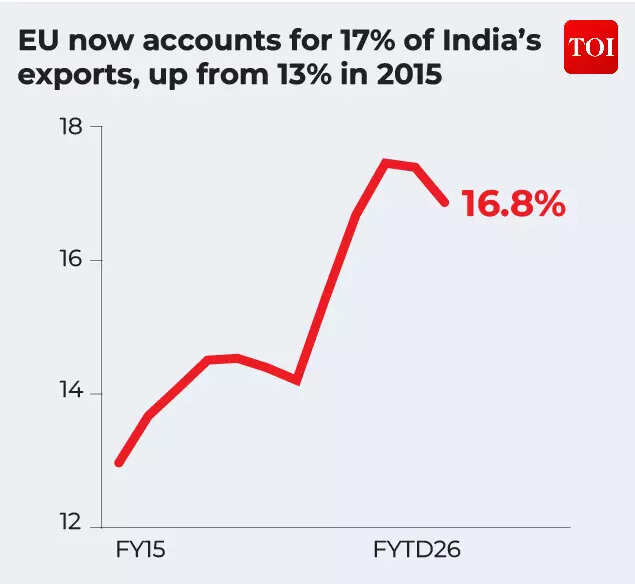
EU now accounts for 17% of India’s exports
The pact also provides visa relaxations for students, including opportunities for post-study employment. Spanning 21 chapters, the agreement also covers services, with the EU committing to open 144 of its 155 sub-sectors, while India will grant access in 104 sub-sectors. In addition, the treaty addresses areas such as intellectual property rights, labour and sustainable development, rules of origin, and provisions for small and medium enterprises, among others.
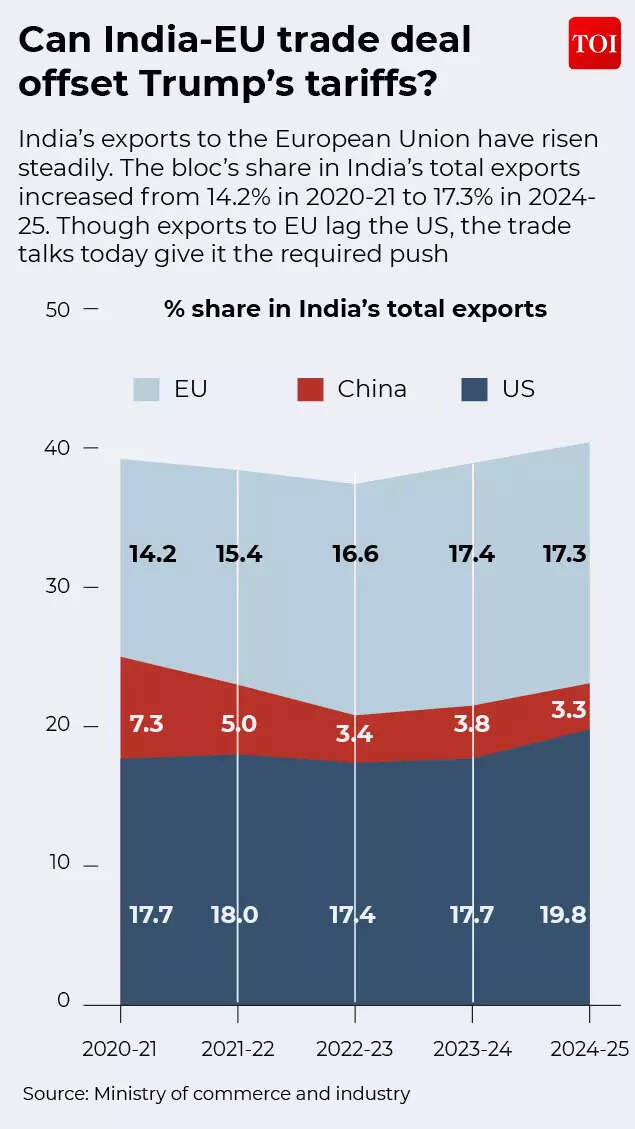
Can FTA offset Trump tariffs?