
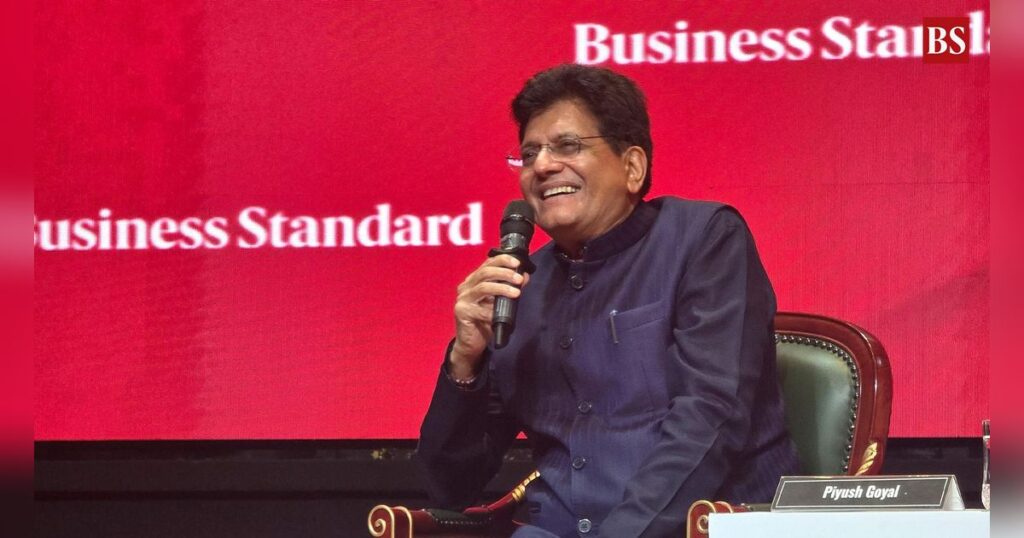
India may adopt a “calibrated” and “step-by-step” approach with respect to easing norms on investments originating from China, Commerce and Industry Minister Piyush Goyal said on Tuesday.
The minister emphasised that foreign direct investment (FDI) from China is certainly not “banned” and goes through an approval process. The government’s approach at the moment is to accelerate the approval process.
“We will see what really needs to be done in consultation with industry. It may be a calibrated response. It may be step by step. At the same time, we will certainly like to speed up the process. Ultimately, it’s not banned; it goes through an approval process. Our immediate effort is to speed up that approval process and make it easier for people to engage with technology and help expand our value chain engagement,” Goyal said at Day 1 of the two-day event — Business Standard Manthan.
Under the current FDI regulations, prior government approval is mandatory in the case of any investment proposals originating from a country that shares a land border with India — China, Bhutan, Nepal, Bangladesh, Pakistan, Afghanistan and Myanmar — and includes cases where the investor is from one of these countries.
Known as “Press Note 3”, India’s position was revised in April 2020 to curb “opportunistic takeovers/acquisitions” of domestic firms, considering their financial stress due to the Covid-19 pandemic. The move was mainly targeted at restricting investments from China amid border tensions.
“Ours is a listening government. We are always open to new ideas, and we are always open to change with evolving times. So we are in dialogue with industry to understand the difficulties they face, how we can make it easier for them to engage. Also, with our neighbouring countries where relationships have improved, we have an open mind to see how we can attract better technology, more investment from China also. We are in dialogue. And let us see — it will be an evolving situation, and we’re open to newer ideas,” the minister said.
FTAs
While finalising free trade agreements (FTAs) under the current administration, the government has ensured that it is able to protect the interests of farmers, fishermen, micro, small and medium enterprises (MSMEs) and startups.
Since 2021, India has signed and finalised FTAs with Mauritius, the United Arab Emirates (UAE), Australia, the European Free Trade Association (EFTA), the United Kingdom (UK), Oman, New Zealand, the European Union (EU) and the United States (US).
“I can assure you, only win-win outcomes from every FTA that we have done. Every trade deal that we have done is in the interests of India, protects our defensive interests… We ensure that we don’t compromise at all on anything that is not good for India, and yet open up opportunities for our business, our industry, our youth, our women entrepreneurs, our startups, our MSMEs, our fishermen, our farmers,” the minister said.
India has been able to double trade with Australia and the UAE since implementation. Many FTAs are in the process of coming into effect. EFTA came into effect on 1 October. “For the UK, we are expecting implementation sometime in April. For Oman, we are expecting sometime in April. For New Zealand, later part of this year. The EU FTA may need to complete processes a little longer in the EU by the end of this calendar year, so it may come into effect in the first quarter of next year,” he said.
As far as India’s FTA talks are concerned, the minister said that on Tuesday it was decided that India and the six-member Gulf Cooperation Council (GCC) nations will launch FTA negotiations and aim to conclude them in about a year.
The minister also held talks with his Chilean counterpart. “We will hopefully conclude a free trade agreement soon with Chile, and the critical element is critical minerals.”
QUALITY CONTROL ORDERS
The minister further said that over the last few years, quality control orders (QCOs) were largely being used by the government to inculcate quality and safeguard consumers’ interests. The government’s intention is not to stop any imports, but to ensure consumers receive superior-quality products.
Goyal further said that the Bureau of Indian Standards (BIS) had been making standards for many years and they were voluntary in nature. The intention was that more and more people would move towards those standards and provide high-quality goods and services.
“Sadly, thanks to some of the steps taken by the previous government in terms of reducing our import duties very significantly in the 2007-08 to 2013-14 period, we had a huge influx of Chinese goods or substandard goods at very low prices coming into India during that period. In fact, I don’t know if you’re aware, the trade deficit with China alone — we heard this — the trade deficit with China alone grew between 2004 to 2014 by over 2,500 per cent. More than 25 times the trade deficit grew between 2004 and 2014,” he said.
“Once you get used to low-quality but low-price goods, it’s very difficult to reel people away. We kept increasing the import duty, but still they kept reducing the price and dumping those goods… I personally believe quality doesn’t come at a cost. Quality, in fact, comes at lower cost over a sustained period of time,” the minister said.