India and Oman signed a free trade agreement on Thursday (December 18, 2025), which will provide duty free access to 98% of India’s exports including textiles, agriculture and leather goods in Oman.
On the other hand, India will reduce tariffs on Omani products such as dates, marbles and petrochemical items.
The deal is expected to come into force from the first quarter of next calendar year. The pact is coming at a time when India is facing steep 50% tariffs in its largest export destination, the U.S.
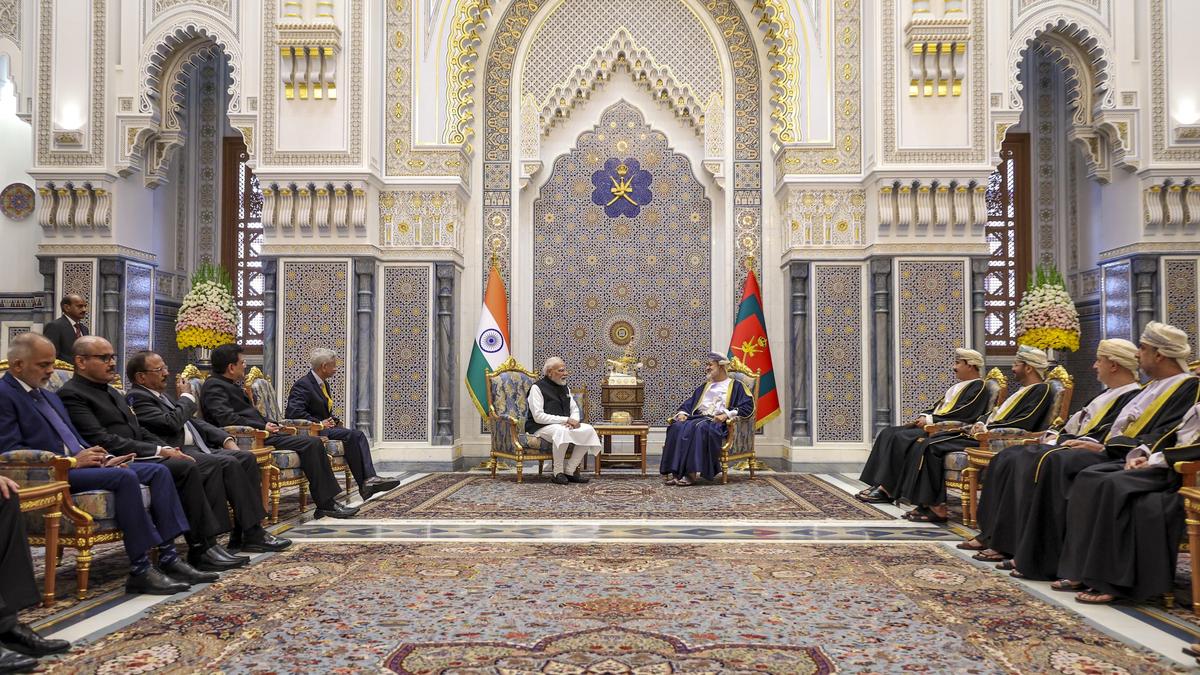
The agreement was signed by Commerce and Industry Minister Piyush Goyal and Oman’s Minister of Commerce, Industry and Investment Promotion Qais bin Mohammed Al Yousef in the presence of Prime Minister Narendra Modi in Muscat.
Oman has offered zero-duty access on over 98% of its tariff lines (or product categories), covering 99.38% of India’s exports to Oman.
All major labour-intensive sectors including gems and jewellery, textiles, leather, footwear, sports goods, plastics, furniture, agricultural products, engineering products, pharmaceuticals, medical devices, and automobiles receive full tariff elimination.
Out of these, immediate tariff elimination is being offered on 97.96% of product categories.
On the other hand, India is offering tariff liberalization on 77.79% of its total tariff lines (12,556) which covers 94.81% of India’s imports from Oman by value.

For the products of export interest to Oman and which are sensitive to India, the offer is mostly a tariff-rate quota (TRQ) based tariff liberalization for items such as dates, marbles and petrochemical products.
To safeguard its interest, sensitive products have been kept in the exclusion category by India without offering any concessions, especially agricultural products, including dairy, tea, coffee, rubber, and tobacco products; gold and silver bullion, jewellery; other labour-intensive products such as footwear, sports goods; and scrap of many base metals.
At present, the labour-intensive goods in Oman attract about 5% import duty.
On the services sector front, Oman will extend substantial commitments across a broad spectrum of sectors including computer related services, business and professional services, audio-visual services, research and development, education and health services.

Oman’s global services imports stood at $12.52 billion, with India’s share at only 5.31%. It shows a significant untapped potential for Indian service providers.
Further a major highlight of the CEPA is the enhanced mobility framework for Indian professionals.
For the first time, Oman has offered wide-ranging commitments under Mode 4 (movement of skilled professionals), including a notable increase in the quota for intra-corporate transferees from 20% to 50%, together with a longer permitted duration of stay for contractual service suppliers – extended from the existing 90 days to two years, with the possibility of a further two-year extension.
The agreement also provides for more liberal entry and stay conditions for skilled professionals in key sectors such as accountancy, taxation, architecture, medical and allied services, supporting deeper and more seamless professional engagement.

The pact also provides for 100% Foreign Direct Investment (FDI) by Indian companies in major services sectors in Oman through commercial presence, opening a wide avenue for India’s services industry to expand operations in the region.
In addition, both sides have agreed to hold future discussions on social security pact once Oman’s contributory social security system is implemented, reflecting a forward-looking approach to facilitating labour mobility and worker protection.
Oman is an important strategic partner in the region and is a key gateway for Indian goods and services to the wider Middle East and Africa.
Nearly seven lakh Indian nationals reside in Oman. India receives about $2 billion remittances from Oman annually.
Indian enterprises have built a strong presence in Oman, with over 6,000 Indian establishments operating across sectors. India has received $615.54 million foreign direct investment from Oman during April 2000 and September 2025.
This is the second trade pact signed in the last six months after the U.K. and is a part of strategy to sign trade agreements with developed economies that are not competing with our labour-intensive interests and provide opportunities for Indian businesses.
This is also the second trade deal of India with a GCC (Gulf Cooperation Council) member. India in May 2022 implemented a similar pact with the UAE and it is expected to soon start talks with Qatar. The other members of the council are Bahrain, Kuwait, and Saudi Arabia.
Talks for the free trade agreement, officially termed as CEPA (Comprehensive Economic Partnership Agreement), formally began in November 2023 and the negotiations concluded this year.
In free trade agreements, the two trading partners either significantly reduce or eliminate customs duties on a maximum number of goods traded between them. They also ease norms to promote trade in services and attract investments.
This is the first bilateral agreement that Oman has signed with any country since U.S. in 2006. Oman is the third-largest export destination for India among the GCC countries.
India-Oman bilateral trade was about $10.5 billion (exports $4 billion and imports $6.54 billion) in 2024-25.
Published – December 18, 2025 04:45 pm IST