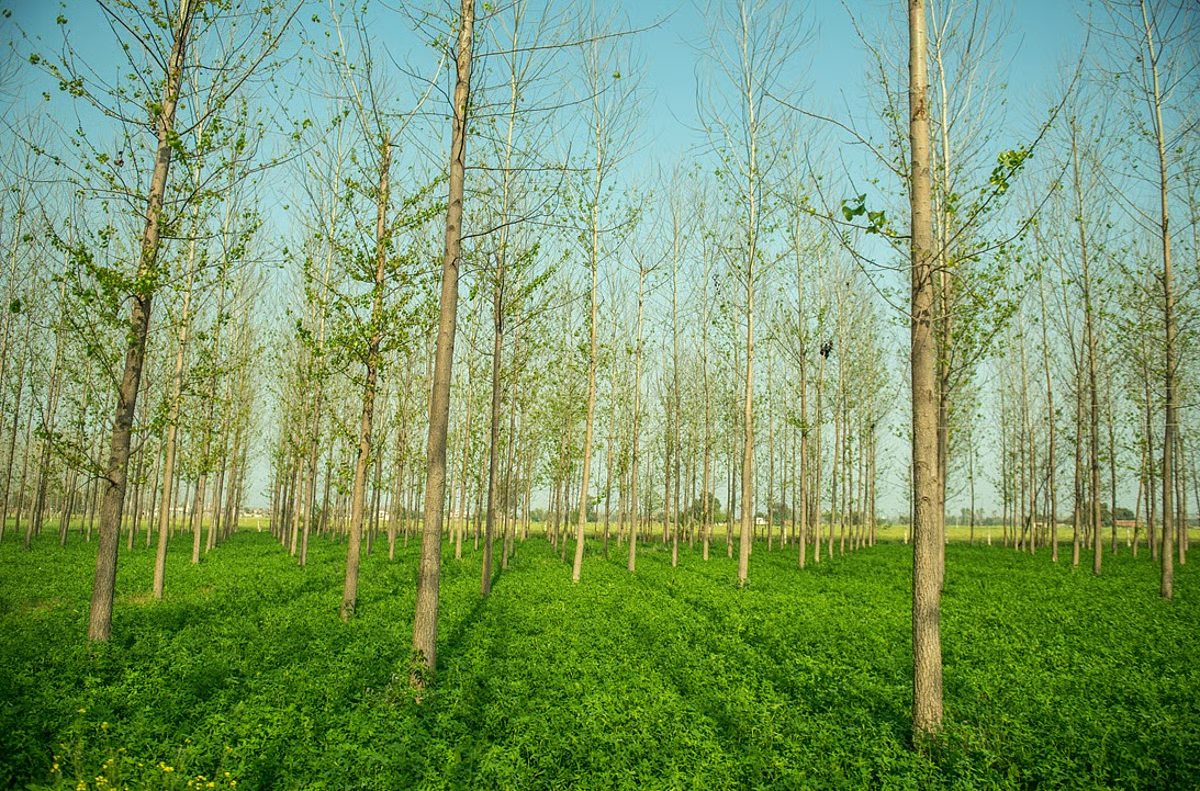
India currently has nearly 28 million hectares of land under agroforestry, and the government has set an ambitious target to expand this to 50 million hectares by 2050. However, despite its growing importance, the sector continues to face major structural constraints, particularly in accessing finance, experts gathered for the first South Asian Agroforestry & Trees Outside Forests (AF-TOF) Congress, noted.
Of the nearly Rs 20 lakh crore in institutional agricultural credit available annually, less than five per cent is directed towards agroforestry, largely due to tenure complexities, collateral limitations, and long gestation periods that can range from five to 30 years.
At the same time, limited awareness among farmers about India’s National Agroforestry Policy 2014, particularly regarding harvesting rights and regulatory clearances — continued to restrict wider adoption and income generation.
Agroforestry — the integration of trees with crops and livestock — which sits at the intersection of agriculture, forestry, climate action, and rural livelihoods and is critical for food security and land degradation. But experts noted that the sector remained under-supported in policy implementation and institutional financing, limiting its scale and impact.
Despite India’s tree systems holding nearly 20 per cent of national carbon stocks, the country continues to import over $7 billion worth of wood annually, exposing a major missed opportunity for farmers and the green economy, according to Manoj Dabas, India Country Director, Centre for International Forestry Research and World Agroforestry (CIFOR-ICRAF).
The ‘Treescapes’ 2026 Congress was organised by CIFOR-ICRAF, in collaboration with the Indian Council of Agricultural Research (ICAR). The two-day Congress brought together policymakers, senior government officials, researchers, industry leaders, financial institutions, civil society organisations, farmers, and youth from across South Asian countries including India, Nepal, Maldives, and Sri Lanka, with discussions focussing on strengthening policy and regulatory frameworks and leveraging agroforestry and Trees Outside Forests (TOF) for climate resilience and ecosystem services.
Dabas added that tree-based agriculture can reduce import dependence, strengthen rural incomes for India’s 86 per cent marginal farmers, and deliver measurable climate outcomes and that the next phase of growth will depend on aligning carbon markets, digital traceability, and private-sector procurement with farmer realities.
Meanwhile, M L Jat, Director General, ICAR, said recent regional studies show that agroforestry has helped reduce deforestation and avoid tens of millions of tonnes of greenhouse gas emissions annually while supporting rural livelihoods.