- India first confirmed Rugose Spiralling Whitefly, a pest that attacks coconut, banana, palm and other crops, in Tamil Nadu in 2016. A decade later farmers still report drastic yield declines due to the pest.
- Florida, where the pest was first recorded, has deregulated RSW after biological control using parasitoids.
- Indian farmers still experience collapsing incomes and repeated failures of extension advice, while climate change and lack of coordinated action act as key barriers in whitefly control.
Across India, farmers battling climate change, erratic rainfall, rising input costs, labour shortages and unstable markets now face another persistent threat: the rugose spiralling whitefly (RSW). An invasive sap-sucking insect, RSW (Aleurodicus rugioperculatus) attacks coconut, banana, palm and other crops, coating leaves with sticky honeydew that causes black sooty mold. This blocks photosynthesis, weakens plants and sharply reduces yields.
Since when RSW was first identified in Florida, U.S., where it was once a major concern, the pest has been brought under control and deregulated in the country – which means it is considered to no longer pose a significant risk, so shipments won’t be checked for it at ports.
In India, however, RSW continues to spread unchecked, driving severe yield losses and rising debt.
India’s coconut economy
Coconut is central to South India’s economy. In 2023–24, coconut was cultivated across nearly two million hectares in four southern states alone. Kerala led with 7.65 lakh hectares (0.77 million ha), followed by Karnataka with 5.64 lakh ha (0.56 million ha), Tamil Nadu with 4.93 lakh ha (0.49 million ha) and Andhra Pradesh with 1.07 lakh ha (0.11 million ha). Together, these states account for over 80% of India’s total coconut-growing area, according to Coconut Development Board data.
As extreme rainfall, drought cycles and heatwaves made paddy, sugarcane and banana risky, coconut became a drought-resilient refuge. India expanded coconut cultivation by 19% since 2000 and production by 69%. However, since 2016, the output has fallen over 10% and productivity has reduced by 14% according to Coconut Development Board data.
Farmers state that RSW is one of the reasons for the decline in output. They say that a ‘whitefly attack’ is no longer an occasional pest incident, but a year-round fear.
How Florida tackled the pest
Scientists traced RSW’s origin to the Caribbean and Central America. Florida’s climate initially enabled rapid spread, prompting close monitoring, but it did not originate in Florida.
In an email interaction with this correspondent, the United States Department of Agriculture noted that RSW is non-quarantined for the continental United States and quarantined for Hawaii and Puerto Rico. “In 2023, the U.S. Department of Agriculture’s Animal and Plant Health Inspection Service’s Plant Protection and Quarantine (PPQ) deregulated the insect through the Deregulation Evaluation of Established Pests (DEEP) review process. Pests deregulated under this process no longer require action at ports of entry if they are intercepted in imported shipments,” the response noted.
“The most effective long-term approach to managing rugose spiraling whitefly is biological control. This method has already proven successful in many areas, where the pest is no longer considered a persistent problem,” the official response added. The most commonly found parasitoid species that worked in whitefly control were Encarsia guadeloupae Viggiani and Encarsia noyesi.
The U.S. effectively managed the challenge within four years, unlike India, where a decade of interventions has failed to provide field-level relief.
India’s first detection of RSW
RSW was officially recorded in India only in 2016 at Pollachi, Coimbatore district of Tamil Nadu. But farmers insist the pest appeared years earlier. A.E. Srinivasan, 68, a B.Sc. Agriculture graduate and coconut farmer for nearly four decades, says, “I first saw whitefly symptoms in the early 2010s, long before 2016. Hybrid varieties suffer more. The leaves turn black, the tree weakens, and the yields collapse.”
He says that during the initial years, the pest was not treated as a serious threat. “At first, nobody saw this as a major pest or a large-scale problem. It was treated like a routine insect issue. There was no urgency or warning. By the time the government acknowledged it properly, it had already spread everywhere. Each state reacted slowly, and now it has become permanent.”

Srinivasan once harvested 200–300 nuts per hybrid tree annually, but now he gets 100–120. Traditional tall varieties that produced 90–120 nuts have dropped to 50–70. He says quality has also fallen. “Tender coconut loses shape, taste and water content. Customers avoid fruits that look affected. Government recommendations such as the usage of yellow sticky traps, neem spray, water jetting, and Encarsia release, are not working. I’ve used these for 10 years and there are no results. Nothing works in the field.”
To keep the trees alive, he supplements them with calcium nitrate, magnesium sulphate, NPK, silicon fertilisers, neem cake and organic manure.
An additional stress for farmers
Patteeswaran. A., 60, from Anaimalai near Pollachi, shifted to coconut cultivation after climate extremes wiped out the crops his family grew for generations. “For decades we farmed 20 acres of paddy, sugarcane and banana. But failed monsoons, sudden droughts, cloudbursts and years of water scarcity made all of them impossible,” he says. Forced by these climate impacts, he started cultivating hybrid coconut in 16.5 acres of land.
The whitefly issue, once mild, has now exploded. “In the monsoon, the sooty mold washes off and the trees breathe again. But in summer, whiteflies multiply uncontrollably. Yields crash and the financial loss is brutal.” What frustrates him most is the lack of support. “We left water-hungry crops because climate change gave us no choice. Now even coconut is collapsing. How are farmers supposed to survive?”
Despite living just 14 kilometres away from Tamil Nadu Agriculture University’s Coconut Research Station, he says no practical help has reached him. “Encarsia cards, sticky traps, water jetting… I followed all of it for seven years. Nothing worked… Sticky traps, neem oil, water sprays, rice-starch, nothing reduces the infestation,” he says.
He continues, “How long will we wait for a real solution? Every year our income shrinks.”
Across Tamil Nadu’s coconut belt, farmers also say that monocrotophos, a dangerous insecticide that is severely restricted, continues to circulate through illegal or informal markets, as repeated whitefly infestations leave them with few effective options. Monocrotophos is a highly toxic insecticide that disrupts the nervous system by inhibiting acetylcholinesterase, posing severe risks to humans, wildlife and beneficial insects. It is banned or severely restricted in many countries, including the U.S. and Australia, and its use in India is restricted due to risks of acute poisoning and ecological damage. Despite knowing the health hazards, some growers turn to it out of economic desperation, as recommended biocontrol measures fail at the field level.


A shrinking income
In the Eruthenpathy Panchayat of Kerala’s Palakkad district, the situation mirrors Tamil Nadu. For Saritha Muruganandam, who has worked on her family’s 10.5-acre coconut farm since childhood, the whitefly invasion has unfolded in complete administrative silence.
“For more than ten years of infestation, not a single agriculture official has visited our field. In Tamil Nadu, at least farmers get subsidy-based sticky traps or advisories. Here, we get nothing.”
With no guidance, Saritha and six neighbouring farmers turned to private pesticide agents claiming to have a whitefly solution. “We paid ₹4,400 per acre. They injected chemicals at the root zone and promised quick relief. Nothing changed. Later we learned it was a fake pesticide racket. We lost money, and the pest kept spreading.”
Another farmer, M. Kannappan, says he has never seen an agriculture official in his field. “I didn’t go to school; farming is all I know. Each palm once gave 90–110 nuts. After whitefly, it dropped to 45–55. Half our income is gone.”
Across Palakkad, severe infestation, collapsing yields and no meaningful state or central support despite a decade of damage, worries farmers.

A national challenge
This correspondent contacted the Tamil Nadu Agricultural University (TNAU) officials and the Aliyar Coconut Research Station for updates on whitefly control measures. Official responses were not received at the time of publishing this article.
Vinayak Hegde, Head of Crop Protection at ICAR–CPCRI (Indian Council of Agricultural Research-Central Plantation Crops Research Institute), Kasaragod, Kerala, spoke to Mongabay-India. “We first confirmed Rugose Spiralling Whitefly in Pollachi in 2016 after farmers reported unusually heavy infestation,” he says, adding that the pest may have entered India through imported plant samplings from Florida or nearby regions.
India’s initial response, he explains, followed Florida’s early strategies which include water jetting, yellow sticky traps, neem oil sprays, releasing the parasitoid Encarsia, and conserving natural predators. “These are entirely biocontrol measures. They work very well in the lab and in controlled conditions. But in India’s field conditions, RSW is extremely difficult to control.”
Climate change, he says, has intensified the crisis. “Over 20 years, rising temperatures have accelerated whitefly reproduction. We have recorded faster spread and higher population build-up.”

He also stresses that India’s plantation landscape is fundamentally different from the U.S. “Florida grows coconut sparsely as ornamental plants. Here, it is a livelihood. We grow 70 trees per acre. Such dense plantations make control far more challenging. We cannot compare India with Florida.”
Regarding the deployment of the parasitoids Encarsia to tackle the invasion of the whitefly, Hegde says that it can only be used as part of a coordinated, integrated management approach. He explained that Encarsia performs well under laboratory conditions and can also work in the field, but its effectiveness depends on simultaneous release by all farmers in a given area. Coordination, he adds, is the biggest barrier. “For whitefly control to work, every farmer in a region must adopt the same method at the same time. If even a few don’t, the pest returns. Achieving this synchronisation in India is extremely difficult.”
He also added that factors such as temperature, pest population density and the ability of Encarsia to establish and multiply in open field conditions significantly influence outcomes. “The lack of synchronised adoption across farming communities is one of the main reasons why Encarsia-based control has not delivered consistent field-level results in India so far.”
Srinivasan and a farming expert from a Chennai-based environmental NGO (on condition of anonymity due to institutional constraints) recommend that India urgently needs a national invasive pest alert system, district-level surveillance teams, mass production and accessible supply of biocontrol agents, climate-linked pest forecasting models, community-based synchronised integrated pest management (IPM) implementation, and stronger regulation to prevent fake pesticide markets. The same pest behaves very differently in two ecological and governance contexts.
According to Hegde however, RSW is now a national-scale problem, spreading from Kerala, Tamil Nadu and Karnataka to other states and now affecting banana, cocoa and more crops. “We have not recommended any insecticide so far. We are studying whether selective chemical options might help but need more evidence,” he says.
Citation:
Antonio W. Francis, Ian C. Stocks, Trevor R. Smith, Anthony J. Boughton, Catharine M. Mannion, and Lance S. Osborne “Host Plants and Natural Enemies of Rugose Spiraling Whitefly (Hemiptera: Aleyrodidae) in Florida,” Florida Entomologist 99(1), 150-153, (1 March 2016). https://doi.org/10.1653/024.099.0134
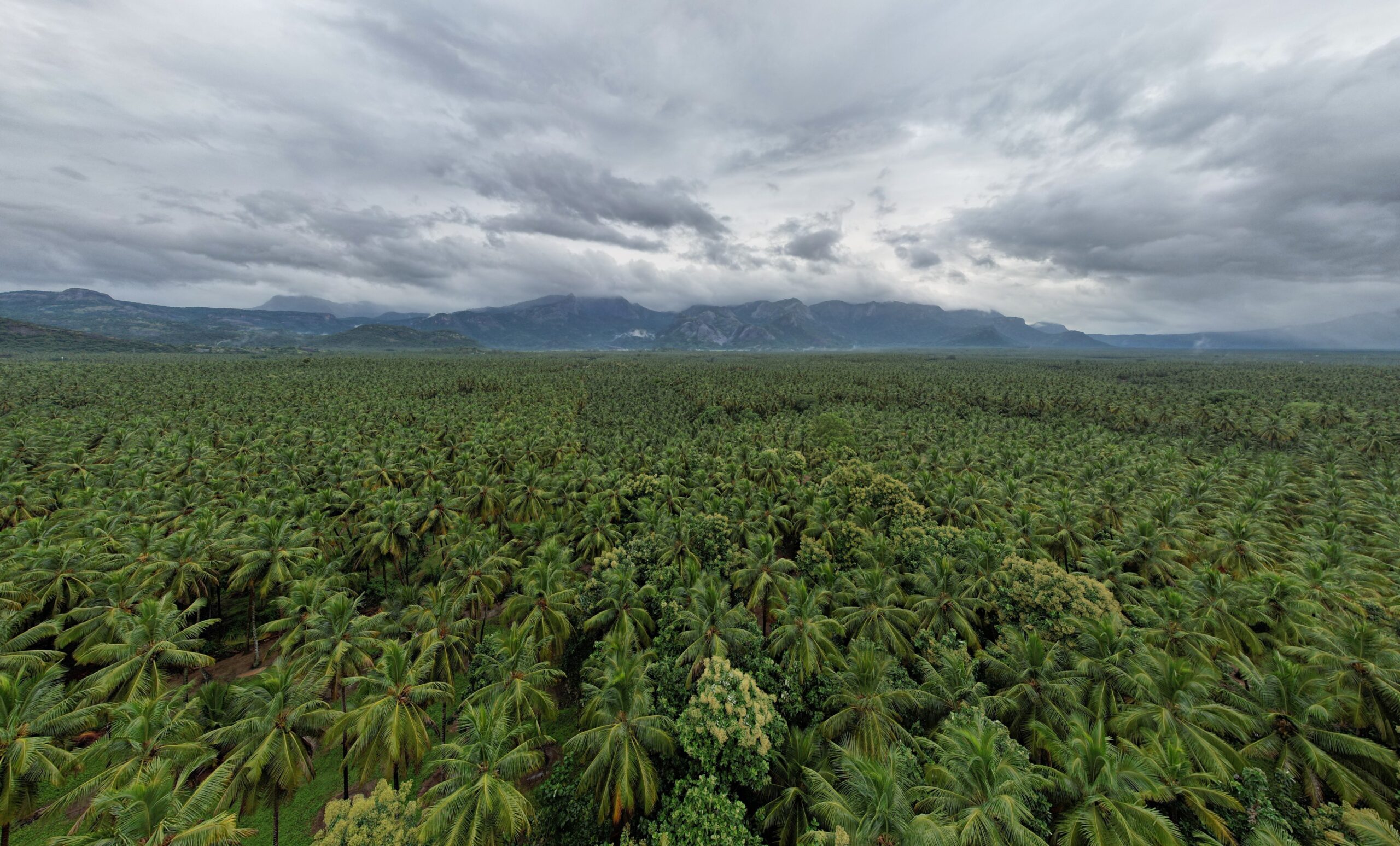
Banner image: Coconut trees under cultivation near Pollachi in Tamil Nadu’s Coimbatore district. India’s first confirmed case of Rugose Spiralling Whitefly attack on crops was reported in Pollachi in 2016. Image by Prasanth Shanmugasundaram.