- India’s latest budget allocates over ₹27 billion to fisheries but its focus on industrial growth overshadows the protection of natural ecosystems that sustain the country’s fish stocks.
- India is investing nearly 200 times more in extractive fisheries than in restoring the coastal ecosystems that protect the depleting fish population.
- The government’s expansionist approach risks eroding the ecological foundation of its ₹600 billion export industry and the livelihoods of people who depend on it.
- The views in this commentary are that of the author.
India’s 2025-26 budget positions the country as a global seafood market with more than ₹2,700 crores (₹27 billion) allocated to fisheries in the budget released earlier this year. The government also aims to double seafood exports from ₹600 billion to ₹1 trillion by 2029. The ambition is that deep-sea fishing vessels, tuna clusters in the Andaman Islands, pole-and-line tuna in Lakshadweep, seaweed farming, and women’s self-help groups will drive the idea of a sustainable blue economy and inclusive growth. But as we look through critical lenses, an important question that arises is whether mangroves, seagrass meadows, and coral reefs show up in it – and if the day-to-day budget decisions are keeping pace with what’s promised on paper.
At present, the imbalance is stark. The National Coastal Mission, which funds mangrove and wetland conservation across Indian coasts, received only ₹12.50 crores (₹125 million) in the 2023-24 budget, with Mangrove Initiative for Shoreline Habitats & Tangible Incomes (MISHTI), the flagship mangrove program launched on World Environment Day 2023, being fragmented into small, state-level allocations. Tamil Nadu, for instance, was given ₹2.20 crores (₹22 million) over six years for restoration at Pichavaram. So, the nearly ₹2,704 crores (₹27 billion) flowing toward fisheries expansion, mechanised vessel acquisition, and deep-sea fishing in “under-utilised” waters is a weird math. India is spending roughly 200 times more on extractive fishing than on protecting the ecosystems that produce them. Such spending reflects a profound imbalance in priorities.
Science supports the concern. The Central Marine Fisheries Research Institute (CMFRI) reported in 2022 that 4.4% of India’s fish stocks are already overfished and 8.2% are under immense pressure. These figures expose a northwest coast pushed to its limits, where 54.2% of fish stocks are already overfished. Nearly half of India’s mechanised fleet crowds these waters off Gujarat, Maharashtra, and Daman & Diu, and the trawlers haul up to 10 kilograms of juvenile bycatch for every kilogram of shrimp. Together, these patterns echo the same critical warning signs that preceded Canada’s cod collapse in 1992. The question is not whether India will overshoot, but whether the government sees it coming and is acting to prevent it.
The evidence suggests, it does not. At least not in ways that matter at the dock.
Consider Lakshadweep, long held up as a model of sustainable fishing, its pole-and-line tuna fishery produces 15% of India’s total tuna using an extremely selective method that costs less bycatch and causes minimal ecosystem impact. For decades, the Lakshadweep Fisheries Department supported this through fuel subsidies, vessel loans, and a co-management of systems that kept livelihoods secure and ecosystems stable. The focus was stability, fairness, and long-term viability.
But the new fisheries framework is set to shift this balance. Boats are upgrading from single-day to multi-day capacity. Greater storage means higher demand for baitfish, i.e., the small lagoon fish used to attract tuna. Fuel consumption also rises. The vision is that bigger boats will harvest exponentially more, but the whole equation overlooks whether our lagoon ecosystem is resilient enough to absorb this change, or how this will affect the livelihood of fishing communities when both fuel and baitfish grow scarce.
Early signs are troubling. Recent studies show total tuna catches in Lakshadweep are declining despite favourable growth trends. The islands’ economy is becoming more specialised, less diversified, and increasingly dependent on skipjack tuna. When that single target weakens — as warming seas, shifting currents, and regional fishing pressure suggest it will, the communities will have no fallback. The safety buffer that once came from a mix of fisheries and livelihoods will be gone. The policy response, therefore, should be defensive, i.e., focused towards reinforcing the lagoon’s baitfish stocks, investing in ecosystem monitoring, capping boat sizes and fishing days, and tying subsidies to conservation metrics rather than volume targets. Instead, the budget frame remains expansionist.
This is where mangroves, seagrass, and salt marshes become important. Mangroves in the Sundarbans, Gulf of Mannar, and Muthupettai support half of India’s fish breeding grounds. Seagrass meadows, which account for 516 square kilometres which are often missing from national accounts, store carbon 35 times faster than rainforests and support over 1,200 marine species, including olive ridley turtles. Salt marshes across 290 square kilometres filter estuaries and shelter juvenile fish. When these habitats erode, as they do at 1-2% a year presently, fish populations collapse. Recovery, if it happens, takes decades.

The budget should reflect this dependency. Funding for mangroves and seagrass should ring-fence in proportion to fisheries expansion, not as a charity gesture, but largely as a risk management strategy for a ₹60,000 crores (₹600 billion) export industry. Instead, mangrove restoration is scattered across three or four programs with sub-crore allocations, often contingent on state co-funding that cash-strapped administrations cannot easily unlock. The National Coastal Mission, for instance, the one closest to a blue carbon program, is still starved for funds. MISHTI, promising on paper, has faced slow uptake because states have to clear their own land, navigate the Mahatma Gandhi National Rural Employment Guarantee Act (MGNREGA) bureaucracy, and integrate multiple separate funding streams. Most barriers are bureaucratic, but they mean the same: that India has announced a blue-carbon framework while underfunding the mechanics of implementation.
Read more: [Explainer] What is blue carbon?
Three shifts could change this. First, we need to start integrating blue-carbon financing into blue economy budgets. Simply put, for every rupee allocated to fisheries expansion, a fixed floor of 15-20 paisa (₹0.15-0.20) should be assigned for restorative practices in the target region. Likewise, Lakshadweep’s deep-sea tuna growth should automatically trigger investment in baitfish and its habitat lagoons. In the case of Andaman, trawler licensing should fund reef protection in the same waters. On the ground, money flows exist; what is missing is the formula that binds extraction to regeneration.
Secondly, ecosystem health quotas must be mandatory for all extraction plans. Overfishing persists because fishing efforts continue to rise even as biomass declines. The fix is simple: if fish abundance in a zone falls by 10% (in a hypothetical situation), the following year’s fishing days or licenses should be reduced in the same proportion. This ties fisher income to ecosystem health, a core principle of stock assessment science already practised in places like Belize, where they have proved to be successful. India can do the same.
Thirdly, we must acknowledge that sustainable fishing and rapid industrial expansion cannot coexist on the same timeline. Lakshadweep’s pole-and-line fishery can grow modestly and sustainably if efforts are capped and baitfish stocks are protected. But if the goal is to double fleet sizes and harvest all in five years, the traditional method will disappear. That choice rests in the hands of the government to make explicitly, and not to bury behind contradictory budget signalling. Choose the priority: volume or sustainability, then fund accordingly.
India’s ocean future depends very largely on everyday governance. Significant progress has been made on maritime infrastructure, sustainable fisheries, and regional cooperation. But without realigning budgets to prioritise the ecosystems underpinning fisheries, and without firm commitments to enforceable ecosystem health indicators, the promises of a thriving blue economy will remain out of reach. Political will to balance short-term yields with long-term ocean stewardship is the missing piece. Until that balance is struck, India’s blue carbon blind spot will continue to put both livelihoods and marine biodiversity at risk.
Read more: What is blue economy? [Explainer]
Citation:
- Sathianandan, T. V, Mohamed, K. S., Kuriakose, S., & Zacharia, P. U. (2021). Status of Indian marine fish stocks: Modelling stock biomass dynamics in multigear fisheries. ICES Journal of Marine Science, 78(5), 1744–1757. https://doi.org/10.1093/icesjms/fsab074
- Angel One. (February 6, 2025). Union Budget 2025–26: A boost for India’s fisheries sector. https://www.angelone.in/news/economy/union-budget-2025-26-a-boost-for-indias-fisheries-sector
- Financial Express. (September 11, 2024). Government targets Rs 1 lakh crore in seafood exports by 2029, strengthens fishing sector with key initiatives. https://www.financialexpress.com/policy/economy-government-targets-rs-1-lakh-crore-in-seafood-exports-by-2029-strengthens-fishing-sector-with-key-initiatives-3608449/
- ForumIAS. (May 21, 2025). Overfishing and urban ecological resilience: Safeguarding India’s blue and green wealth. https://forumias.com/blog/overfishing-and-urban-ecological-resilience-safeguarding-indias-blue-and-green-wealth/
- Journal of Pharmacy and Pharmaceutical Sciences. (October 5, 2025). Revealing fifty years of mangrove disappearance and coastal threats in the Sundarbans through satellite-based vegetation mapping. https://jpharmsci.com/article/revealing-fifty-years-of-mangrove-disappearance-and-coastal-threats-in-the-sundarbans-through-satellite-based-vegetation-mapping
- Ministry of Fisheries, Animal Husbandry & Dairying. (January 31, 2025). Budget 2025–26 proposes a framework for sustainable harnessing of fisheries from EEZ and high seas [Press release]. Press Information Bureau. https://www.pib.gov.in/PressReleaseIframePage.aspx?PRID=2098615
- Mongabay-India. (June 16, 2025) Pole-and-line fishing face new challenges with push for tuna fish exports. https://india.mongabay.com/2025/06/pole-and-line-fishing-face-new-challenges-as-push-for-tuna-fish-exports-rise/
- Outlook Business. (June 11, 2025). Global overfishing pushes one-third of fish stocks toward collapse, India not spared. https://www.outlookbusiness.com/planet/climate/global-overfishing-fish-stock-collapse-india-impact
- The Wire Science. (February 2, 2023). Sitharaman announces push for mangrove conservation, but where are the funds? https://science.thewire.in/politics/government/sitharaman-mangrove-conservation-budget-2023-funds/
The author is a marine conservationist and an ocean-climate communicator. A fellow with The Asia Foundation, he’s the founder of Generation Artivism and President of ThinkOcean Society, leading ocean restoration, literacy, and policy advocacy efforts across six countries. His work spans artivism, High Seas (BBNJ) advocacy, MPAs and ocean education.
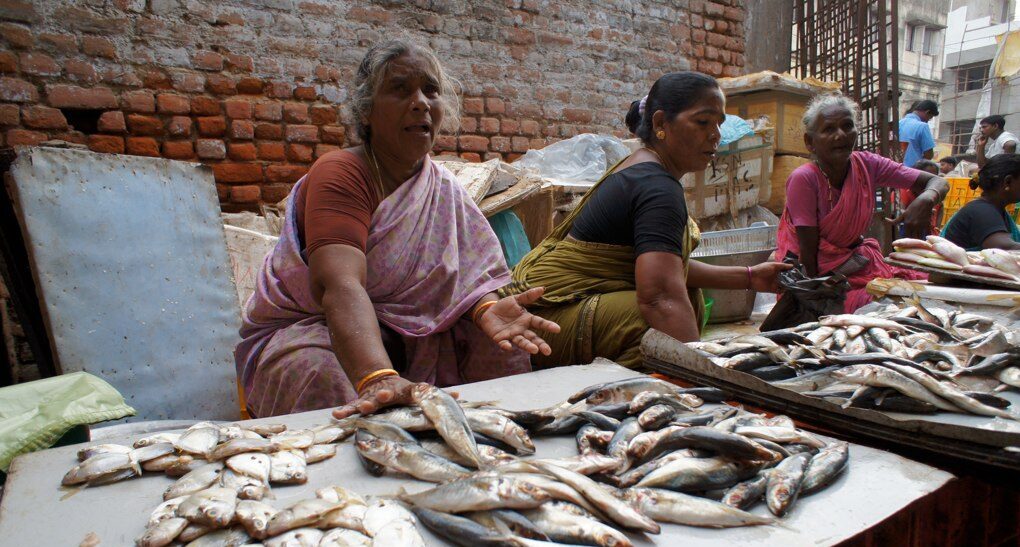
Banner image: Fish vendors at a market in Chennai, Tamil Nadu. Image by Rajesh Pamnani via Flickr (CC BY-NC-ND 2.0).