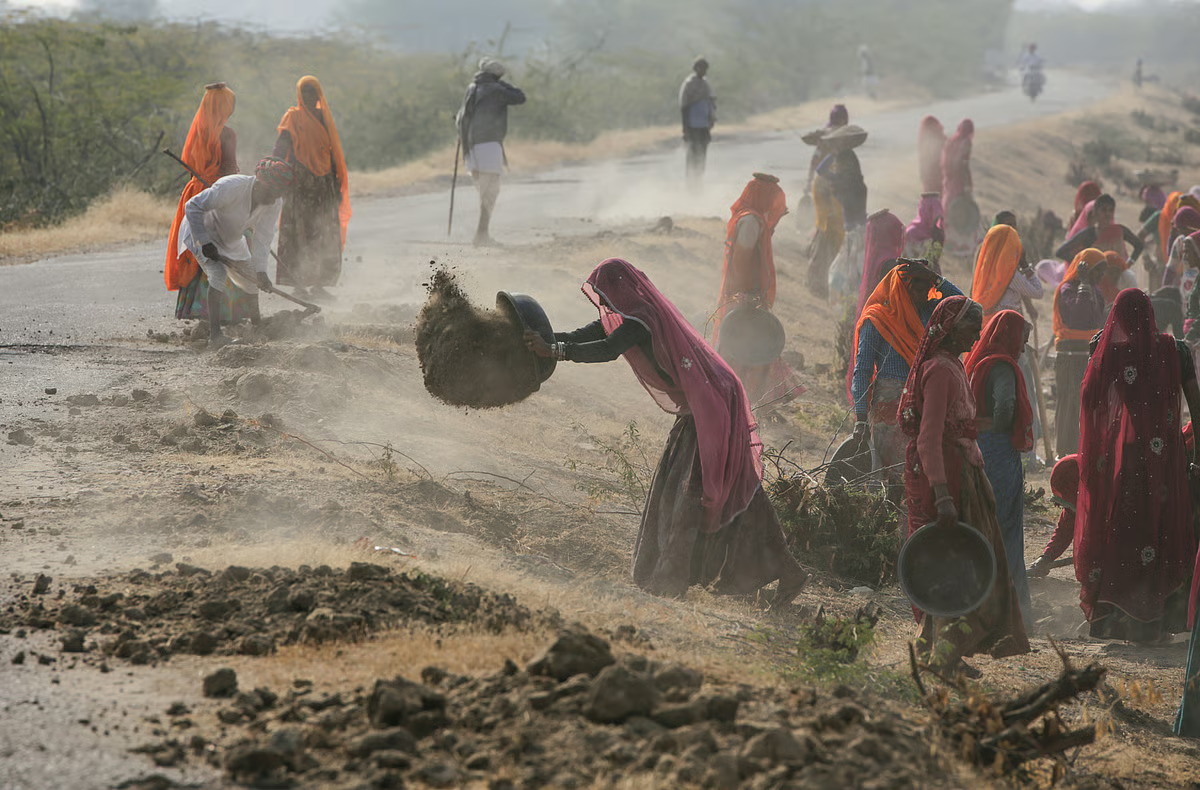
Beyond the change in name, the most visible shift from the Mahatma Gandhi National Rural Employment Guarantee Act (MGNREGA), 2005 to the Viksit Bharat-Guarantee for Rozgar and Ajeevika Mission (Gramin) Act, 2025 is the extension of guaranteed employment from 100 to 125 days. The statutory right to wage employment has been retained, and that continuity matters. However, the revision also presented an opportunity to confront long-standing implementation realities — especially those related to women’s work — which the new law largely leaves untouched.
Women are not peripheral to India’s employment guarantee programme. For over a decade, they have consistently contributed around 50-55 per cent of total person-days under MGNREGS, rising to nearly 58 per cent during the COVID-19 years. Few public employment programmes globally show such sustained participation by women. Yet, paradoxically, this numerical visibility has not translated into policy design that recognises women’s diverse work realities.
The problem lies in how women are perceived—largely as a single, undifferentiated category of workers. In reality, women’s participation varies sharply across life stages. Pregnant women, lactating mothers, and women caring for children below six years of age face very different constraints from older women or those without care responsibilities. Their needs relate not only to the availability of work, but also to timing, proximity, task intensity, and access to childcare support.
These differences have remained largely invisible because of a critical data gap. Despite being one of the world’s largest digital workfare systems, the MGNREGS dashboard has never captured age-disaggregated data for women workers. Women appear in official records only as “female”, not as young mothers, caregivers, or women in peak reproductive years. What cannot be seen cannot be planned for.
The 2025 Act repeats this blind spot. It reiterates that at least one-third of beneficiaries should be women, and that efforts should be made to include single women and persons with disabilities. These provisions reflect continuity with the 2005 Act, but they no longer match ground realities. When women already account for half the workforce, the question is no longer one of minimum inclusion, but whether the programme is designed for those women who face the highest participation costs.
This omission matters even more in the context of India’s broader growth ambitions. Women’s workforce participation in India remains among the lowest globally. Recent labour force surveys show female work participation rates hovering around 35–40 per cent, compared with over 75 per cent for men. Rural women participate more than their urban counterparts, but much of this work is informal, irregular, and constrained by unpaid care responsibilities.
Demographically, India has a large pool of potential women workers. A significant proportion fall within the 21-50 age group — the core productive years for both formal and informal work. Yet this is also the phase when childcare demands peak. Without policy design that responds to this reality, India risks underutilising one of its most important economic resources.
Employment guarantee programmes are uniquely placed to address this challenge because they offer work close to home. But proximity alone is not enough. Women with young children need flexible work arrangements, predictable timings, and reliable care support. One practical step would be to align work hours with the functioning of Anganwadi centres, including extending their timings to match the workday. Another would be to leverage the extensive self-help group (SHG) network under the National Rural Livelihoods Mission to provide neighbourhood-based childcare and support services. These are not new ideas; they build on existing institutional strengths.
India’s policy landscape also offers examples of how direct support to women can work. Cash transfer schemes such as the Ladli Behna Yojana in Madhya Pradesh, and similar initiatives elsewhere, have shown that modest, predictable transfers can enhance women’s agency. A small wage top-up for women workers with young children — explicitly recognised within the employment guarantee framework — could enable them to arrange trusted childcare through family members, neighbours, or SHGs. Such flexibility acknowledges care responsibilities without forcing women to choose between work and childcare.
The absence of disaggregated gender data also limits convergence. Employment guarantee schemes, women-and-child development programmes, and livelihoods missions often serve the same households, yet their data systems operate in silos. Integrating these systems would enable life-cycle-based planning, allowing local governments to design employment, care, and livelihood pathways together rather than as disconnected interventions.
The irony is that the 2025 Act speaks the language of Viksit Bharat — of empowerment, convergence, and inclusive growth — without putting in place the informational foundations needed to realise these goals for women. Centralisation may improve administrative efficiency, but without finer gender lenses it risks flattening complex realities on the ground.
India’s employment guarantee has always been more than a welfare programme. It reflects how the State understands work, care, and citizenship. As states frame the rules under the new Act, there is still time to course-correct — by collecting better data, recognising differentiated needs, and designing work around the lives women actually lead.
Viksit Bharat will not be achieved merely by adding more days of work. It will be achieved when policies learn to see women clearly — not as aggregates, but as workers whose productive potential depends on how seriously the care economy is addressed.
Yogesh Kumar is an economist and development practitioner. Views expressed are the author’s own and don’t necessarily reflect those of Down To Earth