- India’s new solid waste managed rules introduce four-way waste segregation, tighter responsibilities for bulk waste generators, higher landfill fees for mixed waste, and a centralised portal to track waste management.
- Decades of weak enforcement and poor segregation continue to send large volumes of mixed waste to landfills.
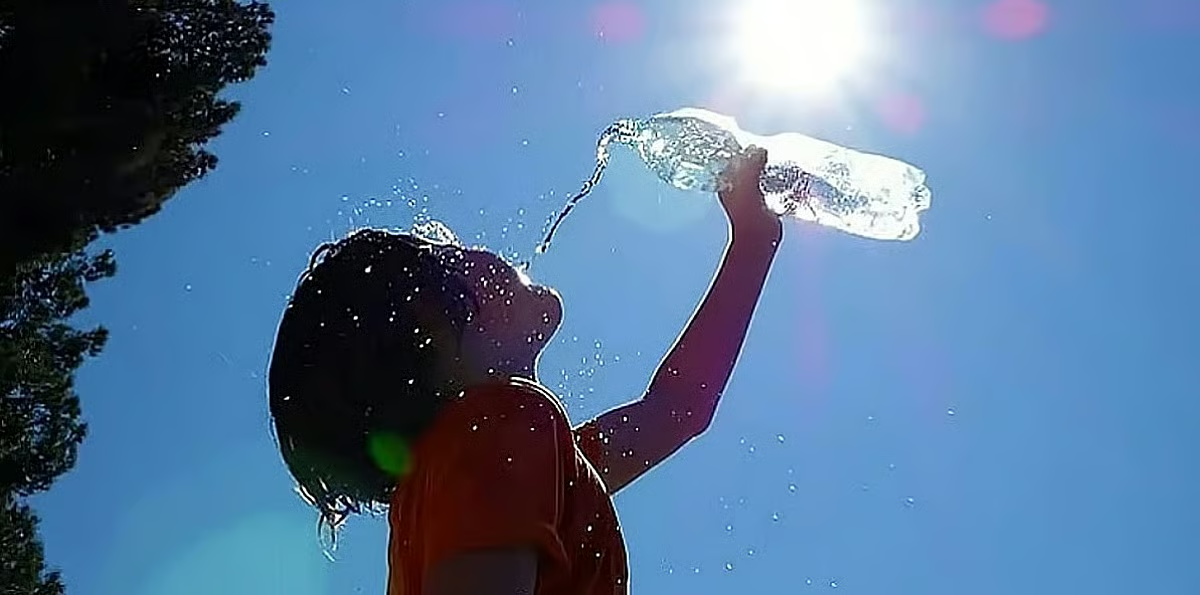
- Landfills and waste burning significantly worsen air pollution and climate impacts, contributing to particulate emissions, methane release and localised heat stress in cities like Delhi.
India’s environment ministry notified the new solid waste management (SWM) rules of 2026 on January 27, superseding the 2016 rules. The new rules signal a shift towards a more systematic compliance architecture, with a clearer outline of duties for waste generators, a revised definition of Bulk Waste Generators, and higher landfill user fees for mixed waste to encourage segregation.
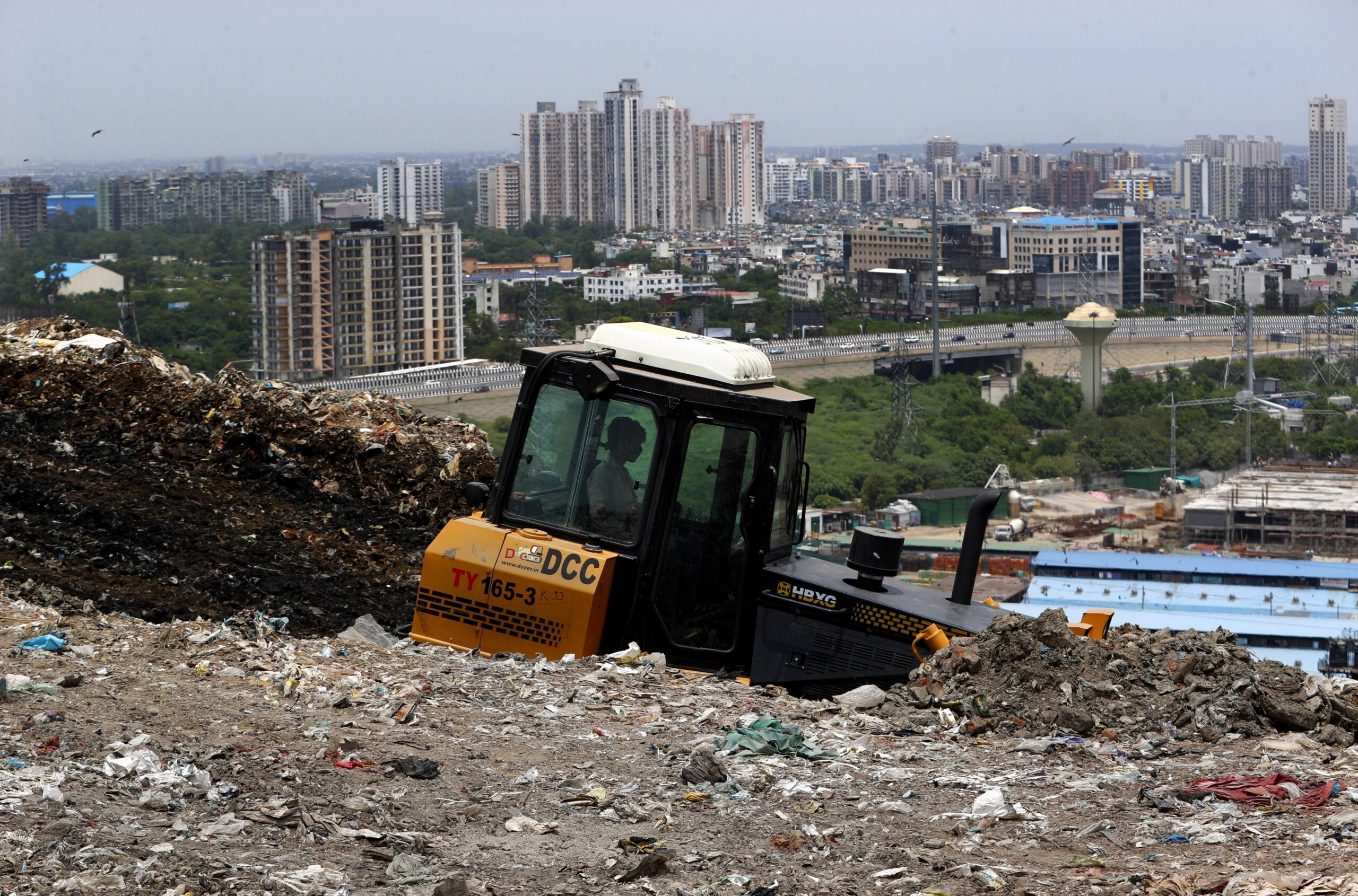
Well-intentioned as the new rules are, experts caution against gaps in implementation that have dogged solid waste management in India for decades. Illustrating this are the towering landfills in New Delhi — Bhalaswa, Ghazipur and Okhla — symbols of the city’s historical failure to segregate waste at source. Delhi leads all Indian cities, generating approximately 600 grams of waste per person per day. Nearly 64% of the collected waste is processed, according to the Central Pollution Control Bureau (CPCB), while the remaining 36% or. 4,241 tonnes, find its way to unsanitary landfills, or dumpsites everyday.
These landfills and dumpsites are silent contributors to air pollution through the year as well as to greenhouse gas emissions and heat stress during the summers. Biomass and waste burning are the second largest contributors to particulate matter emissions in Delhi, contributing 23% to PM10 and 24% to PM2.5, according to one source apportionment study. When biodegradable waste accumulates and is left to rot, it produces methane, which has a warming potential 80 times greater than that of carbon dioxide, over a 20-year-period, and is the second-largest contributor to global warming. According to another study, higher temperature zones within the Ghazipur landfill are widening and reaching the surface, which is unsuitable.
“There are not many provisions in the new rules that directly address air pollution or heat stress, despite the clear link between waste burning, emissions and air quality,” says Shrotik Bose, Research Associate, Solid Waste Management and Circular Economy, Centre for Science and Environment (CSE).
What the new solid waste management rules say
The new rules, which come into effect on April 1, mandate four-way segregation of waste, marking a shift away from the three-way segregation system, which divided waste into dry, wet, and domestic hazardous waste. Now, waste must be segregated into dry, wet, sanitary and special care waste, which includes medicines, paint cans, bulbs, and mercury thermometers, among others.
Extended Bulk Waste Generator Responsibility (EBWGR) is also introduced, to put a stricter focus on generators who produce more than 100 kg of waste or occupy more than 20,000 square meters of area, or consume more than 40,000 litres of water per day. Bulk waste generators make up 30% of total solid waste generation and must either treat wet waste on-site, or send it to an appropriate facility and obtain an EBWGR certificate as proof instead.
Restrictions on landfills are strengthened, with only non-recyclable, non-energy recoverable waste and inert material being allowed and higher landfill fees prescribed for local bodies sending unsegregated waste to sanitary landfills. Further, the rules mandate mapping and assessment of all legacy waste dumpsites and provide for time-bound biomining and bioremediation. These are microorganism-based technologies – the former extracts metals from the waste and the latter helps break down toxic contaminants.
“I think the 2026 rules have addressed several gaps from the 2016 framework. The move to four-way segregation is a step up — it shows higher ambition, and that’s always good to have. Overall, there is greater clarity now about who is responsible for what. The document has absorbed many lessons from the past decade. But ultimately, the real test will be implementation.” says Lakshmi P., Head of Impact, Cleanhub, an environmental technology company focused on plastic waste collection.
A centralised online portal is being developed to track all stages of solid waste management, including waste generation, collection, transportation, processing at Material Recovery Facilities (MRF), and disposal. Urban local bodies are central to these operations. According to Bose, whether the new framework and portal will improve the functioning of ULBs is unclear. “The real challenge lies in rewriting old agreements with waste processing facilities, registering them on the portal, and managing compliance at that scale,” he says.

Renewed faith in waste-to-energy plants
The new rules encourage circularity by restricting landfill dumping, but they still reinforce Waste-to-Energy (WtE) Plants as a permissible processing pathway for waste, despite longstanding concerns of their contribution to air pollution. An inspection by the CPCB in response to the National Green Tribunal found the Okhla WtE incinerator releasing dioxins and furans, highly toxic carcinogens at levels almost 900% above permissible limits.
“In India, waste really has calorific value only after proper segregation. But once you segregate, the recycling industry is strong enough to absorb most of that material. The truly non-recyclable fraction is actually very small — maybe 5 to 10 percent by weight. At the same time, Extended Producer Responsibility (EPR) and better product design are supposed to reduce non-recyclable plastics. So waste-to-energy, EPR, and recycling all end up attacking the same waste.” says Lakshmi.
She adds, “WtE plants need to run for many years to become economically viable, which creates pressure to keep feeding them waste — often mixed waste. These plants operate at relatively low temperatures, meaning toxins such as dioxins and heavy metals are not effectively broken down. When located within or near cities, this can pose significant environmental and public health risks.”
“It’s a common misconception that technology can fix this,” says Dr. Ruby Makhija, an opthamologist and founder of the Why Waste Wednesdays Foundation that has been working to scale a zero waste to landfills model across Delhi-NCR. “No matter how advanced or expensive the machinery, it will fail if waste is not segregated at source. Nearly 70% of effective waste management depends on segregation, but this is not treated as an investment priority.”
The new rules require WtE and cement plants to increase their Refuse Derived Fuel (RDF) sources from 5% to 15% over a period of six years. RDF has been defined in the new rules as “Fuel produced by shredding and dehydrating municipal solid waste with high calorific value, primarily consisting of non-recyclable plastic, paper and textiles.”

Integrating health into waste management
Despite mandates on paper, thousands of tonnes of mixed waste continue to reach landfills in Delhi due to weak enforcement, waiver of fines, and limited Resident Welfare Association (RWA) budgets. “In cities like Indore which have succeeded in mainstreaming segregation, it’s because the state itself was involved in going door to door and creating awareness. Non profits are treated like partners. With the Municipal Corporation of Delhi, NGOs are not seen as partners but as dispensable actors.” said Bharati Chaturvedi, founder and director of the Chintan Environmental Research and Action Group, a Delhi-based advocacy group working on circularity and waste.
According to Makhija, closing the environmental and health gap in waste management requires less reliance on technological fixes and more on restoring accountability in the system. “If a person is being asked to segregate waste at home and they do it properly, there must be assurance that the system beyond them is already in place. What happens too often is that if residents segregate, when the collector arrives and mixes everything again, all that effort goes to waste. That completely erodes trust. At the same time, Urban Local Bodies collect user fees for waste management — but how many residents actually pay them?”
The consequences of mounting mixed waste is tangible. An accidental fire in Bhalaswa landfill in 2022 led concentrations of PM2.5 to increase by 45–55%, while PM 10 rose by 40–50% in the vicinity. Toxic nitrogen oxides, carbon monoxide, and sulphur dioxide levels rose between 25 and 100% too, illustrating how waste burning can trigger abrupt localised air pollution that rivals some of the city’s worst smog events.
Until segregation and decentralised processing are backed by both institutional enforcement and individual responsibility, the fight against toxic air and rising heat will remain incomplete, says Makhija. “Waste does not disappear once it leaves the doorstep; it returns through the air people breathe, the water they drink, and the food grown in contaminated soil,” she says.
Banner image: Garbage being collected for segregation at the Ghazipur landfill in New Delhi. The Ghazipur landfill in New Delhi, within which a study reveals higher temperature zones are widening. (AP Photo/Manish Swarup)