
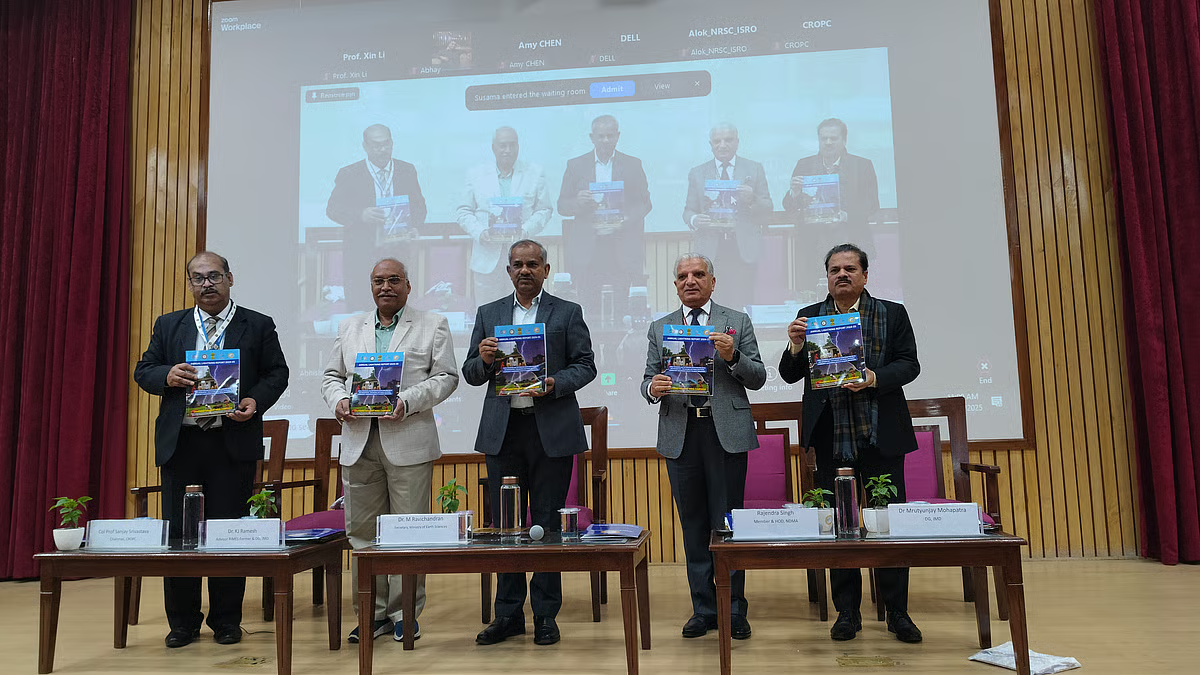
Lightning kills more people in India than any other natural disaster, yet remains an understated threat because it is a dispersed extreme weather event, experts said at a recent national conference in New Delhi.
India needs to significantly strengthen its ground-based instrument networks to detect lightning, establish high-voltage laboratories to test equipment, and expand public awareness programmes, according to speakers at the 9th National Lightning Conference held at Prithvi Bhavan in New Delhi on December 22, 2025.
In a rapidly warming world, the intensity and frequency of thunderstorms and the with them are increasing. Experts said the phenomenon needs to be better understood through more granular modelling of thunderstorms, which would also improve forecasting by capturing the growing generation of atmospheric electricity.
The conference saw the release of the Annual Lightning Report 2024–25, prepared by the Climate Resilient Observing Systems Promotion Council (CROPC) in collaboration with the India Meteorological Department (IMD) and the Union Ministry of Earth Sciences (MoES). A sharp rise in the frequency of lightning strikes across India was highlighted in the report, alongside a decline in deaths due to improved early warnings and increased community awareness.
Lightning data from the past six years show a 400 per cent increase in strikes between 2019 and 2025. The geography of lightning is also expanding, with new hotspots emerging in northern and western parts of the country.
“Contrary to earlier assumptions, the highest cloud-to-ground lightning strikes occur in eastern and central India, which corresponds to the highest casualty burden,” wrote Sanjay Srivastava, principal scientist at CROPC and convener of the National Lightning Resilient India Campaign, in the report.
A second key finding of the report is the rise of Rajasthan, Gujarat, Haryana, Punjab and Delhi as new lightning hotspots, marking a significant shift in vulnerability in desert and semi-arid climatic zones, Srivastava said. “A third notable pattern is the emergence of hotspots along the Kaimur and Satpura ranges, spanning regions between the Ganga and Sone river basins across Madhya Pradesh, Bihar and Uttar Pradesh,” he added.
Seasonal analysis by the IMD showed that lightning incidents covered a wider geographic area during the southwest monsoon than during the pre-monsoon season, according to a presentation by IMD scientist Trisanu Banik. Western and north-western regions experience more lightning during monsoon months, while the western peninsular region records higher activity during the pre-monsoon period.
Between 2014 and 2025, Madhya Pradesh recorded the highest number of lightning-related deaths, with 3,496 fatalities, followed by Bihar with 3,041 and Himachal Pradesh with 2,923, according to the report.
The study also carried out a district-level vulnerability analysis based on the number of lightning incidents, mortality rates, climate change indicators and socio-economic factors. It found high vulnerability in 207 districts, moderate vulnerability in 434 districts and low vulnerability in 132 districts. The analysis used data from lightning detection networks operated by the Indian Institute of Tropical Meteorology, Pune, and the National Remote Sensing Centre of the Indian Space Research Organisation.
The report noted a significant surge in atmospheric electricity. “As the atmospheric electricity or charge increases in clouds, their moisture-holding capacity rises substantially. There is a direct relationship between increases in extremely heavy rainfall or cloudbursts and lightning,” it said.
The authors also found that the geomorphology of certain regions, such as the rocky formations of the Western Ghats and the limestone hills of Uttarakhand, can attract higher levels of atmospheric electricity.
Experts said reductions in lightning deaths were already being achieved through early warning alerts issued by the IMD and the National Disaster Management Authority (NDMA), alongside on-the-ground awareness programmes run by the National Lightning Resilient India Campaign. Alerts are disseminated through the NDMA’s Sachet app and the IMD’s Mausam and Damini apps. However, speakers said further improvements were needed to reduce fatalities even more.
“A good early warning system for lightning should detect both the intensity of an event and the probability of it occurring. This is now being done through a multi-model ensemble developed for this purpose,” said Mrutyunjay Mohapatra, director general of the IMD.
If the electric field in a region of the atmosphere increases to around 100 volts per metre, there is a possibility of lightning reaching the ground, pointed out M Ravichandran, secretary of the MoES. “Measuring atmospheric electric fields can therefore provide much earlier warnings,” he said.
Calling for decentralised planning, K J Ramesh, former Director General of the IMD and adviser to the Regional Integrated Multi-Hazard Early Warning System, said: “We need district-specific lightning mitigation plans. I would also urge the ministry to establish laboratories for testing high-voltage lightning detection instruments.” He added that detecting surges of atmospheric electricity as high as 2.5 million amperes would require specialised atmospheric windmill-based instruments.
Without capacity-building at the community level, the development of early warning products for lightning detection is of little use, Mohapatra said, adding that detection capabilities in hilly and mountainous regions also needed to be strengthened.
“Early warning should lead to early action. The warning should be in a language that people understand with clear action guidelines. Community central mitigation of lightning is non-negotiable,” said Rajendra Singh, member and head of department of NDMA, at the conference.
Krishna S Vatsa, also a member of the NDMA, described lightning as a “dispersed disaster” that is difficult to mitigate without local-level interventions. “Technical capacity for lightning mitigation is very limited at the state level. Programmes need to function at the district and even Gram Panchayat levels,” he said, suggesting that wider areas could be covered using a minimal number of detection devices at the village level.