- India has announced its Nationally Determined Contributions for 2031–2035 under the Paris Agreement.
- India aims to cut emissions intensity, raise non-fossil power capacity and expand carbon sinks by 2035.
- Experts say the targets reflect progress but question whether they are ambitious enough given current trends.
India has announced its updated Nationally Determined Contribution (NDC) for the period 2031-2035, setting revised climate targets to reduce emissions intensity, increase non-fossil fuel-based electricity and increase forest and tree cover.
NDCs are voluntary national climate action plans by countries under the Paris Agreement. India’s updated targets include reducing the emissions intensity of GDP by 47% from 2005 levels by 2035, increasing the share of non-fossil fuel-based installed electricity capacity to 60%, and creating a carbon sink of 3.5 to 4.0 billion tonnes of CO₂ equivalent through forest and tree cover by 2035.
India’s original climate commitments, submitted in 2015 under its Nationally Determined Contributions (NDCs), set targets for 2030 to reduce the emissions intensity of GDP by 33-35% (emissions per unit of GDP) and achieve a 40% share of non-fossil fuel-based power capacity. In 2022, India updated its NDCs, raising the ambition to a 45% reduction in emissions intensity from 2005 levels and a 50% share of non-fossil energy capacity.
The union cabinet approved the targets on March 25 and are to be communicated to the United Nations Framework Convention on Climate Change (UNFCCC). The Railways and IT Minister Ashwini Vaishnaw said in a media briefing that the targets were approved in line with the five-year cycle under the Paris Agreement. “The current goals are for 2025 to 2030. Now the targets up to 2035 have been approved through this Cabinet decision,” he said.
The decision is aligned with India’s long-term goal of achieving net-zero emissions by 2070, according to the government.
Builds on early achievement
The government statement said the revised commitments build on earlier targets submitted in 2015 and updated in 2022, several of which have been achieved ahead of schedule.
India’s emissions intensity declined by 36% between 2005 and 2020. As of February 2026, non-fossil fuel-based sources account for 52.57% of installed electricity capacity. India has also created a carbon sink of about 2.3 billion tonnes of CO₂ equivalent through forest and tree cover by 2021, it said.
The updated NDC builds on what the government described as a track record of meeting key targets ahead of schedule, including achieving over 50% non-fossil power capacity nearly five years before the 2030 deadline.
Shruti Sharma, Lead, Affordable Energy, The International Institute for Sustainable Development (IISD), said the updated targets reflect continuity in India’s approach to its climate commitments. “India’s updated NDC signals continuity with a climate strategy that has remained steady and implementation-focused: lowering the emissions intensity of GDP, expanding non-fossil power capacity, and strengthening carbon sinks. India has a pragmatic approach to setting NDC targets: India tends to make commitments it is confident it can meet, and its track record shows that approach has delivered results.”
She added that this approach has contributed to consistent progress. “That approach has helped place India among a relatively small group of countries that have made consistent progress on their NDC commitments, including achieving targets ahead of schedule.”

Targets and policy framework
The government statement said that the targets have been developed through consultations led by NITI Aayog involving ministries, industry bodies, domain experts, and civil society, with inputs across sectors including energy, industry, transport, agriculture, water, and urban development.
However, several experts raised questions about the financial requirements and the overall ambition and clarity of the updated NDCs.
Suranjali Tandon, Associate Professor, National Institute for Public Finance and Policy, said, “The NDC sets the path for transition by targeting 60% non-fossil capacity while aligning with net zero by 2070. NITI Aayog estimates suggest India could reach 81–83% non-fossil capacity by 2050 under current policies. Meeting these targets will depend on scaling technologies in hard-to-abate sectors and mobilising finance, with an estimated $5.15 trillion required between 2025 and 2050, as multilateral funding alone will not be sufficient.”
Shantanu Srivastava, Research Lead, Sustainable Finance & Climate Risk, South Asia, Institute for Energy Economics and Financial Analysis (IEEFA), said clarity is still needed on how the targets translate across sectors. “It would be good to see how it aligns with the modelling studies published as part of the Viksit Bharat scenarios… A breakdown or alignment of the NDC into sectoral pathways… is still a missing piece.”
The government statement highlighted several initiatives related to energy infrastructure by saying, “India’s climate strategy is implemented through a series of measures including those on large-scale renewable energy expansion, battery storage systems, and green energy corridors, cleaner manufacturing, and ensuring reliable and sustainable infrastructure across the country.”
However, some analysts said the clean energy targets may understate the pace of change already underway. Lauri Myllyvirta, Lead Analyst and Co-Founder, Centre for Research on Energy and Clean Air, a non-profit think tank, said, “India’s new 2035 climate targets underestimate the country’s potential for transformative clean energy growth. Under current plans, the target of 60% clean power capacity will be achieved before 2030, rather than by 2035.”

Adaptation and resilience
The updated NDC includes measures on climate adaptation and disaster resilience. The statement said that, as climate change impacts are already being felt, India has placed strong emphasis on adaptation and disaster resilience across the key actors of its economy.
These include protecting vulnerable coastlines through mangrove restoration, early warning systems for cyclones and storm surges, glacier monitoring, biodiversity conservation, and climate-resilient infrastructure in regions facing risks such as landslides and glacial lake outburst floods.
“We have a goal to make infrastructure resilient, considering risks such as sudden rainfall and cloudbursts,” Vaishnaw said in a briefing to the media.
The plan also includes heat action plans and community-based disaster preparedness programmes.
Global context and mixed assessments
The updated NDC takes into account the outcomes of the Global Stocktake under the Paris Agreement and is guided by the principle of common but differentiated responsibilities and respective capabilities, notes the government statement.
The announcement comes amid global supply chain disruptions and energy security concerns linked to geopolitical developments.
Arunabha Ghosh, CEO, Council on Energy, Environment and Water (CEEW), said, “A targeted 60% share of non-fossil electricity capacity in 2035 suggests that while India has raised its ambition to decarbonise the power sector, it is also doubling down on energy security and affordability for hundreds of millions of its citizens.”
Anne-Sophie Cerisola, Distinguished Fellow, Strategic Perspectives & former Director, Climate Action Team, Executive Office of the United Nations Secretary-General, said India’s direction remains significant in the global context. “Whatever a country with 1.4 billion people does matters, and whatever one of the fastest-growing emerging economies in the world matters. India is shifting from a country addicted to coal to one with a fast-growing clean-tech sector – what matters is the direction and pace of travel, and on those metrics this plan represents progress.”
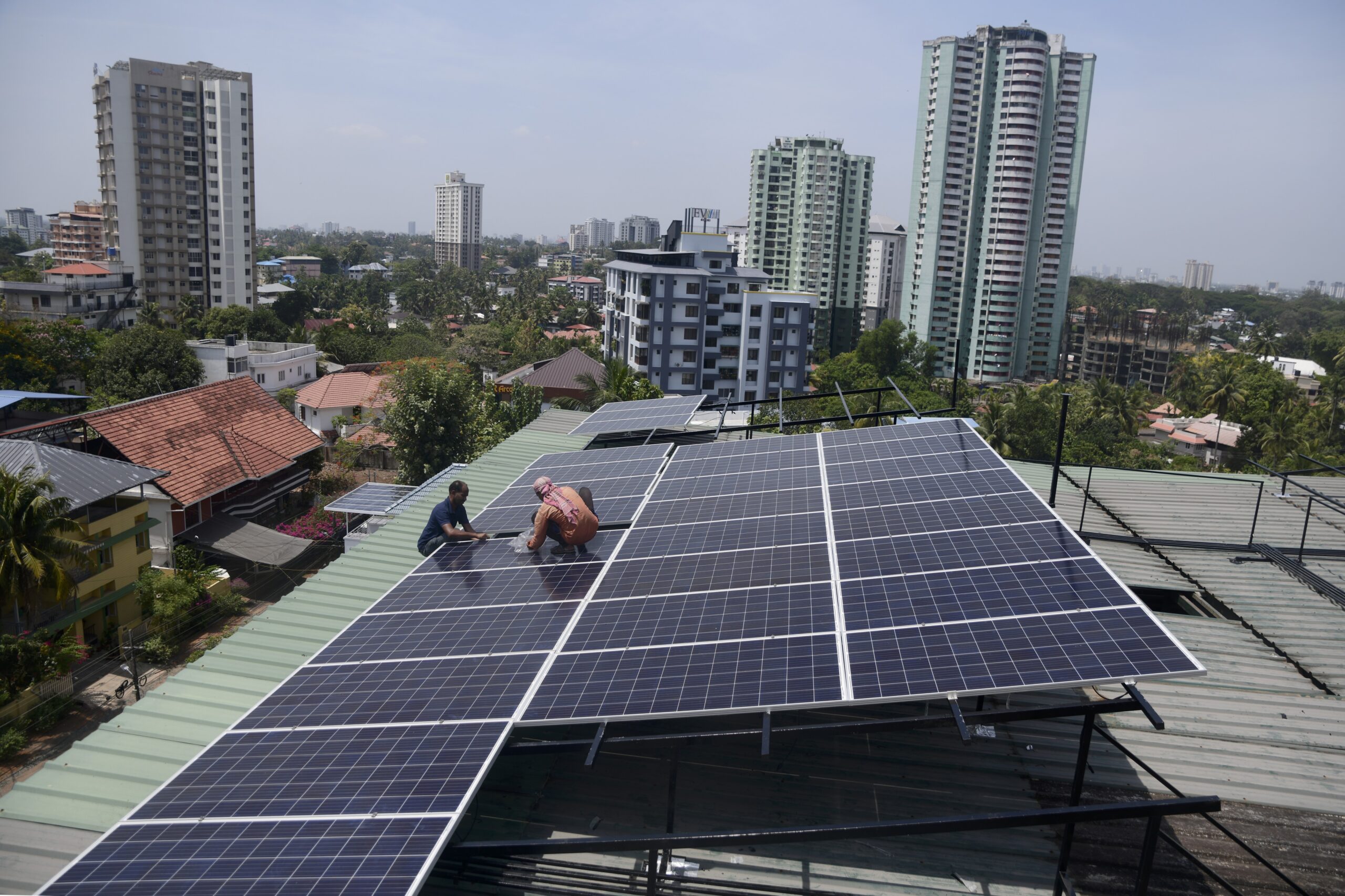
Banner image: Workers install solar panels on the roof of a residential apartment in Kochi, Kerala. (AP Photo/R S Iyer, File)