
Germany has entered one of the most controversial frontiers of modern defence research: the creation of bioelectronic insects for surveillance and reconnaissance. A German startup, SWARM Biotactics, has unveiled prototypes that combine living insects with neural interfaces, miniature sensors and AI-assisted control systems. The concept aims to turn insects into mobile intelligence platforms capable of operating in environments where conventional drones struggle. According to the company, development moved from concept to early field testing in roughly a year, reflecting the accelerating pace of military innovation. While the technology is still experimental, it highlights a broader shift in warfare toward systems that prioritise stealth, deniability and access over raw firepower.
What are Germany’s lab-made insects?
Bioelectronic insects, often described as biohybrid or cyborg insects, are living insects enhanced with electronic components rather than fully artificial machines. Engineers attach ultra-light modules that may include sensors, power units and communication chips, sometimes interfacing directly with the insect’s nervous system. The insect itself provides locomotion, balance and adaptability that robotics still struggles to replicate at such small scales. Unlike micro-drones, these systems rely on biology for movement, which reduces energy requirements and mechanical complexity.At the core of the system is a neural interface designed to stimulate or interpret signals from the insect’s nervous system. This allows limited influence over movement, such as steering or initiating flight. Sensors collect basic environmental data, while wireless transmitters relay information to operators. AI software plays a supporting role by analysing incoming data, coordinating multiple insects and assisting with navigation or task allocation. These insects are not independent decision-makers, and autonomy remains constrained, with humans retaining operational control.
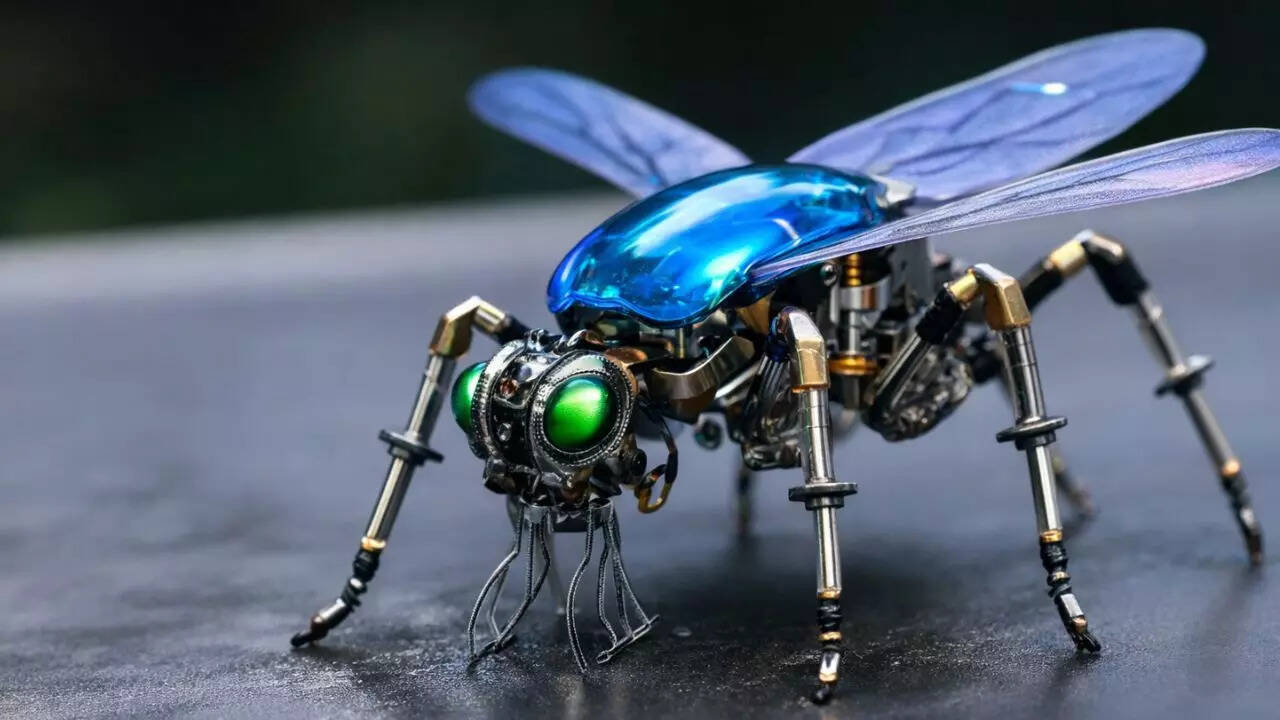
Representative Image
Why militaries see strategic value
Defence planners are drawn to bioelectronic insects because they offer capabilities that traditional drones cannot easily match. Their near-silent movement, natural appearance and ability to enter confined or cluttered spaces make them well suited for urban warfare, indoor reconnaissance and environments filled with debris. Insects can traverse rubble, ventilation systems and dense vegetation with minimal detection. From a military standpoint, this enables intelligence gathering while reducing visibility and escalation risks.
How does this compare with earlier research
The concept of insect-based surveillance has been explored for more than a decade. Academic institutions and defence agencies, including earlier programmes supported by the US Defence Advanced Research Projects Agency, have demonstrated neural control of insects in laboratory settings. What distinguishes the German effort is its emphasis on rapid prototyping, early field testing and potential deployment scenarios rather than purely experimental demonstrations. Even so, experts note that scaling such systems for consistent real-world use remains a significant challenge.Despite the promise, major uncertainties remain. Payload capacity is extremely limited, restricting the sophistication of onboard sensors. Environmental conditions such as temperature, humidity and predators can disrupt performance. Reliability outside controlled environments is still unclear, as are endurance, range and resistance to electronic interference. There is also no public evidence that these systems have been formally adopted by Germany’s armed forces.Using living organisms as tools of warfare raises ethical and legal questions that existing frameworks do not clearly address. Animal welfare concerns, accountability in covert surveillance and potential civilian misuse are all unresolved issues. As biohybrid systems advance, they are likely to face increased scrutiny from regulators, ethicists and civil liberties groups.
The signals about future warfare
Bioelectronic insects point to a broader shift toward smaller, quieter and more ambiguous military technologies. Rather than replacing drones or satellites, they could complement existing systems by filling intelligence gaps in hard-to-reach environments. Whether they evolve into operational tools or remain experimental, they demonstrate how advances in AI, neuroscience and materials science are pushing warfare into increasingly unconventional territory.