

In January 2020, KPMG executives gathered in Orlando for a ribbon-cutting ceremony at the Lakehouse, a sprawling, state-of-the-art learning and innovation center designed to be the firm’s cultural home. Just two months later, the world shuttered under the weight of a global pandemic.
While the timing appeared catastrophic—and many partners grumbled about how it was surely coming out of their compensation—the $450 million investment transformed into what leadership now describes as a strategic “accelerant” for the firm’s most ambitious pivot ever: the AI revolution. Today, Lakehouse is one of the firm’s major hubs for training a new generation of professionals to navigate a world where generative AI is no longer a peripheral tool but a core component of professional service.
Fortune was invited to sit in on a three-day session with 600 winter interns, chosen from a pool of 9,000 applicants, representing 146 schools, as the waves of talent from New Jersey to Utah to Texas celebrated leaving school by essentially going back to class again. Lakehouse had bits of flair located throughout, such as the KPMG-branded “GEN AI Invaders” arcade game, but the large, modern building feels like a blend of a state-of-the-art hotel, a KPMG office building and a learning center.
The Immersive Cultural Home
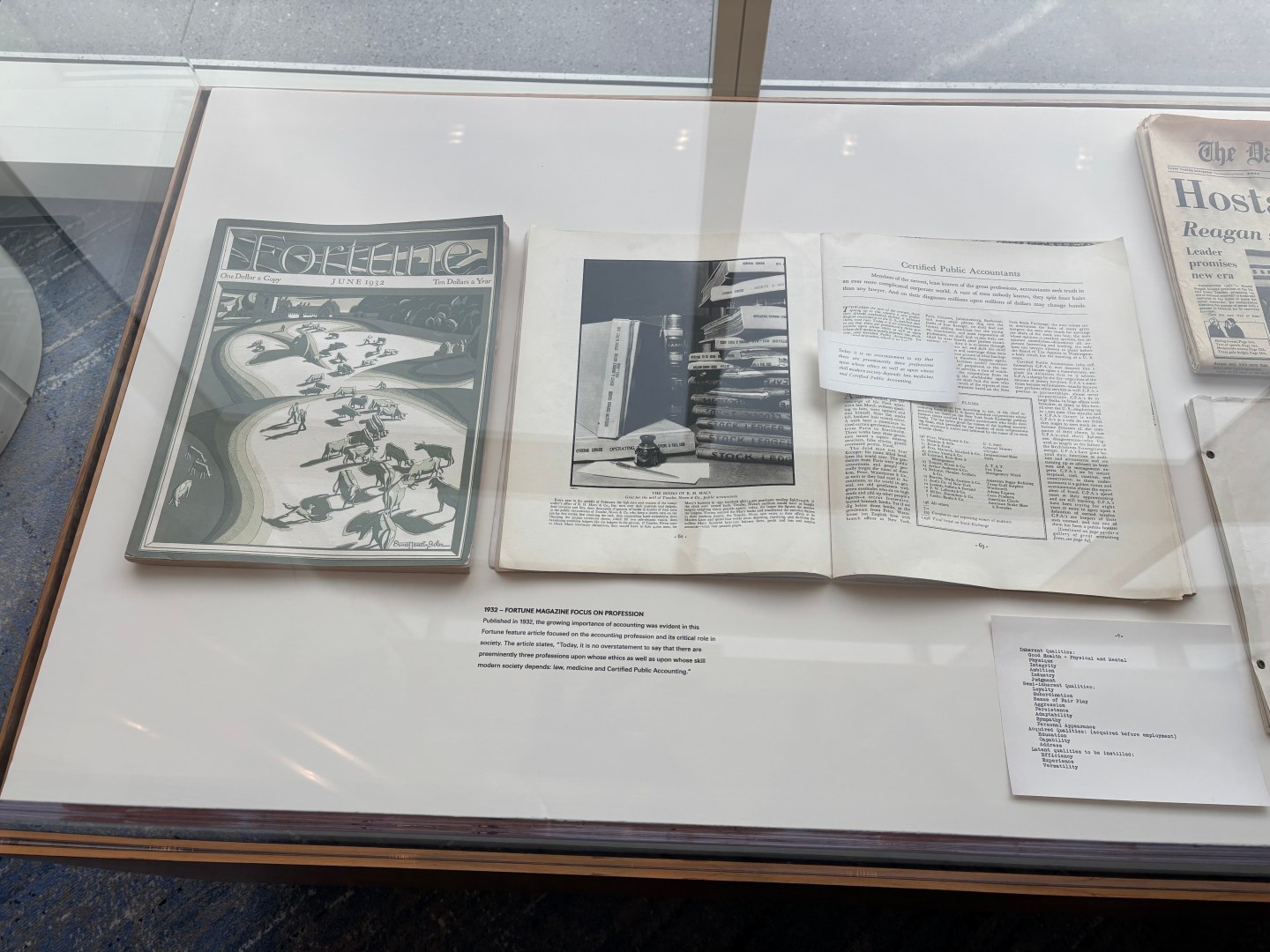
Lakehouse has 800 single-occupancy guest rooms (staffed by long-term partner Hyatt) and common areas on each floor, complete with a fully packed fridge. Lakehouse boasts high-end dining amenities, including the Common Ground grab-and-go coffee shop, a wine bar called Blend, a sports bar known as The Landing and a market-style food hall called The Exchange, where you have coiches including shawarma, pizza, salads and more. (It even features a company history section, including a 1932 edition of Fortune, profiling the hot new sector known as accounting.)

It’s a far cry from the accounting, auditing and consulting firm—known for its royal-blue color scheme and its status as one of the “Big 4” in corporate accounting, along with PwC, EY and Deloitte—and its gleaming new headquarters in New York City, as toured by Fortune‘s Eva Roytburg in November. The firm’s new Chair and CEO, Timothy Walsh, who began his five-year term in July 2025, spoke to Fortune in October about the fear “that honestly keeps me up at night,” around cyber and quantum evolving faster than KPMG and its clients can keep ahead of.
Under Walsh, KPMG has consolidated three legacy Manhattan offices—345 Park Avenue, 560 Lexington Avenue, and 1350 Avenue of the Americas—into a 450,000-square-foot space that includes “war-mapping” strategy rooms, skyline lounges, and even what one executive called “MTV-style” confession rooms for clients to record reflections after big projects. “I really do believe that someone can start here as an intern, like I did, and build a long-term career,” he told Fortune in November. And while the Manhattan headquarters offer one type of focal point for KPMG’s 90-plus offices and more than 36,000 employees and partners, Lakehouse is where interns start their journey.
The campus also encourages physical activity through a (recently updated) sports complex called Lakeside Park, featuring basketball, beach volleyball, bikes, 1.2 miles of walking trails, pickleball and an 18-hole miniature golf course, modeled on the actual PGA tour. Patrick Ryan, National Managing Partner of Advisory, Strategy & Markets, told Fortune at Lakehouse that, compared to the firm he joined decades ago, you can feel how different KPMG is now—literally. He recalled a pickup basketball game at Lakehouse a few months previously. “There were a couple hard fouls, like really hard fouls going on,” Ryan told Fortune. “I wasn’t giving them. It was a hard game.”


Nick Lichtenberg/Fortune
Ryan said he heard afterward that some of his team members had gone up to the interns afterward and said, “Hey, just so you know, that was a hard foul on the guy who runs the advisory business.” He said that while he avoided getting dunked on, he definitely took “some hard charges, we’ll just say that.” (Ryan actually started his career at KPMG and, in a relatively rare move, departed before boomeranging back in 2011 as a Partner in KPMG’s Deal Advisory and Strategy Business. He then became Office Managing Partner of Washington, D.C. and leader of the Federal Business in June 2024 before adopting his current role in July 2025). “I think we’re a flatter organization than a lot of the big firms,” he said. “Lots of reasons behind that, but I think we’ve done that pretty intentionally relative to our culture.”
Ryan recalled that he was at the ribbon cutting for Lakehouse in January 2020 and remembered the grumbling at the time: “Capital-intensive, middle of nowhere in Orlando … some people might think the worst timing. It turned out it was actually the perfect timing, because this was our safe haven for the middle of the pandemic.”
Ryan was one of several KPMGers who described how Lakehouse turned into the Big 4 firm’s version of the NBA bubble in nearby Disney world, as it incrementally reopened to KPMG employees with safety protocols in place, including onsite testing and social distancing, for both indoor and outdoor events and gatherings. Then, once reopening was under way, in 2023, “we have clients here every single week in scale.”
Sherry Magee, a longtime Orlando resident who has worked at Lakehouse since it was a construction site, drove this editor around the campus in a (quite fast-moving) golf cart, emphasizing that the central Florida location was within a two-hour flight for most of KPMG’s U.S. workforce.

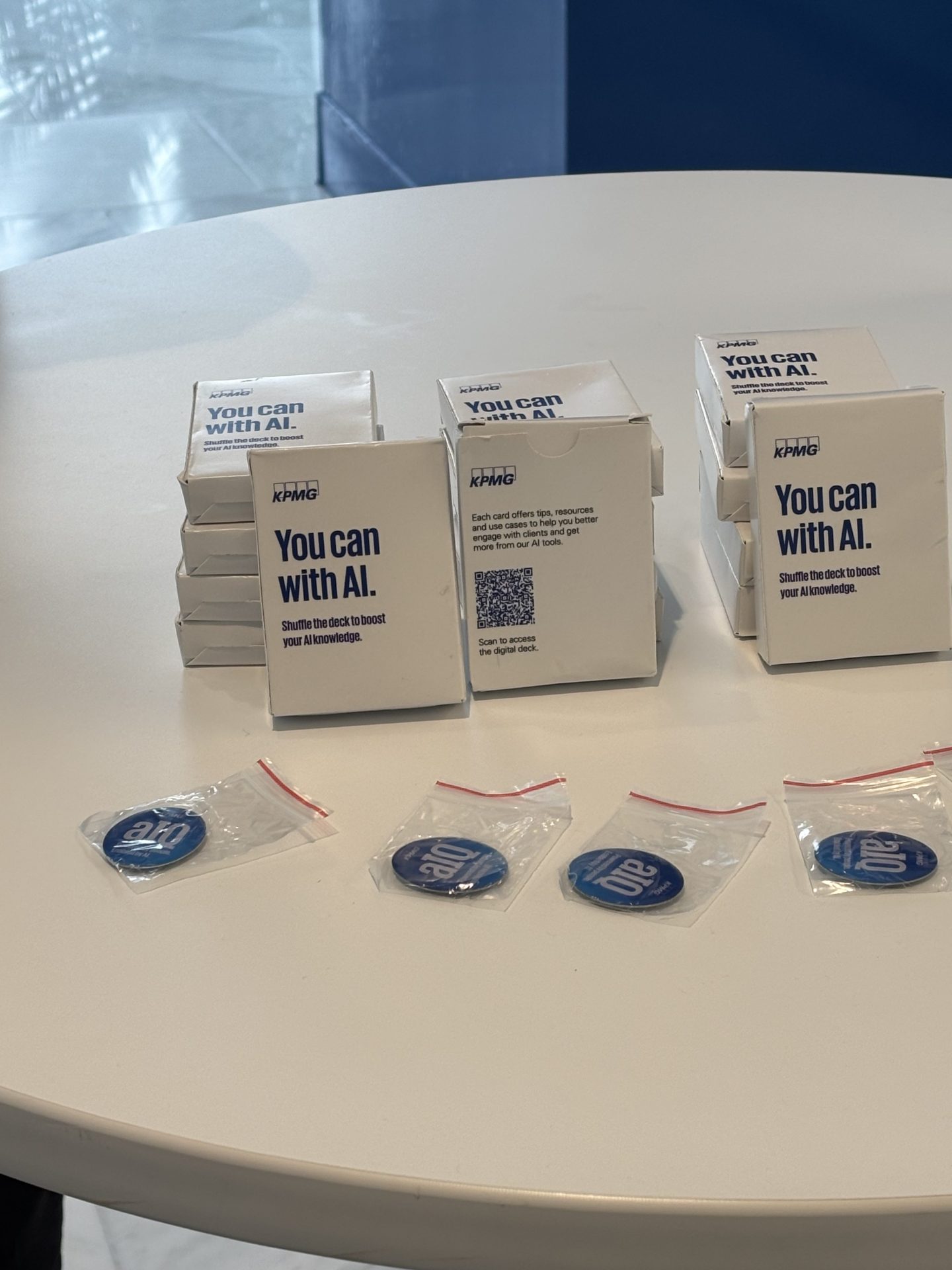
Given that KPMG has 2,400-plus partners, there’s sometimes not enough Lakehouse to go around. (KPMG said it sometimes works with several partner hotels to accommodate larger groups if necessary.) As Magee wheeled around the sidewalks and man-made lakes of Orlando, she highlighted features such as the on-site beekeeper (four colonies and 80,000 bees, by las count) and falconer (to steer away the prospect of coyotes, snakes and alligators). She also highlighted the many ways KPMG is turning Lakehouse into an AI crash-course, even down to AI-themed playing cards, available at its aIQuad, its AI channel on a nearby TV and the library located next to The Blend featuring AI thought leadership books. (She wouldn’t let Fortune walk away with a deck, but she did offer a gift of AI-themed dress socks.)
‘Think, Prompt, Check’: The New AI Standard
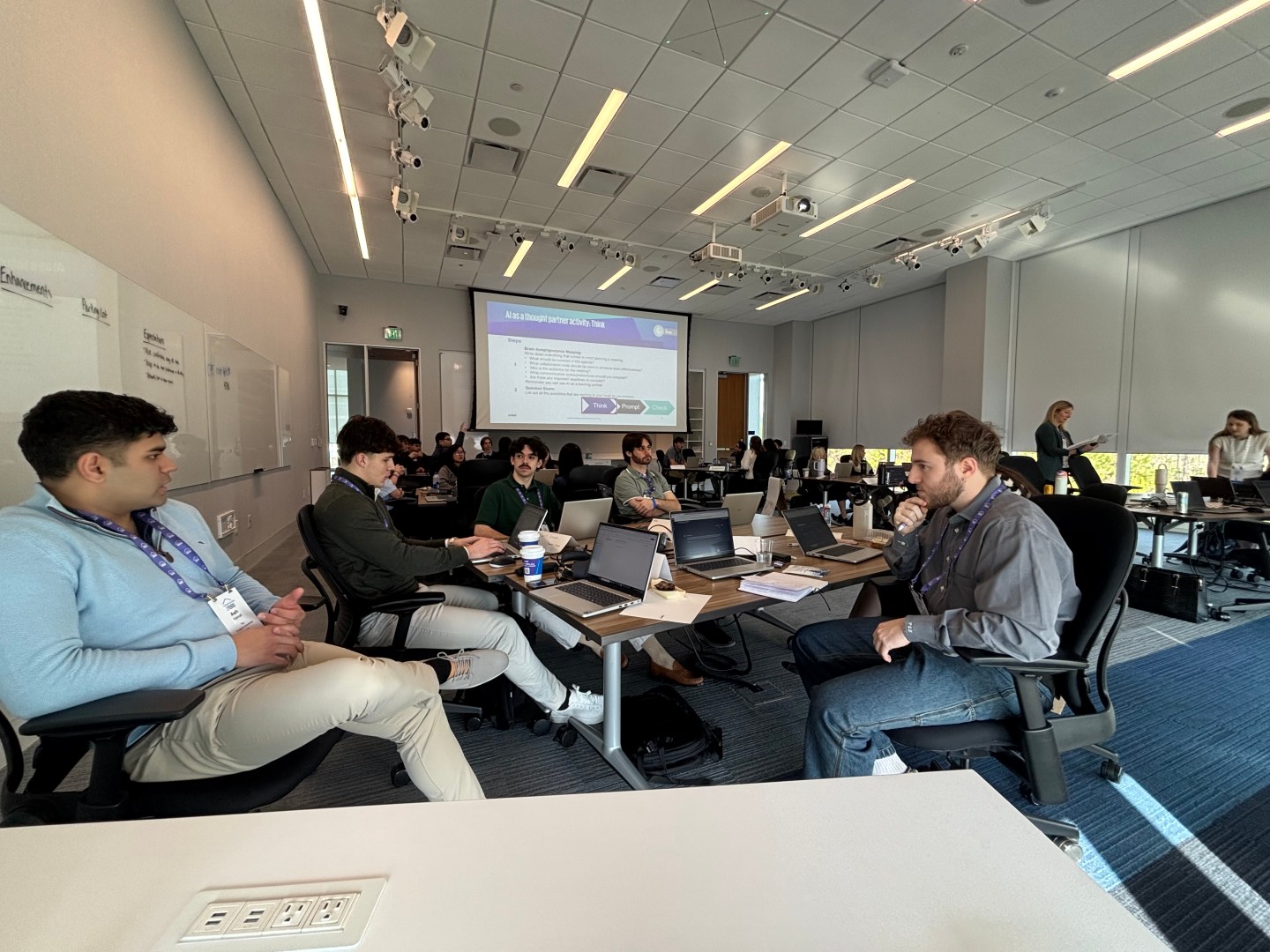
Many of the KPMG interns that Fortune spoke to described a strange situation where the accounting classes they learned even two years ago were obsolete in a world where AI would do much of the lifting for them. Bedecked in quarter-zips and khakis, the students were learning best practices on AI from instructors who were writing the curriculum virtually in real time.
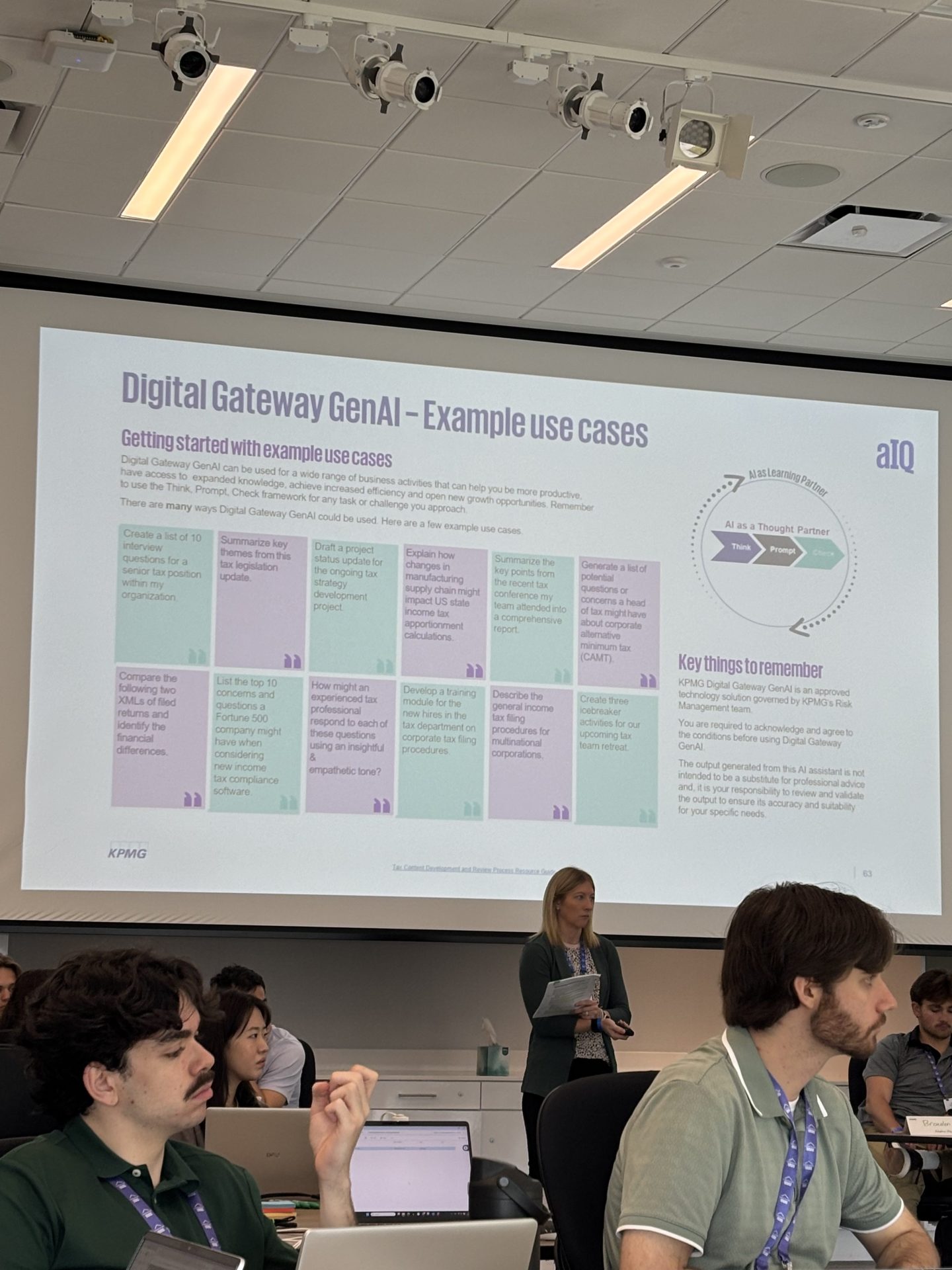
At the heart of the current lesson plan is a framework in which KPMG instructors training tax interns to “think, prompt, check,” or TPC. Holly Ricker, a director in the tax learning and development group, told Fortune that the framework had evolved in just the last three months; it used to be “think first, prompt later,” but she and other instructors realized that they needed to explicitly tell students to check things. “We were telling everyone to think first and then prompt, but … just because you’re prompting, doesn’t mean you’re getting the right prompt.” She said she’s pleased with the early results. “Everyone’s going around saying ‘TPC, remember the TPC.’ It’s really caught on.”
Justin Day, an intern based out of the Salt Lake City office, explained that he was older than many of his fellow classmates, as he had finished up at Brigham Young University after spending two years as a missionary for the Church of Jesus Christ of Latter-day Saints in Ethiopia and Kenya. When he got to college in 2022, he had invaluable real-world experience and was poised to adopt AI from the very beginning, he said, as he started using ChatGPT within days of its release. Day explained that he was an avid AI adopter because it was helpful for researching the historical accuracy of his creative writing hobby: fantasy novels, in the style of Brandon Sanderson. He said he learned from it even when it was wrong. “I think that was just part of the learning curve. Usually when it leads me astray, it’s more my fault, and I just didn’t know what I did wrong to prompt it to not give me the right answer.” Day may not have known it, but he was already modeling “TPC.”
Ricker and other instructors explained that interns are being taught to utilize AI in two distinct capacities: as a learning partner to fill knowledge gaps in unfamiliar topics, and as a thought partner to iterate and bounce ideas off, once a foundational understanding is established. Ricker said the Tax practice is using a prompting framework called C-A-R-T-S to tailor outputs for different audiences. It stands for Character/Role, Audience, Request & Context, Type of Output, Style & Tone. The Audit practice has a similar acronym: C-R-E-A-T-E, which stands for Context, Role, Expected Outcome, Adjust parameters, Tone, Evaluation/Extra.
This shift is significantly altering the daily workflow, reducing the “middle to middle”—the automated, repetitive tasks that previously consumed three-quarters of a professional’s day. By automating these tasks, KPMG intends for its employees to reallocate their time to critical thinking, judgment, and the human element of service.
KPMG’s AI strategy is bolstered by deep technical partnerships with industry giants. The firm utilizes a Microsoft environment, integrating Copilot into Outlook, PowerPoint, Excel and Teams to streamline communication and presentation building. Partner Patrick Ryan highlighted the recent release of Google Gemini as a “market-leading” turning point. For example, he highlighted the preparation work he has to do for external meetings with top executives, which involves going through old notes, PowerPoint presentations and correspondence. He used to spend a “huge chunk” of his time on this, but with AI tools, and Gemini in particular, he estimated that he cut his prep time by up to 75%. “There was just this moment of: everything just became easier, especially on the go-to market side of things,” Ryan told Fortune.
‘More about conceptual things than hard facts’
K-Linh Nguyen, an intern from Houston, Texas, told Fortune that she wasn’t a typical “Aggie” despite her dark maroon Texas A&M polo shirt, choosing her studies over football games most of the time. Her parents had fled wartorn Southeast Asia to settle in Houston, she explained, and she was drawn to A&M’s Professional Program in Accounting, or PPA, because it allows students to get both an undergraduate and master’s degree in just five years. Her father, a former PwC consultant, now owns two businesses in the Houston area, and her mother works alongside him.
Nguyen shared several times how excited she was to get started on her internship (specifically, she wanted to note that she’s a Financial Due Diligence intern specializing in energy (ENRCI: Energy, Natural Resources, Chemicals, Infrastructure) at KPMG’s Houston office. At the same time, Nguyen also said she was worried about the impact of AI on her own work and her generation’s job prospects. “It’s scary; the reliance on it is really scary.” In Nguyen’s opinion, she was lucky to enter school slightly before the onset of ChatGPT, so she “built those fundamental skills to discern when it’s right and when it’s wrong.” She couldn’t explain how to develop that sense of when the AI might be hallucinating, but “You have to have an eye for it … You can’t teach that eye unless you — How do I say this? It’s one of those things where you have to experience it to appreciate it.”
Angela Chen, out of KPMG’s New York City office, told Fortune that her parents were torn about the long hours she spent studying at Baruch College, because they needed her help running their Chinese restaurant in the Coney Island section of Brooklyn. Eventually, though, her mother encouraged the career path, calling it a “golden spoon”—a lucrative to earn a living and find independence.
On the subject of AI, Chen was level-headed. “I use AI as a learning tool. I think it’s very helpful for me to work with it,” she said, adding that “of course” she understands it won’t always provide perfect information, and you always need to “check” what it’s telling you. “Usually when I use AI, I just search for definitions and concepts … it’s more about conceptual things than hard facts.”
Chen wrote to Fortune via LinkedIn that her three-day crash course at Lakehouse had set her up for success: “It was great, I was filled with learning and food.”