- A study finds that invasive mesquite trees and free-ranging dogs are reshaping the Thar’s native carnivore community.
- Species adapted to thrive only in grasslands, such as the desert fox, avoid habitats dominated by mesquite and adjust their activity to reduce encounters with free-ranging dogs.
- Managing mesquite spread and controlling free-ranging dogs in sensitive grasslands is critical to conserving specialist desert predators, say researchers.
Grasslands around the world are quietly changing under pressure from overgrazing, cropland expansion, climate change and biological invasions. In India’s Thar Desert, these pressures are reshaping which species survive and how they share space. A new ecological study finds that two invasive forces, fast-spreading mesquite trees and free-ranging dogs linked to human settlements, are changing how native mesocarnivores (medium-sized carnivores) move, hunt and coexist in this landscape.
“Wildlife communities of the Thar Desert remain relatively understudied even as the landscape undergoes rapid ecological change,” says Chetan Misher, a wildlife ecologist at the Wildlife Conservation Trust and the study’s corresponding author. “Mesquite has become the dominant woody plant, altering habitat structure, while free-ranging dogs function as apex or dominant predators in many areas. Together, these invasives are reshaping native communities through habitat modification, changes in predation, competition and interference, with cascading effects across the ecosystem,”
A changing desert landscape
The Thar spans about 446,000 square kilometres across western India and southern Pakistan, covering over 200,000 sq km across parts of western Rajasthan and the Kachchh region of Gujarat.
To capture ecological variation across this landscape, researchers focused on two contrasting sites for the study: the mesquite-dominated Banni grasslands of Gujarat and the more fragmented, agriculture-influenced grasslands around Bikaner in Rajasthan.
Both regions support similar wildlife, including desert and jungle cats, desert and Indian foxes, golden jackals, along with a wider range of desert-adapted small mammals, birds and reptiles. The researchers conducted field surveys using motion-triggered infrared camera traps to record wildlife presence and activity.
The study also used high-resolution satellite imagery to map land cover, including open vegetation, invasive woodland, agriculture, water bodies and built-up areas. These habitat layers were linked to each camera location across multiple spatial scales. Using occupancy modelling, the study estimated where carnivores were likely to occur while accounting for missed detections and environmental influences. The study also use temporal activity analysis to examine when species were active and how much their daily routines overlapped.
Winners and losers in an invaded desert
The study results showed that Indian foxes avoided areas used by desert foxes or dogs. But they were often found where golden jackals were present, in contrast to a study from Maharashtra where Indian foxes avoid jackals. Jungle cats also frequently appeared alongside jackals. Desert foxes and dogs were recorded more often in Bikaner, whereas jackals and jungle cats were more common in mesquite-dominated Banni. Indian foxes were not detected in Bikaner, while desert cat detections were similar in both regions.
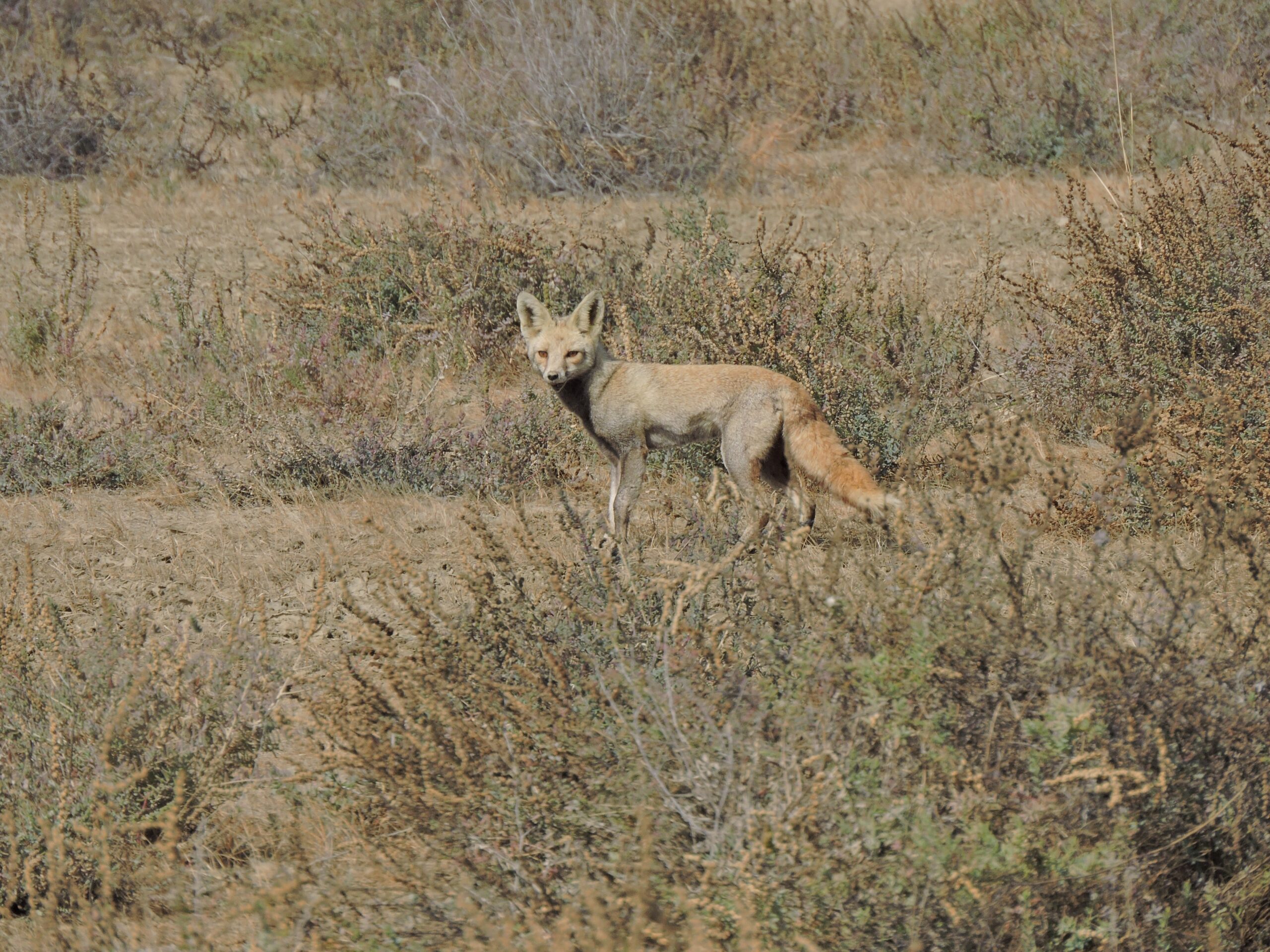
Desert foxes strongly preferred open native vegetation and avoided mesquite woodland and farmland. They were also frequently found close to human settlements, likely because villages in Bikaner lie near the remaining grassland patches they depend on.
Golden jackals, as habitat generalists that can thrive in diverse environmental conditions, used a wide range of environments and persisted even where the mesquite expanded. Indian foxes, the smallest canid in the study, avoided desert foxes and dogs and disappeared from Bikaner altogether, suggesting possible competitive exclusion where predator and dog pressures are high. The overlap with jackal territory was surprising, with one explanation being size-structured competition. “In the Thar, the desert fox, being intermediate in size, may experience more direct competition with jackals, while the smaller Indian fox could overlap spatially with jackals to avoid stronger competitive pressure from desert foxes,” says Misher.

The study did not detect the Indian fox in Bikaner. This absence, despite earlier reports of it being present, raises concern. Misher states that this may suggest local decline or displacement, potentially linked to high dog abundance and activity in the region, but cautioned that the evidence is not yet conclusive and requires further investigation.
Among wild cats, jungle cats appeared to benefit from invasive woodland, showing higher occupancy in mesquite-dominated areas, while the elusive desert cat showed weak habitat associations, likely reflecting low detection rates. Overall, spreading mesquite seems to favour adaptable species while placing grassland specialists at risk.
These vegetation changes are likely to ripple through the prey base that sustains desert carnivores. “Invasive species can alter both herbivore and carnivore communities,” says Abi T. Vanak, director of the Centre for Policy Design and senior fellow at the Ashoka Trust for Research in Ecology and the Environment (ATREE), who was also involved in the study. “For example, mesquite can alter grasslands and convert them into woody-dominated states, and thus favour generalist species. Species (of rodents) such as Rattus are more commonly found in mesquite thickets compared to open grassland specialists such as Millardia. Habitat structure driven by invasive species, and the associated differences in predation risk, microclimate and food availability, can alter the community of herbivores and carnivores at a site.”

Dogs reshape behaviour
If mesquite alters habitat, dogs alter behaviour. Supported by human food and shelter, free-ranging dogs are dominant predators. Native carnivores respond by avoiding them spatially or by shifting activity patterns.
Desert foxes, for example, remained largely nocturnal, but in dog-dominated areas, the study found, their activity shifted further away from peak dog movement, reducing the likelihood of encounters. Yet the relationship is not purely one of avoidance. Occupancy models revealed an unexpected positive spatial association but a strong temporal avoidance between desert fox presence and dog occurrence. Simply put, they tend to use the same areas, but at different times of day.
The findings point to a clear conservation message: landscape structure determines survival. Managing the spread of mesquite in key grassland refuges, alongside targeted control of free-ranging dogs in ecologically sensitive areas, will be critical to reducing predation pressure, disease risk and habitat loss for specialist predators. Maintaining mosaics of open grassland with low woody cover may allow both specialists and generalists to coexist.
Read more: [Explainer] How are invasive alien plants removed?
Banner image: The study found desert foxes strongly preferring open native vegetation and avoided mesquite woodland and farmland. Image by Chetan Misher.