
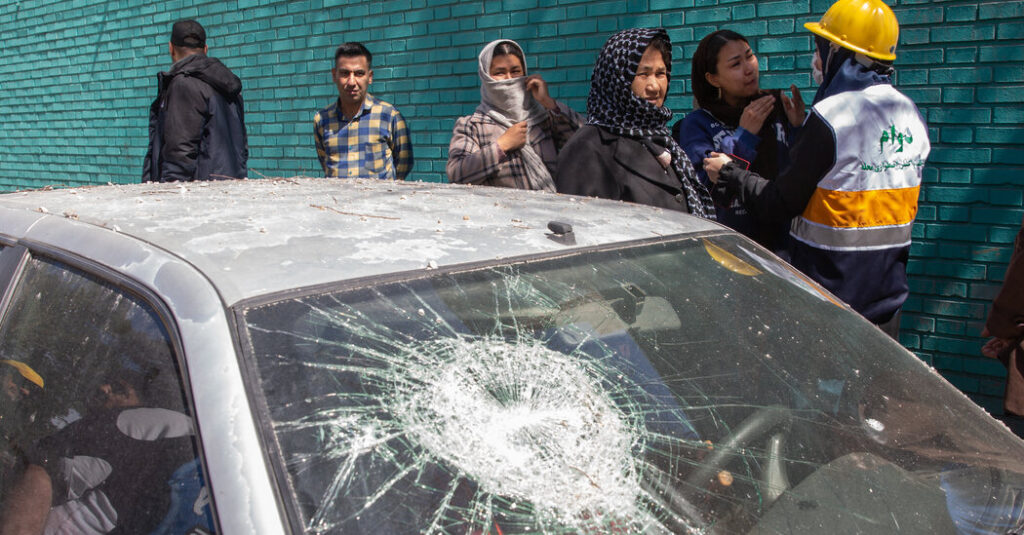
Amid the Israeli-U.S. bombing campaign against Iran, strikes on Iran’s industrial infrastructure widened on Friday, with attacks on two major steel production complexes that are vital to the country’s economy, along with other industrial sites.
Iranian officials attributed the strikes to Israel. The Israeli military acknowledged bombing two nuclear facilities, but did not explicitly address the other sites. Israel and the United States have bombed Iranian nuclear sites before, both in the current month-old war and in a 12-day conflict last June.
But the other strikes on Friday appear to reflect a shift in Israeli targeting toward degrading Iran’s civilian infrastructure and economy; Israel announced this week that it would intensify attacks on infrastructure.
The Israeli military has noted that the industries struck are often “dual use,” with both civilian and military applications, or have ties to the government and armed forces. Last week it struck the Pars gas field that supplies most of the country’s domestically used natural gas, and on Wednesday it hit two sprawling industrial complexes, Alborz and Leah, near the city of Qazvin.
President Trump has threatened to bomb Iran’s electric power plants if the Strait of Hormuz is not reopened to shipping, but so far he has refrained.
The targets on Friday included the steel complexes in Isfahan and Khuzestan, a mine that was part of a cement factory in Firouz Abad, an industrial city in Kheirabad and a warehouse at Mashhad’s airport, according to Iranian media reports and official comments. The state news agency reported that airstrikes on the mine killed two workers and injured two others; Jalil Hassani, deputy governor of Fars province, told state media that the cement factory was purely civilian.
The Islamic Revolutionary Guards Corps of Iran threatened in a statement to retaliate with strikes on industrial facilities in Arab countries of the Persian Gulf, particularly those with American shareholders.
The Iranian foreign minister, Abbas Araghchi, said on social media that Israeli attacks undermined President Trump’s statement that the United States would refrain from targeting Iranian infrastructure for 10 days to allow for diplomatic negotiations. “Iran will exact HEAVY price for Israeli crimes,” said Mr. Araghchi in his post.
Iran’s Atomic Energy Agency said in a statement that the attacks on the nuclear sites did not result in any radiation leaks or casualties.
But the attack on the Mobarakeh Steel Complex in Isfahan killed one person and injured 15, Mehdi Jamalinejad, the governor of Isfahan province, told Iranian media. He said two large electric power plants that supply the steel complex were also damaged.
A separate strike on the Khuzestan Steel Industries complex injured 16 workers, the deputy governor of Khuzestan province, Valiollah Heyati, told state television.
A senior Iranian official said the attacks on the steel mills delivered a major blow to the country’s economy, and would hamper recovery and reconstruction efforts once the war ends. The official, who spoke on condition of anonymity because he was not authorized to speak publicly, said the steel plants produced material needed for construction of buildings and roads.
It was not immediately clear whether the two steel factories, owned by a combination of private shareholders and government institutions, had contracts with Iran’s armed forces. Both companies are under U.S. sanctions; the U.S. Treasury contends that Mobarakeh is part of a network supporting the Basij paramilitary force.
A former engineer at Isfahan Mobarakeh Steel Complex who asked not to be named said in a text message that entering the site daily, even for employees, required extreme security clearance and any vendor or contractor entering the complex had to be vetted and given a special entrance permit.
A businessman in Ahvaz, who is a vendor for the Khuzestan steel plant and visits the site frequently, said in an interview that the attacks were extremely disconcerting for the business community and contractors who work with various sectors that could be deemed as dual use. He said Iran’s steel industry produced a wide range of products, including steel plates for ship building.
In addition to the attacks on industrial sites, the United States and Israel continue to strike such major cities as Tehran, Isfahan, Shiraz and Tabriz, according to interviews and comments on social media by residents of these cities.
“Last night the attacks were extremely huge, the ground was shaking beneath us as if we are in an earthquake for several hours,” said Susan, a 56-year-old resident of Tehran, in a telephone interview. Like most people interviewed she asked her last name not be used, out of fear of retribution.