
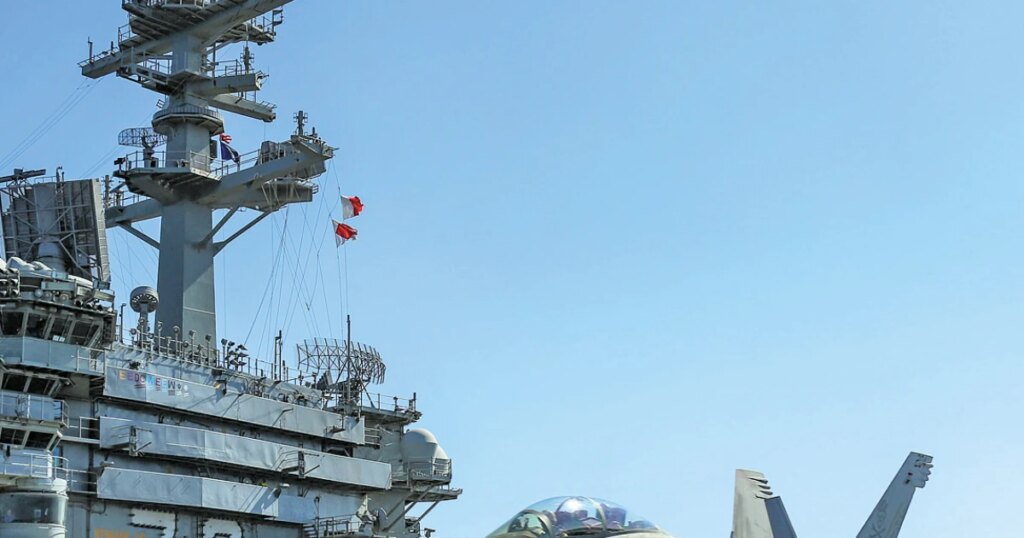
Relations between Iran and the United States (US) are currently at one of their lowest points in recent decades, characterised by extreme hostility, no direct diplomatic ties, and heightened military tensions. The possibility of carrier-borne US military strikes in support of citizen protests in Iran, triggering unpredictable retaliation by Iran, is being mooted. Several airlines suspended their flights to West Asia on January 24, and both uncertainty and anxiety are palpable in the region.
To recapitulate: Iran experienced its most intense and bloody anti-government protests in January 2026, with the official death toll exceeding 3,000, and this is considered to be a conservative estimate. The internet has been disabled since the end of December last year when the protests began, and foreign media access remains very limited. Some human rights groups and non-governmental organisations aver that the death toll could be much higher (20,000 or more) and that those injured could be closer to 50,000. This is a tragic loss of life and points to the intensity of the violence that engulfed Iran.
The latest Iranian protests are the seventh such major uprising against the regime and erupted initially over severe economic issues, like the rial’s collapse to record lows, touching over 1.3 million to one US dollar. This was compounded by hyperinflation (food prices up by almost 72 per cent year-over-year, annual inflation around 40 per cent), unemployment, and low wages — all of which quickly escalated into widespread calls to overthrow the Islamic Republic regime.
The Iranian “bazar” comprising the traders is a critical constituency for regime stability, and this time around, they joined the protests, which spread to all 31 provinces nationwide. Observers described the January protests as the most serious challenge to the clerical regime since the 1979 Islamic Revolution, surpassing even the “Woman, Life, Freedom” movement in 2022-2023, which was sparked by the death of 22-year-old Mahsa Amini who had defied the hijab rules.
The current confrontation
Presently, the Iranian government led by President Masoud Pezeshkian is in control, with security forces, including the Islamic Revolutionary Guard Corps remaining loyal to Supreme Leader Ayatollah Khamenei. Despite some assessments that a regime change was in the offing, there have been no major reported defections or internal fractures that would be deemed sufficient to topple the current regime. The clergy-led government, which remains in power, although uneasily, has accused foreign forces (the US and Israel) of stoking and supporting the protests.
Earlier, US President Donald Trump had warned Iran not to execute the protesters and added (on January 22) with ominous ambiguity: “We have an armada. We have a massive fleet heading in that direction and maybe we won’t have to use it, we’ll see.”
Why is Iran, which was once a close ally of the US when the Shah (former Iranian ruler Mohammad Reza Pahlavi) was in power, a target of US intimidation? Ever since the US embarked on the global war on terror in 2001, after the enormity of the 9/11 terror attack, the US arrived at a determination that certain nations represented the “axis of evil” and that they should not be allowed to acquire nuclear weapons. The three countries listed were Iraq, North Korea, and Iran, and then US President George W Bush accused them of sponsoring terrorism and aggressively pursuing weapons of mass destruction (WMDs), threatening world peace.
This was the rationale for the US attack on Iraq in 2003, and though it was later revealed that the US had made a counter-factual accusation regarding Iraq and WMDs, the die had been cast. Nuclear weapons in West Asia were taboo, and only Israel was allowed to retain its ambiguous posture. Former US President Barack Obama continued with this policy, and Libya followed in 2011, with the former Libyan leader Muammar Gaddafi meeting the same fate as the former Iraqi President Saddam Hussein.
Nuclear capabilities
Iran, which had an active civilian nuclear enrichment programme, was suspected of nuclear non-proliferation transgressions — as it was secretly trying to acquire a nuclear weapon — and became the next target. A nuclear
weapon-enabled Iran was unacceptable not just to the US but also to Israel, Saudi Arabia, and the United Arab Emirates (UAE), and the pressure on Iran mounted.
To his credit, Obama pursued the diplomatic option and played a pivotal role in the negotiation and implementation of the Joint Comprehensive Plan of Action (JCPOA), commonly known as the Iran nuclear deal. From 2009 to 2017, Obama prioritised diplomacy to address Iran’s nuclear programme and opted for a multilateral approach. The JCPOA was signed in July 2015 between Iran and the P5+1 group (the US, United Kingdom, France, Russia, and China plus Germany) together with the European Union.
The deal aimed to roll back Iran’s nuclear capabilities in exchange for phased relief from international sanctions. Core provisions included limits on enrichment, wherein Iran agreed to reduce its uranium enrichment centrifuges from about 19,000 to 5,060; cap enriched uranium stockpiles at 300 kilograms (at 3.67 per cent purity), and restrict research on advanced centrifuges for 8-10 years.
Had this deal reached fruition, Iran would have benefitted enormously and regained its credibility as a major regional power — but this was not to be.
In his first term as President, Trump decided in May 2018 that the US would withdraw from the JCPOA, and this was supported by the conservative lobby within the country as well as Israel and Saudi Arabia, among other US allies.
The current US objective with respect to Iran is multifaceted, but the nuclear strand remains a significant aspect. The Trump administration’s goal is to prevent Iran from acquiring nuclear weapons, and the US has been using a combination of diplomatic pressure, economic sanctions, and military threats to achieve this.
Specifically, the US wants to deny Iran any nuclear enrichment capability, and Trump has often expressed his resolve to dismantle Iran’s nuclear programme entirely. Further, the US wants Iran to accept permanent and verifiable constraints on its nuclear and ballistic missile programmes and, in effect, neuter Iran.
Given the inflexible anti-US and anti-Israel orientation of Iran’s hardliners, the US has also sought to curtail Iran’s regional influence and reduce its support for US-designated terrorist groups (Hamas, Hezbollah) and militias (Houthis) in the Middle East.
The October 2023 Hamas terror attack on Israel was a tipping point for Iran’s regional adversaries, who have long accused it of supporting Shia fervour in the region and supporting destabilising activities.
Within months of Trump returning to the White House for his second term, Israel attacked Iran’s WMD assets with active US military support in June 2025. Over a thousand Iranians were killed in these attacks. The impunity with which the country was attacked and the inability to counter or deter such an onslaught on its sovereignty dented the clerical regime’s credibility. Subsequently, Iran was subjected to a “maximum pressure” approach that included US-led Western sanctions and military threats.
This was the geopolitical backdrop to the domestic conditions that led to the latest Iranian protests, and Supreme Leader Ayatollah Khamenei and the regime faced their most severe survival challenge. The Trumpian churn in global geopolitics has eroded whatever support Iran could have got from other major powers, such as China and Russia, and the next few months will be critical for Iran.
Will the US attack Iran and force a change of regime by bringing back the monarchy? The son of the deposed Shah, Reza Pahlavi, is currently in exile in the US, and it appeared that some protesters wanted his return, but this has since petered out. Currently, the US naval armada being positioned in the region may be a case of muscle-flexing to keep Iran in a state of anxiety and extended unstable equilibrium.
Regional geopolitics
But it is instructive that in January, amid renewed fears of US strikes against Iran, long-time rival Saudi Arabia, along with Qatar and Oman, launched diplomatic campaigns to dissuade the Trump team from such an action. Saudi officials warned that ineffective or escalatory US strikes could destabilise the region, harm global energy markets, and potentially strengthen hardliners in Iran.
Saudi Arabia communicated directly to Iran that it would not allow its territory or airspace to be used for attacks on Iran, signalling a desire to stay out of any conflict. Arab Gulf states also lobbied the US against military intervention, fearing blowback like Iranian retaliation against US bases or allies in the Gulf. A worst-case exigency would be the disruption of the hydrocarbon energy trade in the Persian Gulf and an attack on oil facilities in the region.
Saudi Arabia’s relations with Iran are complex, and the recent Israel-UAE cooperation has added a new dynamic. While Saudi Arabia and Iran have historically been rivals, they have been engaging in talks to de-escalate tensions. The Abraham Accords and Israel-UAE normalisation have likely pushed Saudi Arabia to reevaluate its regional strategy. This is a development that will have implications for the regional strategic calculus and, by extension, for India’s West Asia policy.
The Saudi Arabia-Iran rapprochement is being driven by the former’s assessment that it needs to counter growing Israeli influence in the region, and by trying to reduce tensions with Iran, the kingdom could present a united front against Israel. Saudi Arabia may also be hedging its bets due to perceived US disengagement from the region. As major oil producers, Saudi Arabia and Iran have shared economic interests, particularly in cooperation by the Organization of Petroleum Exporting Countries at a time of unexpected geopolitical turbulence driven by President Trump.
Iran is a regional heavyweight with a population of 92 million, a gross domestic product of $400 billion, and a per capita income of about $4,000. For India, the distinctive geography of Iran and its proven oil reserves accord it a strategic relevance that is further heightened by the China-Pakistan factor. While India has been compelled to reduce its trade and oil imports with Iran due to US sanctions, India had invested in the Chabahar port to enable access to Central Asia and Afghanistan, which is currently thwarted by Pakistan — and this will be of abiding value. This project may be stalled by the threat of US sanctions, but it will be prudent for India to persevere.
While India has diversified away from Iranian oil, any escalation in oil prices due to instability in Iran could spike global oil prices (Iran produces about 3 million barrels per day). A 10 to 20 per cent price surge could inflate India’s import bill by $10-15 billion annually, given the 85 per cent oil import dependency. Prolonged unrest in Iran could also adversely impact the International North–South Transport Corridor linking India to Russia via Iran and jeopardise $30 billion in potential annual trade.
In conclusion, Iran has a pedigree that goes back to the seventh century BC and is the inheritor of a rich and evolved Persian civilisation. In the modern period, Iran has wrestled with colonial machinations, a yearning for democracy and the adherence to Shia Islamic jurisprudence (constitutionalists versus clericalists) and floundered. The 1979 Revolution allowed the clergy to overthrow the monarchy and take over the reins of power, but its misplaced ideological certitude, illiberal governance, rampant corruption, and harsh gender laws have led to deep disillusionment among the people.
Periodic anti-government uprisings and protests have taken their toll, and Iran, despite its rich legacy, is today an unhappy and insecure state. The current US policies leave little or no room for a consensual modus vivendi. If the US armada moves into combat mode and delivers ordnance against Iran, more lives will be lost, the hardliners in Iran will prevail, the Great Satan (an epithet used in Iran to refer to the US) would be resurrected, and the strategic fallout would be damaging both for Iran and the extended region.