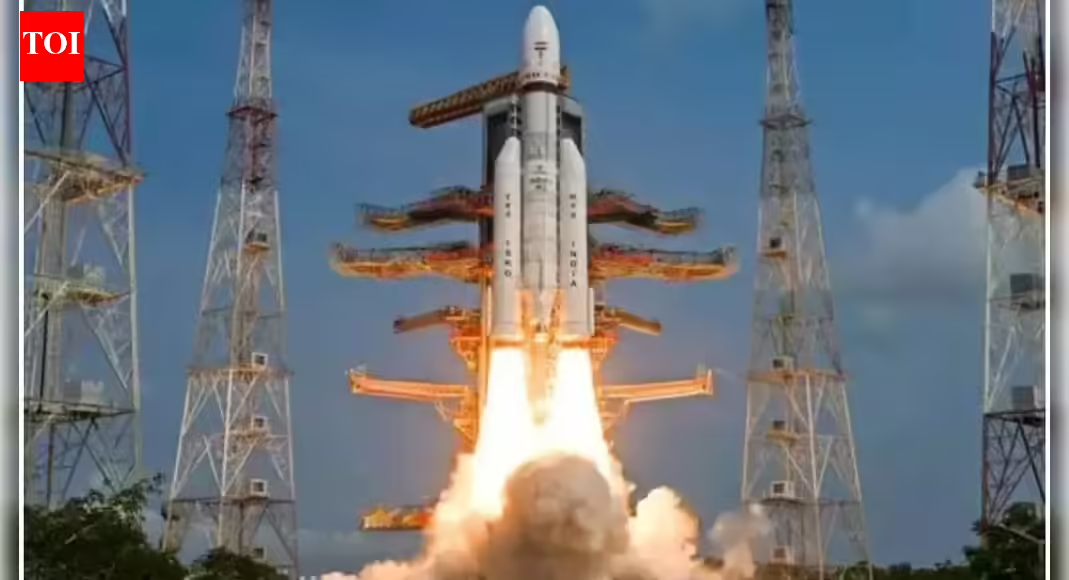
The Indian space program has kick-started its launch plans for 2026 with the launch of PSLV-C62, a crucial move that will involve coupling commercial satellite launchers with a high-end earth observation system.According to the latest reports available, ISRO has confirmed that there had been a technical anomaly on board the third stage of the mission during the launch of the PSLV-C62, resulting in the satellite not being in its intended orbit. This, as reported, has led the space agency to form a failure analysis committee to determine the reasons for the anomaly.
ISRO’s PSLV-C62 launch : What to know about Anvesha spy satellite and mission 2026
Anvesha is India’s new hyperspectral Earth observation spy satellite
Anvesha, officially designated EOS-N1, is a hyperspectral Earth observation satellite designed for strategic and civilian use. It can capture images across multiple light bands, allowing precise analysis of terrain, vegetation, water bodies, and man-made structures. This capability strengthens India’s surveillance, border monitoring, environmental tracking, and disaster response from space.
PSLV-C62 marked India’s first space mission of 2026
The PSLV-C62 launch on 12 January 2026 marked the beginning of India’s spaceflight calendar for the year. Lift-off took place from the First Launch Pad at the Satish Dhawan Space Centre in Sriharikota. The mission drew significant attention as it combined strategic payload deployment with commercial satellite launch services.
The mission was the 64th flight of ISRO’s PSLV rocket
PSLV-C62 represented the 64th flight of the Polar Satellite Launch Vehicle, reinforcing its status as ISRO’s most reliable and frequently used launch system. Over the years, PSLV has supported landmark missions including Chandrayaan-1, the Mars Orbiter Mission, and Aditya-L1, while also serving global commercial customers.
NewSpace India Limited handled the commercial launch operations
The mission was operated by NewSpace India Limited, the commercial arm of ISRO, and PSLV-C62 marked NSIL’s ninth dedicated commercial mission. It was to be tasked with launching the main EOS-N1 satellite along with several co-passenger satellites, demonstrating India’s increasingly important position as a trusted service provider of launch services globally.
PSLV-C62 carried 15 co-passenger satellites from India and abroad
Alongside Anvesha, the rocket carried 15 co-passenger satellites belonging to domestic and international customers. These included small satellites and technology demonstrators. Such shared launches allow multiple organisations affordable access to space while maximising the launch vehicle’s payload capacity and overall mission efficiency.
The PSLV-DL variant was used for the mission
ISRO has employed its PSLV-DL rocket in this mission, which has two solid strap-on stages. These are added to offer an enhanced thrust level. This particular model is best suited for orbital insertions that entail accurate handling. It is an attribute that has made it suitable for both strategic and commercial applications.
ISRO reported an anomaly during the third stage of flight
ISRO later confirmed that the PSLV-C62 mission experienced a technical anomaly during the third stage of flight. This prevented the satellite from being placed into its intended orbit. The space agency stated that a detailed failure analysis was initiated to identify the cause using onboard flight data.