
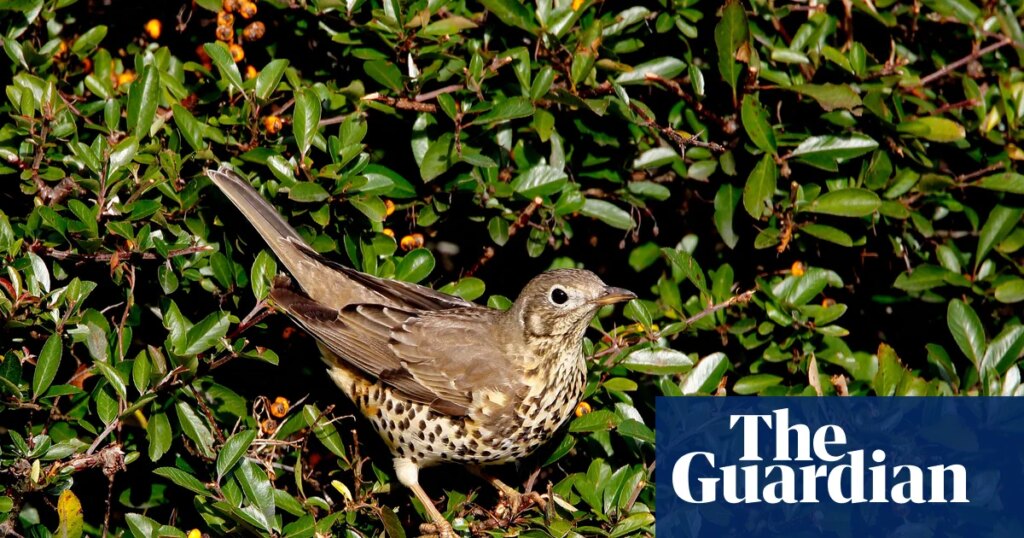
When Natasha Walter first became curious about the birds around her, she recorded their songs on her phone and arduously tried to match each song with online recordings. After a friend recommended Merlin Bird ID, a free app, she tried it in her London garden and was delighted to discover the birds she assumed were female blackbirds – “this is how bad a birder I was” – were actually song thrushes and mistle thrushes.
“I’m obsessed with Merlin – it’s wonderful and it’s been a joy to me,” says Walter, a writer and human rights activist. “This is what AI and machine-learning have been invented for. It’s the one good thing!”
Merlin is having a moment. The app, developed by the Cornell Lab of Ornithology in New York, which listens for birdsong and identifies the species singing, has been downloaded 33m times, in 240 countries and territories around the world. Britain has the second highest total number of users – more than 1.5 million in 2024, an 88% increase from 2023. Every month, there has been a 30% increase in new users of the app, whose sound identification function was launched in 2021.
Merlin has been trained to identify the songs of more than 1,300 species around the world, with more birds added twice a year. Different songs make distinct patterns on spectrograms and Merlin is trained to recognise these different shapes and attribute them to a species.
For latecomers to birding, or those lacking a knowledgeable friend, the app has become their teacher. “My fear at first was I wouldn’t actually learn because I’m outsourcing my understanding of birds to this app,” says Walter. “But that hasn’t come to pass. It’s helped me continue my journey of learning.” Nowadays, she guesses, and uses Merlin to confirm her hunches. “It’s wonderful if you’re coming to bird-watching late and don’t really have a mentor,” she says.
Angela Townsend from Bedfordshire began using Merlin after going on a nightingale walk one spring and being overwhelmed by the range of bird-voices in the evening chorus. She has found it has steadily built up her bird knowledge. “Warblers were just little brown jobbies but I can now recognise Cetti’s warblers and willow warblers when I’m out without having to put the app on,” she says.
Mary Novakovich, author of My Family and Other Enemies, is another recent adopter. She has found it particularly useful when travelling across Croatia, where her parents are from. “I love putting a name to a face and a name to the sound,” she says. “It really brings you closer to the natural world, rather than it being disconnected from your life. It’s part of what makes life a joy.”
Merlin is not flawless, however. The first time Kasper Wall, 12, tried it in his Norfolk garden, it detected a northern cardinal and a brown-headed cowbird – North American species not found in Britain.
“I think it was figuring out where we live,” says Wall, who enjoys using it even though he is now an extremely knowledgeable birder. “A couple of weeks ago we were looking at a large group of goldcrest and it came up with a firecrest. I thought, ‘Oh, there must be a firecrest in here too’ and 30 seconds later we saw one, which was the first I’d ever seen. I like it and it’s very good but I wouldn’t say that it’s better than the best people at identifying bird-calls like [the naturalist] Nick Acheson. It can definitely be fooled.”
Wall enjoys fooling Merlin with his uncanny impressions of a curlew, barn owl and greenshank.
Acheson doesn’t use Merlin. He welcomes it, but points out it can replace learning. “Anything that gets people out, thinking about and reacting to nature is a great thing,” he says. “But there’s certainly a risk that people don’t learn and just abdicate responsibility for learning to Merlin.”
He has noticed a glitch where Merlin interprets a certain type of chaffinch call as a redstart, leading to people being absolutely adamant that there is a rare bird in their garden. “There’s no substitute for a real person explaining to you how a birdsong feels and encouraging someone to engage with it emotionally,” he says.
John Williamson, who works as a guide for Norfolk Wildlife Trust, has found Merlin repeatedly identifying high-pitched calls as a spotted flycatcher, a bird that is very unlikely to be found in the middle of Hickling Broad nature reserve’s large reedbeds. “Merlin can’t do habitat,” he says.
Merlin has also excited visitors by identifying a golden oriole, a very occasional rare migrant, in Hickling woods, but no one has actually seen the species. Williamson is convinced it is misinterpreting a fairly unusual “catcall” of a female jay, a common woodland bird.
That said, Williamson finds it a “good tool” and welcomes how it is encouraging new people to enjoy birdsong, and particularly its mental health benefits. He knows one person who suffers from acute anxiety but Merlin has got him out into the world again and into nature, providing a focus for calming trips outdoors. “I find it impressive that an app can empower people to go out into nature,” he says.
Research has found that birdsong is particularly beneficial to mental health, and has a lasting positive impact on wellbeing. For millions around the globe, that’s exactly what Merlin is doing.
“It reminds you that there are birds knitted into your daily life,” says Walter. “It’s not about, ‘now I’m going to do a bit of birdwatching’, you may simply be walking through the park and you hear something and it gives you a sense that these birds are singing away all the time, even in London.”