
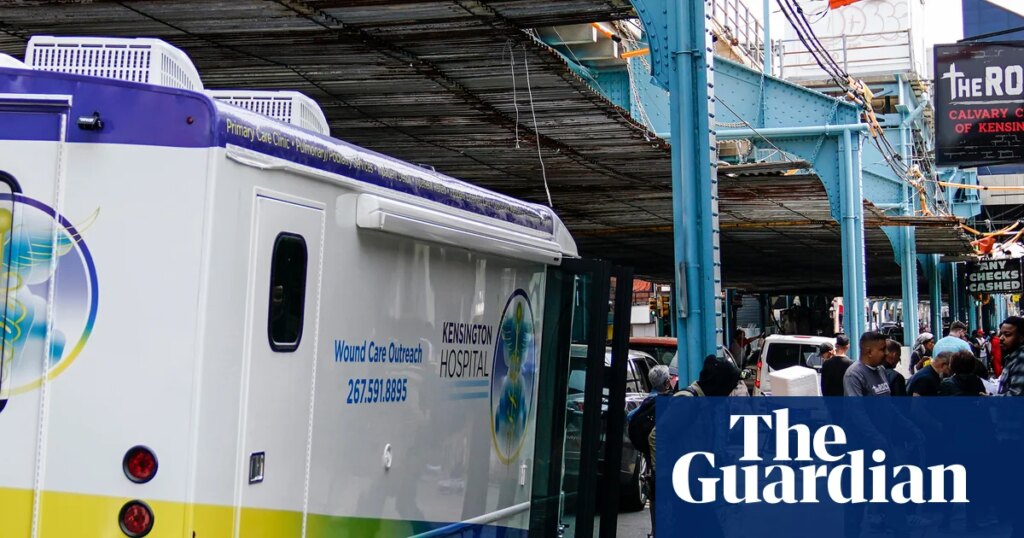
The staff at harm reduction hub Sunshine House in the middle of Kensington, a neighborhood in north-east Philadelphia home to the most notorious open drug scene in the US, often reverse at least one overdose per day.
But the mutating illegal drug supply is regularly conjuring new drugs with novel sets of potentially deadly risks. For the past 18 months, there has been a new drug in circulation, the veterinary sedative medetomidine, also known as “rhino tranq”. It has perhaps the most extreme and fast-acting withdrawal symptoms of all known street drugs.
Even as open drug scenes go, the vibe in Kensington is particularly bleak. Dozens of people line the main thoroughfare folded forward at the waist in unresponsive stupors from the effects of the drugs.
Dealers stand on the corner of every block, sometimes offering free samples. Members of religious group the Black Hebrew Israelites sometimes proselytize at the intersection wearing golden robes and claiming the use of cannabis is “against God”. They don’t seem to have got the memo that medetomidine-adulterated fentanyl has been the predominant form of “dope” in circulation since the beginning of the year.
“It’s made things worse for everyone – not only the people who use it but for the doctors too,” says Roz Pichardo, the founder of Sunshine House, where people who use drugs can access support. “No one knows how it works.” Well known locally, Pichardo says she has personally reversed more than 3,000 overdoses since the busy hub opened in 2018.
But medetomidine complicates matters because people remain unconscious after the fentanyl overdose has been reversed. “It’s causing havoc on people’s organs,” Pichardo says of the medetomidine, which is causing even younger people to experience organ failure. “Narcan works wonders, but it doesn’t fix organs.”
Chris Simpson, a glazer by trade who specialized in commercial skylights, is a regular visitor to Sunshine House, where people can gather to watch TV, receive clean clothes and stock up on medetomidine testing kits and Narcan, the life-saving opioid overdose reverser.
“The cartels figured out a way to make more money this way,” the south Jersey native who is currently street homeless says. “Heroin used to last all day. This shit only lasts for like four hours. The rush is the same but there’s no euphoria.”
The withdrawal effects are far worse than any other drug, too, he says, following his relapse three months ago after becoming street homeless after years “clean”. “I won’t be able to stop throwing up until it’s only bile,” he says. “My heart goes crazy, and I get the spins.”
Others describe excruciating “brain zaps” and tell of being hospitalized after heart attacks due to the intense withdrawal effects. Pichardo says she knows of up to 20 people who have died over the past year.
The run-down neighbourhood of Kensington made its name as an epicentre of the heroin trade, with documentary film-maker Louis Theroux making a popular episode of his Law and Order series here in 2004 on the continuing gang violence.
Then the “dope” on the street courtesy of the dealers who control the market became predominantly fentanyl, which is much cheaper. By 2021, most “stamps” – small bags of opioid-based drugs which also contain fentanyl, the potent synthetic opioid which remains the leading cause of fatal overdoses in the country – contained xylazine, an even cheaper veterinary sedative also known as “tranq”, which has no approved medicinal uses.
After Pennsylvania last year banned xylazine amid a crackdown on the drug, the gangs who control the drug trade replaced it with medetomidine, mostly used as an anaesthetic for dogs but also in intensive care wards (ICUs) to deeply sedate mechanically ventilated patients.
By the beginning of this year, medetomidine was present in about seven in 10 stamps. According to the Drug Enforcement Administration, medetomidine is 200 times more potent than xylazine, the flesh-destroying drug which leaves people with bone-exposing wounds on limbs that many people in Kensington have needed to get amputated.
“This shit’s fucked up,” says 33-year-old Earl, who had both his legs removed two years ago and is currently street homeless. “I’m just trying to get by,” he adds, as the metro train rumbles overhead. “They’re preying on us.”
Medetomidine does not carry the same risks from intravenous injection as xylazine, one of few plus points on the shifting supply. But detox centers are ill-equipped for the task at hand because pharmaceutical-grade medetomidine can only be prescribed to patients in ICU. The sudden prevalence of the street drug has placed hospitals under significant pressure.
“Twenty-five percent of all of our ICUs are occupied by patients in withdrawal some months,” says physician Jeanmarie Perrone from Penn Presbyterian medical center’s emergency room, which equates to about 35 patients per month, with the number of people presenting for withdrawal treatment citywide more than doubling since medetomidine was first detected last year.
“It is always difficult to track the cause of death, partly because hospitals don’t test for medetomidine. I’m not sure that medetomidine is causing more fatalities – it might be – but it’s causing a lot more morbidity.”
Tolerance to medetomidine can increase rapidly, too. Perrone has treated some patients who use up to 50 stamps per day. “There are people with extraordinarily heavy use here that we take care of,” she says. The grave situation facing hospitals is “uniquely bad for several reasons”, Perrone explains. Medetomidine withdrawal “doesn’t even have a diagnosis code”, she says. “Our rehab centers are still set up for addiction 101. We need rapid innovation.”
If medetomidine was a national issue it might have attracted more attention, she suggests, with its emergence in Philadelphia appearing to have been the direct result of the state ban – a measure that went into force in May, just after people who had overdosed on medetomidine started showing up in ERs.
“It’s created a lot more tracking of xylazine, and that’s right when we saw the switch to medetomidine,” says Perrone.
Overdose deaths are declining rapidly across the US after the surges related to the pharmaceutical-industry driven opioid crisis and the introduction of uber potent fentanyl to the drug supply over the past decade, before the widespread distribution of Narcan.
In Philadelphia last year the annual number of overdose deaths fell for the second consecutive year, to 1,045. Preliminary official data suggests this year might record less than 1,000 overdose deaths for the first time since 2016 after 469 fatalities were recorded in the City of Brotherly Love from January to August.
The Democratic mayor Cherelle Parker was elected in 2024 on a “tough on crime” platform, pledging to transform Kensington. She has since invested in building a new treatment center where people can live following their detox and tripled the number of police officers assigned to the area.
“What has been allowed to become the status quo, standard operating procedure for how life is lived in the Kensington area, it didn’t happen in a day,” she told local media in April last year. “I know we’re not going to fix it in a day … We know we just can’t police our way out.”
But Parker has been criticized over a controversial crackdown on mobile harm reduction services, a scheme which gives homeless people one-way bus tickets out of Philadelphia, and the $5.5m Kensington Neighborhood Wellness Court, a same-day diversion pilot program which aims to get people who use drugs rapidly into treatment. With most people taking medetomidine, state treatment programmes are increasingly unfit for purpose, activists warn, with supervised overdose prevention sites nowhere in sight after the authorities threw out proposals last year.
Back at Sunshine House, during Thanksgiving week, a turkey has just been donated along with a variety of other foods. The act of kindness brings some temporary cheer but, for Pichardo, one of the most potentially impactful ways out of the current chaos in Kensington is being completely ignored.
“I’m all for safe supply,” she says, referring to the legal prescribing of controlled drugs to people with addictions, with schemes showing success in Canada and Switzerland. “You can have someone do pure heroin, where you know what it does, or you can have this other crazy stuff.”