
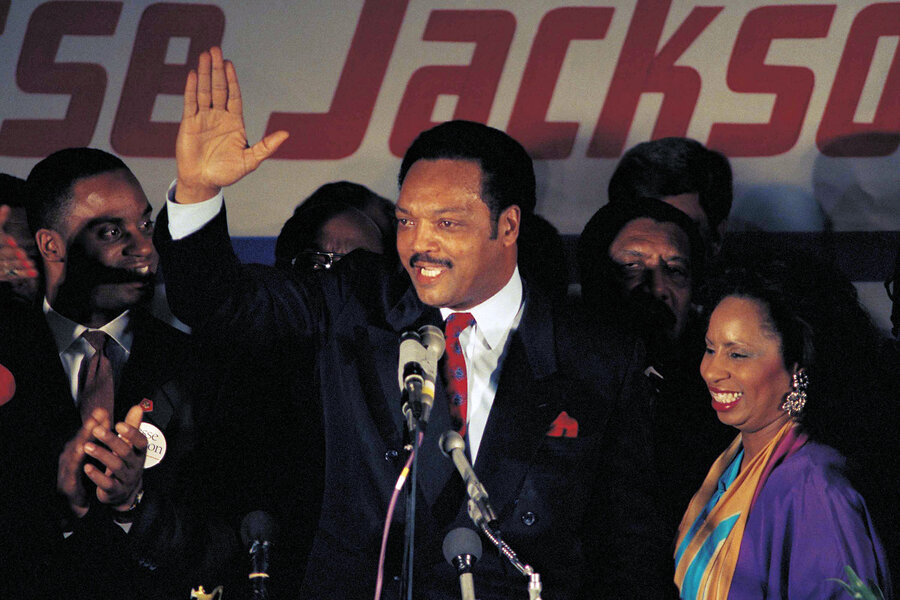
Back in 2024, I met the Rev. Jesse Jackson on Juneteenth and watched him do something truly remarkable – cast a shadow as a giant, figuratively, as a more than 40-foot-tall and 150-foot-wide monument to freedom was being dedicated in Montgomery, Alabama. There was a sea of people who took part in the monument’s dedication, and then those souls gravitated toward Mr. Jackson in a manner worthy of his gravitas.
“Charismatic leadership” is a phrase that might be used to describe Mr. Jackson’s persona and politics, much like it might have been used to describe Martin Luther King Jr. or Malcolm X. And yet, what defines them and their legacies is not celebrity alone. It is their actions and words, expressed in and out of season, in the spirit of creating a better world.
Mr. Jackson died Tuesday morning at age 84, his family confirmed in a statement, which spoke glowingly of him being a “servant leader.”
Why We Wrote This
Jesse Jackson, who died Tuesday, took up the mantle of Martin Luther King Jr. as a voice for equality, a presidential candidate, and a champion of Black voting. Our commentator traces Mr. Jackson’s journey to its roots in their shared home state, South Carolina.
“His unwavering commitment to justice, equality, and human rights helped shape a global movement for freedom and dignity,” Mr. Jackson’s family wrote. “A tireless change agent, he elevated the voices of the voiceless – from his Presidential campaigns in the 1980s to mobilizing millions to register to vote – leaving an indelible mark on history.”
As a South Carolina native, and, like the late Chadwick Boseman, connected with South Carolina’s Upstate, I knew about Mr. Jackson at a young age. More importantly, I was familiar with the protest that activated him and many others – the desegregation of libraries in his native Greenville in 1960. During the Christmas break of 1959, Mr. Jackson came home from the University of Illinois and attempted to secure a book for an assignment, but was rebuffed at a whites-only library.
After a pair of initial protests the following March, on July 16, 1960, Mr. Jackson and seven high school students would return to that library and perform an effective sit-in before being arrested. A similar occurrence happened in February 1960 in Greensboro, North Carolina, with students at North Carolina A&T, and proved effective against segregated businesses. Mr. Jackson later transferred to North Carolina A&T, where he played football and was elected student body president.
By the end of the decade, his personality and politics connected him with Dr. King and the Southern Christian Leadership Conference. In 1966, Mr. Jackson took the reins of Operation Breadbasket, a Chicago-based program focusing on economic empowerment. That project established Mr. Jackson’s roots in Chicago and was the genesis for future mobilization efforts such as the Rainbow PUSH Coalition. After Dr. King’s assassination in 1968, Mr. Jackson was seen as his successor because of their contributions to civil and human rights.
While Dr. King’s criticisms of Vietnam eventually led to his pro-labor and pro-Black campaign in Memphis, Tennessee, Mr. Jackson’s criticism of the Ronald Reagan administration led to two bids for the Democratic nomination, in 1984 and 1988. While Mr. Jackson didn’t win the nomination in either campaign, he crafted populist messaging that would be realized 20 years later with the election of Barack Obama, whose “Yes, we can!” and “Hope” were similar to his predecessor’s exhortation of “Keep hope alive!”
His actions at times stirred personal or professional controversies. But Mr. Jackson never stopped fighting for working-class, everyday people. As late as 2018, he pushed for economic boycotts of companies that created food deserts.
“Our father was a servant leader – not only to our family, but to the oppressed, the voiceless, and the overlooked around the world,” said the Jackson family. “We shared him with the world, and in return, the world became part of our extended family. His unwavering belief in justice, equality, and love uplifted millions, and we ask you to honor his memory by continuing the fight for the values he lived by.”
Aside from his being a native South Carolinian, what I will always remember is the beauty of Mr. Jackson on “Sesame Street” in 1972, wearing a manicured Afro with sideburns and a gold pendant. It is a reminder of the origins of ”Sesame Street,” a program designed to educate and acknowledge young people in urban centers. In this particular episode, children of various nationalities and races all sat in proximity of Mr. Jackson, who led them through a recitation of “I Am Somebody!”
It is the kind of edifying narrative that defines Mr. Jackson’s brilliance and love for people.