

Claire GrahamBBC News NI, Royal Courts of Justice in London

Judgement has been reserved in the challenge to throw out a terror case against a member of the rap trio Kneecap.
The UK government is appealing the September 2025 decision to dismiss the case against Liam Óg Ó hAnnaidh, which was thrown out on technical grounds relating to how the charge against him was brought.
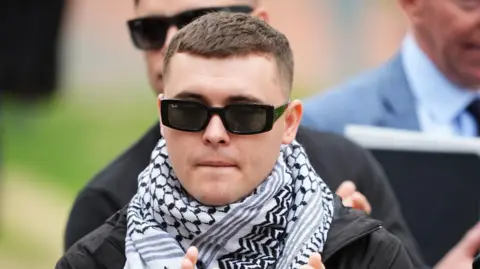
The artist from west Belfast, known as Mo Chara was accused of showing support for proscribed organisation Hezbollah following a gig in London in 2024.
The case against him was dropped on a legal timing issue.
It was found his charge was approved outside the six month time frame from the event, by one day.
The Director of Public Prosecutions has appealed the decision to drop the case.
Lord Jusice Edis who is hearing the appeal with Mr Justice Linden told the court, “we will be reserving judgement in this case”.
This means they will hand down their ruling in the case at a later date.
Lord Justice Edis said the submissions had “given us a great deal to think about”.
Ó hAnnaidh was charged in May after allegedly displaying a flag in support of proscribed organisation Hezbollah at a gig at the O2 Forum in Kentish Town, London, in November 2024.
The 28-year-old, who performs under the stage name Mo Chara, had denied the charge and described it as political.


The judgement will be published digitally, not necessarily including a further hearing, the Lord Justice added it will “probably not be necessary” as the consequences will be clear.
At the hearing at the Royal Courts of Justice in London on Wednesday, Jude Bunting KC acting on behalf of Liam Óg Ó Hannaidh told the court the ruling the technical issues that led to the terrorism charge against the rapper being thrown out “arose because of human error”.
In written submissions O Hanaidh’s team put forward “The answer to this appeal is straightforward… The necessary permission and consent were not provided at the time the proceedings were ‘instituted’.
“As such, the chief magistrate was plainly correct to hold that these proceedings were not instituted in the correct form within the six-month statutory time limit.”
Ó hAnnaidh’s defence previously argued that the charge was not brought within the six-month time limit since the alleged offence took place.
Paul Jarvis KC acting for the Director of Public Prosecutions, said a gap in time for consent from the attorney general was acceptable if everything was in place by the time the defendant first attends court.
He also argued case law, or previous cases, to suggest that the charge issued within the six months since the time of the alleged offence was valid.
At the time, Senior District Judge Paul Goldspring ruled proceedings could not proceed at Westminster Magistrates’ Court, because the charge fell outside the time frame.
In court on Wednesday morning, Jocelyn Ledward KC also made submissions on behalf of the attorney general.
The court heard that the attorney general’s legal team did not accept some elements of the original ruling last year and gave examples of how consent to start a prosecution can come at a later date.
The legal team for Ó hAnnaidh is due to speak in court later on Wednesday.
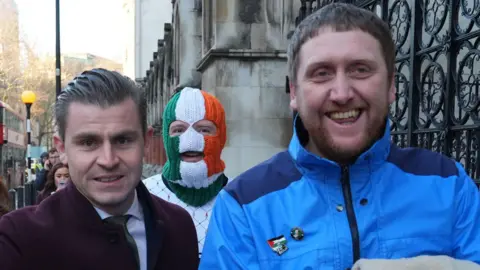
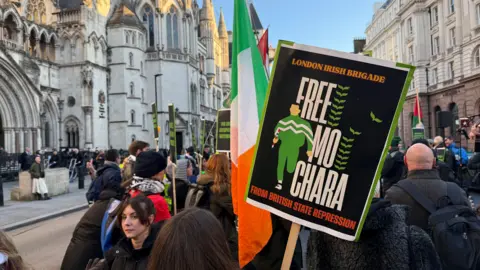
Earlier, supporters of Kneecap had gathered at the Royal Courts of Justice just before 09:00 GMT carrying Irish tricolours and Palestinian flags and various signs.
Outside the court, at The Strand in central London, about 80 supporters gathered with flags and banners. Musicians played to the crowd from a platform.
The Sinn Féin MPs John Finucane and Paul Maskey are inside the court with Kneecap supporters, band manager Dan Lambert and J.J. Ó Dochartaigh, aka DJ Próvaí, alongside an assortment of press.
The hearing continues.
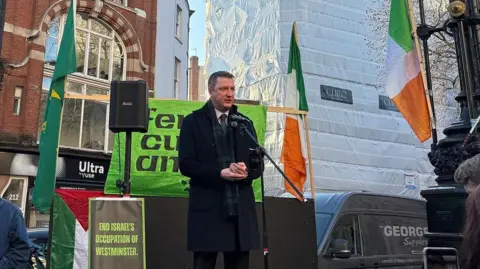
Finucane spoke to supporters of Kneecap outside the court.
“We will continue to stand with Liam we will continue to stand on the right side of history,” the Belfast North MP said.
In September, Chief Magistrate Paul Goldspring told Woolwich Crown Court that the charge against Ó hAnnaidh was “unlawful” and “null”.
In his judgement, the chief magistrate outlined that permission was not given to the Director of Public Prosecutions (DPP) to consent to the prosecution until 22 May, a day after Ó hAnnaidh was charged.
If 22 May was considered to be the date of the charge, that was six months and a day after the London gig where the offence allegedly happened.
The decision did not relate to any of the allegations Ó hAnnaidh had been facing.
The DPP argues that it was sufficient that the charge was brought before Ó hAnnaidh made his first appearance at court on 18 June 2025 to answer the written charge.
The Crown Prosecution Service (CPS) announced in October 2025 that it would appeal the decision “as we believe there is an important point of law which needs to be clarified”.
In a statement issued on social media at the time, Kneecap said the appeal would be “a massive waste of taxpayers money, of police time, of court time”.
The group added: “News of a CPS appeal against the ruling of their own judge is unsurprising.
“It is unsurprising, because the whole process has not been driven by the police or courts, it has been driven by politicians backed up by the British media.”
They said this is “political policing”.
“There is no important point of law. The CPS have submitted nothing new in their appeal. What there is though is a state wide witch-hunt against Palestinian solidarity.”
In a social media post earlier this month, Kneecap said: “It is the view of our legal team that there is not an iota of logic for this [appeal], it is without any sound legal basis.”
Who are Kneecap?
