
- A new analysis finds that the floods of Punjab in August 2023, were not caused by rainfall during the flood period, but in the month before.
- Pong dam, a storage and hydroelectric dam on the Beas river, is believed to have worsened the disaster by allowing the reservoir to fill to near maximum levels before increasing outflows too suddenly.
- The researchers argue that forecast-based decision-making could have reduced the impacts of the flood.
The floods of Punjab in August 2023, were not caused by rainfall during the flood period, but driven by exceptionally high levels of rainfall in the month before, a new analysis tracking the flood’s causes and impacts has found.
Researchers from the Indian Institute of Technology-Mandi, compared flood events in July and August 2023 in Punjab, the latter of which turned very severe, inundating 11,927 villages. Over 50 people died in the aftermath of the floods. Specifically, the researchers sought to understand why the floods were so severe despite below average levels of rainfall in August. “We noticed that in July, when there were severe floods in Himachal, there wasn’t as much of an impact downstream in Punjab, and yet the opposite happened in August, which deserved investigation,” said Vivek Gupta, Assistant Professor at the School of Civil and Environmental Engineering at IIT-Mandi, and a co-author of the paper.
The research examined the meteorological and operational reasons for the flood, as well as its socioeconomic impacts, to arrive at a “multi-scalar assessment” of the flood. The Pong dam, an earth-filled storage and hydroelectric dam on the Beas River, is believed to have worsened the disaster by allowing the reservoir to fill to near maximum levels before increasing outflows too suddenly.
The IIT-Mandi study says that the dam’s flood control measures limited the flood’s exposure to 205,664 individuals, compared to a “no control” scenario where the flood would have affected 367,531 people. The lack of forecasting in the dam operations, however, prevented it from acting more efficiently.
According to Himanshu Thakkar, a dam expert and convenor of South Asia Network on Dams, Rivers and People (SANDRP), who was not part of the study, the role of the dam in causing the floods of 2023 and the more recent floods of 2025 in Punjab is “indisputable.”
“Considering the rainfall in the catchment area which started on August 10 in 2023, the outflows from the dam should have started much earlier instead of waiting till it was at near-full capacity,” he said.
Rainfall and vulnerability
Exceptionally high rainfall in the upper Beas River in July 2023 in Himachal Pradesh — the Pong dam’s catchment area — primed the region for severe flooding downstream the next month, the IIT study found. “Soil moisture at the 40-100 cm depth exceeded the long-term climatology by 40-60% across the study area. These anomalies highlight that the July rainfall events created a highly saturated baseline… suggesting that July rainfall preconditioning extended into deeper soil,” the study says.
Atmospheric upwelling in the Beas river basin caused abnormally high rainfall, “which in turn accelerated catchment runoff and amplified inflows into Pong Dam.”
Punjab witnessed two acute flood events in August 2023 — one between August 15-17 and another between August 23-25. The flood led to disproportionate impacts, especially for each day that the flood persisted. Between August 15-17, the number of women exposed to the flood increased by 46.1%, particularly among non-working groups. Children aged 0–6 years showed the highest vulnerability, with their exposure rising by 49.4%.
“We were able to find these results by overlaying the inundation maps with the population distributions of the affected areas,” said Ashish Pathania, lead author of the study. “There are also some global studies which state that these particular sections, which are dependent ones, face the impact of the flood more due to their limited coping capacity and their restricted access to resources.”

The role of the dam
According to the study, the Pong dam received its highest peak inflows of approximately 12,500 metres cubed per second on August 15, the highest recorded since 1979, while maintaining reservoir levels above 420 m. The highest it reached The Pong dam’s maximum reservoir capacity is listed on its website as 432 m.
Outflows from the dam were recorded at 499.5 cumecs (a unit of volumetric flow rate representing one cubic meter of fluid flowing per second) on August 14; 2,472.6 cumecs on August 15; 4,017.5 cumecs on August 16; and 3,679.1 cumecs on August 17, indicating “that Pong Dam effectively absorbed the impact of high inflows through a phased water release strategy.”
Using a simulated Soil and Water Assessment Tool — a forecasting tool which optimises release scenarios under varying maximum reservoir limits — reduced dam outflows even when reservoir was tested at a maximum limit of 426.4 meters. “Peak outflows were effectively reduced in all scenarios, with those having higher stage limits enabling greater water storage within the reservoir,” says the study.
“Our argument is that if forecast-based decision-making had been incorporated, it could have reduced the impacts of the flood further,” said Gupta, adding that as per the IS 5477 standard for fixing capacity of reservoirs, flood and surcharge storage capacities lie between the “safety limit” and maximum reservoir level.
However, Thakkar pointed out that the outflows from the dam were decreasing till August 15 even though the reservoir was approaching its safety limit. Though the dam’s absolute maximum capacity is listed as 432 m, the Full Reservoir Capacity, or safety limit, is 1,390 feet, or 423 m, to protect against flash flood instances. At its peak during preceding the flood, the reservoir capacity had crossed this threshold, reaching 426.5 m, according to the IIT-Mandi study.
“The study doesn’t mention the dam’s rule curve, which is a guide for dam operators to fill the dam to its capacity by a certain date during the monsoon season. For the Pong and Bhakra dams, that date is September 20,” said Thakkar.
“If in July if there was heavy rainfall upstream and the dam was required to absorb the impact, outflows should have remained relatively higher to abide by the rule curve. In any case, heavy rainfall in the catchment had already started by August 10. In this case, the outflows kept reducing before suddenly increasing hugely after August 15, which was too late and ended up creating avoidable floods.”
In 2025, the operation of the Pong dam faced renewed scrutiny when flooding in Punjab inundated around 1,900 villages.
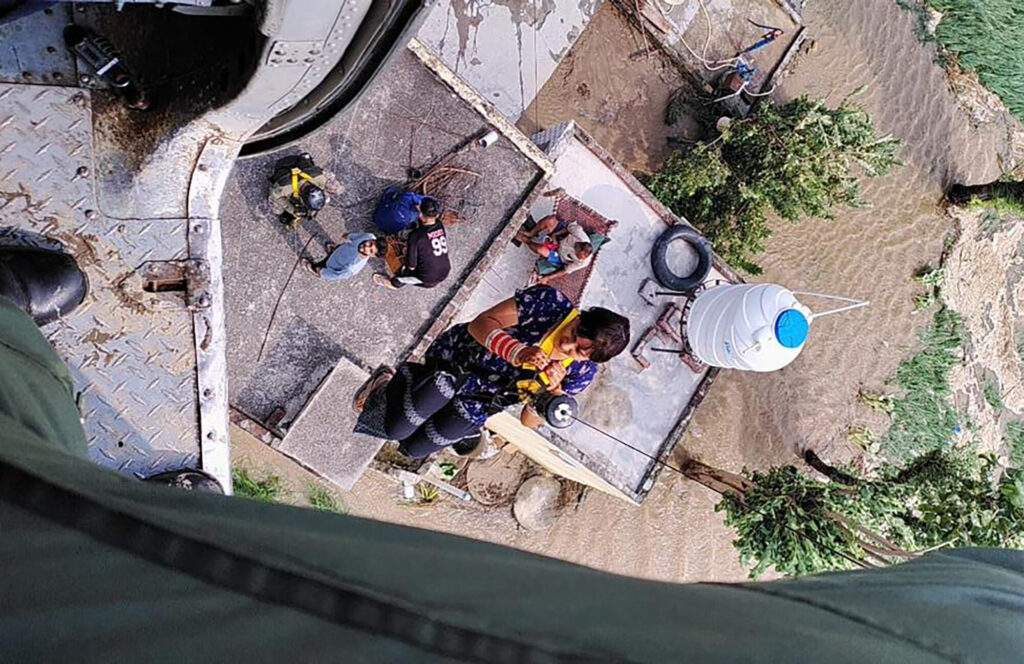
Banner image: A woman is airlifted from a flood-affected area in Himachal Pradesh in August 2023. (Indian Air Force via AP)

