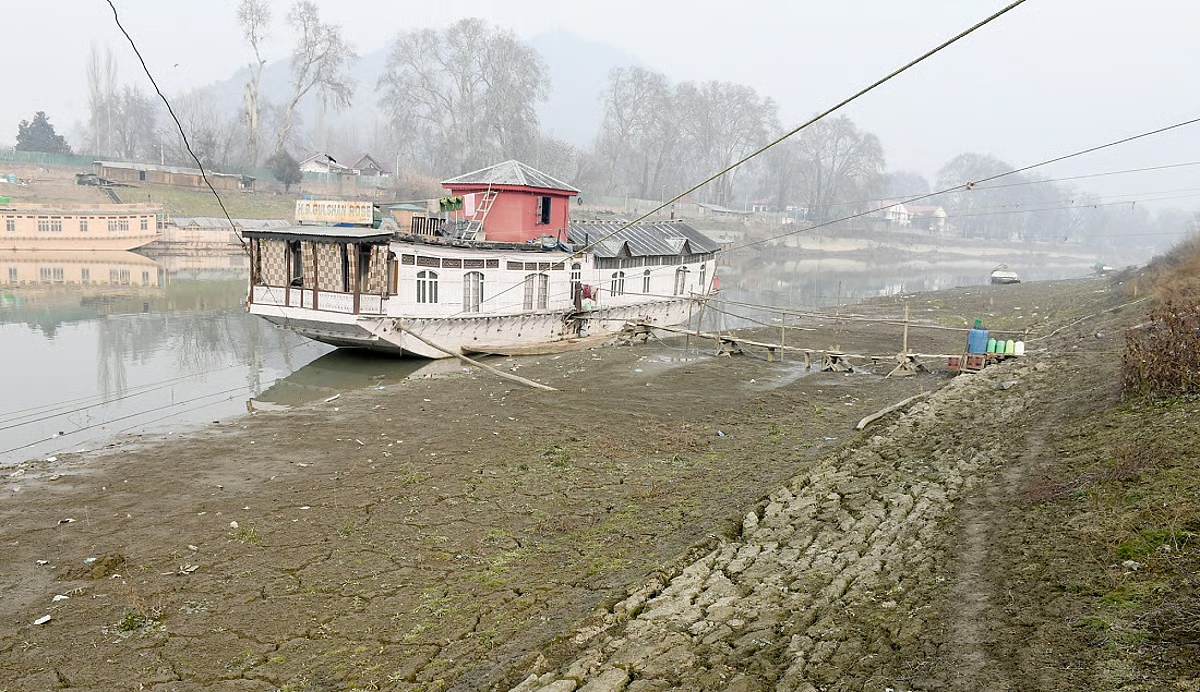
“The heat is accelerating evaporation and reducing the amount of water reaching rivers,” Ahmad said.
Researchers are now trying to understand where much of the meltwater is going.
“We are studying whether glaciers are melting and, if so, why the additional water is not appearing in river discharge. Evaporation driven by heatwaves could be consuming a significant portion of the water before it reaches rivers,” he said.
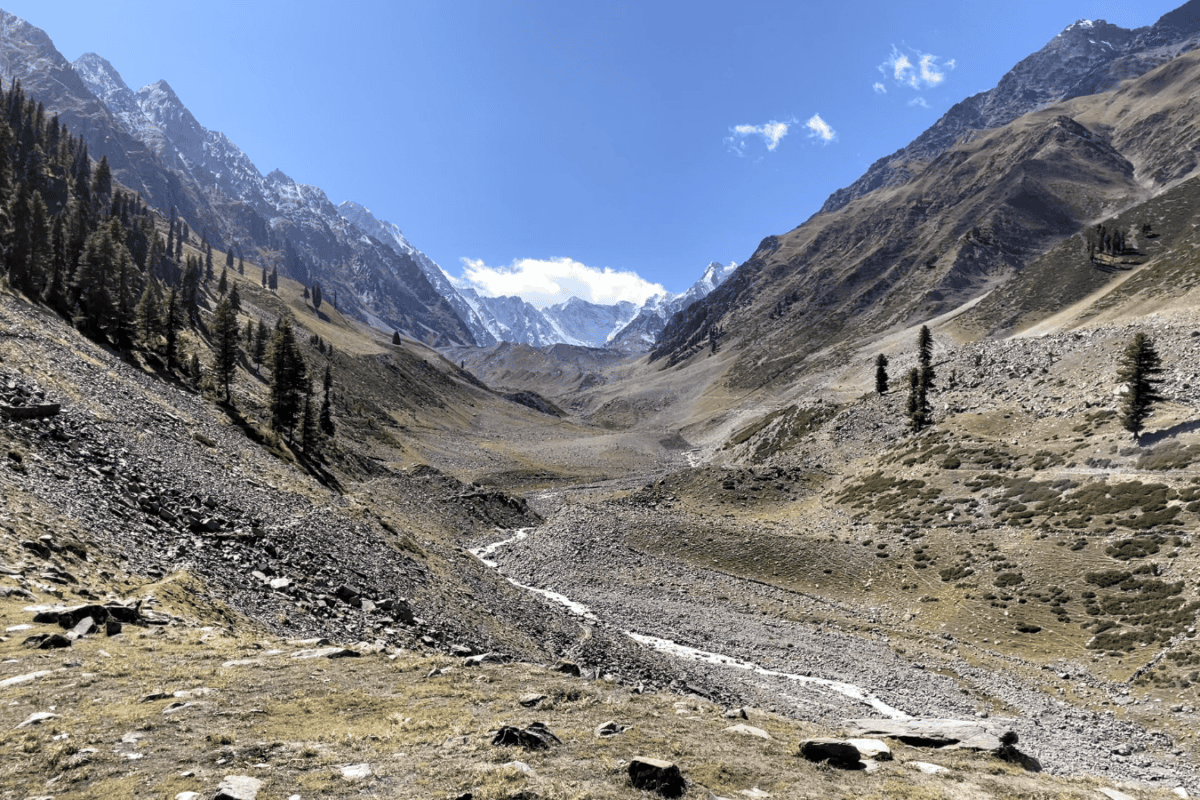
Long-term studies show that Kashmir’s glaciers have been steadily retreating for decades. The total glaciated area of nine benchmark glaciers in the region has shrunk by 5.2 square kilometres, nearly 18 percent between 1980 and 2013, showing a broader warming trend across the Himalayas.
Ahmad, who has also served as Professor (M.K. Gandhi Chair) at the Centre for Disaster Management in the Department of Geography at Jamia Millia Islamia, New Delhi, said snowfall plays a crucial role in sustaining the region’s water resources.
“Snow acts as a natural water lock,” he said. “In a normal year, snow accumulated at lower altitudes melts during spring and recharges springs, streams and wells. This year there is hardly any snow at lower elevations.”
He added that farmers may need to reconsider water-intensive crops in view of changing climate patterns.
“Farmers should gradually shift away from highly water-intensive crops like paddy in some areas and adopt drip irrigation or more climate-resilient crops,” Ahmad explained.
A lived reality
For Kashmir’s farmers, these changes are no longer just warnings but lived realities.
In Charsoo village of Pulwama district, about thirty kilometres south of Srinagar, Arshid Hussain Bhat, a fourth-generation farmer, watches the river levels closely each year. Bhat cultivates paddy on ten kanals (1 kanal is 0.0505857 hecatres) of land, relying on irrigation channels that draw water from the Jhelum.
In recent years, he said, the seasonal rhythm of farming has begun to shift.
“Last year our crops were badly hit,” Bhat recalled. The rains arrived late, and floods in September damaged fields just before harvest.
Now, with river levels already low in early spring, he worries about the coming months.
“When the water level drops, the pumps stop working,” he said. Without sufficient water in the river, irrigation channels fail to carry water to fields further away.
Bhat also blames extensive sand mining along parts of the Jhelum for worsening irrigation problems.
“Mining has deepened sections of the riverbed and damaged embankments, making it harder to draw water into irrigation canals,” he said.
The rising temperatures worry him even more.
“If it is already around twenty degrees now and the heat continues like this, it could reach thirty-eight or forty degrees in June,” he said.
The road ahead
Agricultural scientists say farmers may have to adapt to these changing conditions.
At the Sher-e-Kashmir University of Agricultural Sciences and Technology (SKUAST) Kashmir, researchers have been working on contingency plans for farmers facing water shortages.
Sameera Qayoom, professor and head of the university’s division of agrometerology, said the university has issued advisories urging farmers to conserve soil moisture and prepare for drought conditions.
“Crops are vulnerable under the current conditions,” Qayoom told DTE, noting that February alone recorded precipitation deficits of nearly 85 per cent.
The university has advised farmers to apply organic mulch such as paddy straw around fruit trees to retain soil moisture, avoid fertilisers in orchards where irrigation water is scarce, and limit urea application in field crops unless adequate moisture is available.
Vegetable growers have also been encouraged to irrigate during cooler hours and protect nurseries using shade nets or straw coverings.
In the longer term, she said, farmers may have to reconsider cropping patterns.
“If water availability becomes uncertain, farmers will have to think about growing crops like maize or pulses instead of water-intensive crops such as paddy in some areas,” she said.
For now, officials remain optimistic that conditions may improve.
Nisar Ahmad Malik, executive engineer with the Irrigation and Flood Control Department in Anantnag, said river flows could still rise if temperatures trigger stronger snowmelt later in the month.
“After mid-March we expect some increase in water levels,” Malik told DTE.
Yet even he admitted that winters in Kashmir no longer behave the way they once did.
“Twenty years ago, this period used to see snowfall,” Malik said.