Wes Streeting says world will be safer with rules-based system, and it should be collectively rebuilt
Wes Streeting, the health secretary, was doing a media round on behalf of the government this morning. Like Kemi Badenoch (see 9.20am), he also acknowledged that support for the rules-based international order was weakening. But he sounded less willing than she was to accept this. He told GB News:
The UK supports the rules-based international system. We have seen it creaking at the seams, and now we see it disintegrating.
It is our responsibility collectively to rebuild the rules-based international system, because a world in which countries are abiding by the same rules and working with each other is a world in which we are all safer, but we are a far cry from where we have been, sadly, since the Second World War in terms of upholding that rules-based international system.
Starmer tells cabinet they need to show 2026 is year when ‘renewal is becoming reality’
Keir Starmer has told his cabinet ministers that 2026 will be the year when they need to show that “renewal is becoming reality”.
Speaking at the start of this morning’s political cabinet, he said:
This will be an important year as we show that renewal is becoming reality and that Britain is turning the corner.
Getting our country back on track is hard, difficult work and we will reject the politics of easy answers and gimmicks that, frankly, got us here in the first place.
At the next general election we will be judged on whether we’ve delivered on things that really matter, do people feel better off, are public services improving – for which they will look to the NHS – and do people feel more safe and secure in their own community?
They are the issues we will be judged on at the next general election, that is our focus.
Badenoch claims Brexit not succeeding because UK ‘not doing anything with it’
In her Today programme interview, Kemi Badenoch also claimed that Brexit was not working because the UK is not “doing anything with it”.
Badenoch was an enthusiastic supporter of Brexit, even though she was not an MP at the time of the 2016 referendum, and as a minister she was seen as a keen Brexiter.
Asked by Nick Robinson, the presenter, how she thought Brexit was going, on a scale of one to 10, Badenoch replied:
We’re not doing anything with it, that’s the problem.
Asked again how it was going, she said:
We successfully left the European Union, so 10 out of 10 for leaving. But using the opportunity – we’re not using the opportunity …
What I’m saying is that nothing’s happening. Nothing’s happening.
We need to compete aggressively with other countries. We need to be close with Europe, not run by Europe. That is Conservative policy. Let’s stay close to our regional and international allies. But sovereignty matters.
Britain formally left the EU in 2020 when Boris Johnson – like Badenoch, a hardline Brexiter – was prime minister. Some rightwingers argue that the UK would thrive outside the EU if it deregulated more aggressively, and diverged more from the EU. But in the four years they were in office after Brexit, the Tories did not implement the sort of policies Badenoch seems to be proposing because they judged they would not benefit the economy.
Recent research says Brexit has cut the UK’s GDP by between 6% and 8%.
Government publishes plan to protect public services from cyber threats
A new plan to protect public services from cyber threats has been published today, PA Media reports. PA says:
The government has set out measures to make online services more secure and give the public confidence that their data is protected when applying for benefits, paying taxes or accessing healthcare.
The cyber action plan, backed by £210m, aims to highlight where risks lie across government and take joined-up action across departments as well as speeding up reactions to attacks.
It comes amid efforts to digitise services, which the government hopes will reduce phone queues and paperwork and says could unlock up to £45bn in savings.
Digital government minister Ian Murray said: “Cyber attacks can take vital public services offline in minutes – disrupting our digital services and our very way of life. This plan sets a new bar to bolster the defences of our public sector, putting cyber-criminals on warning that we are going further and faster to protect the UK’s businesses and public services alike.”
Labour to protect existing MPs above winning more seats at next election, deputy leader Lucy Powell says
Labour will switch to an “incumbency first” model to protect MPs at the next election rather than targeting seats, the deputy leader, Lucy Powell, has told Labour MPs. Jessica Elgot has the story.
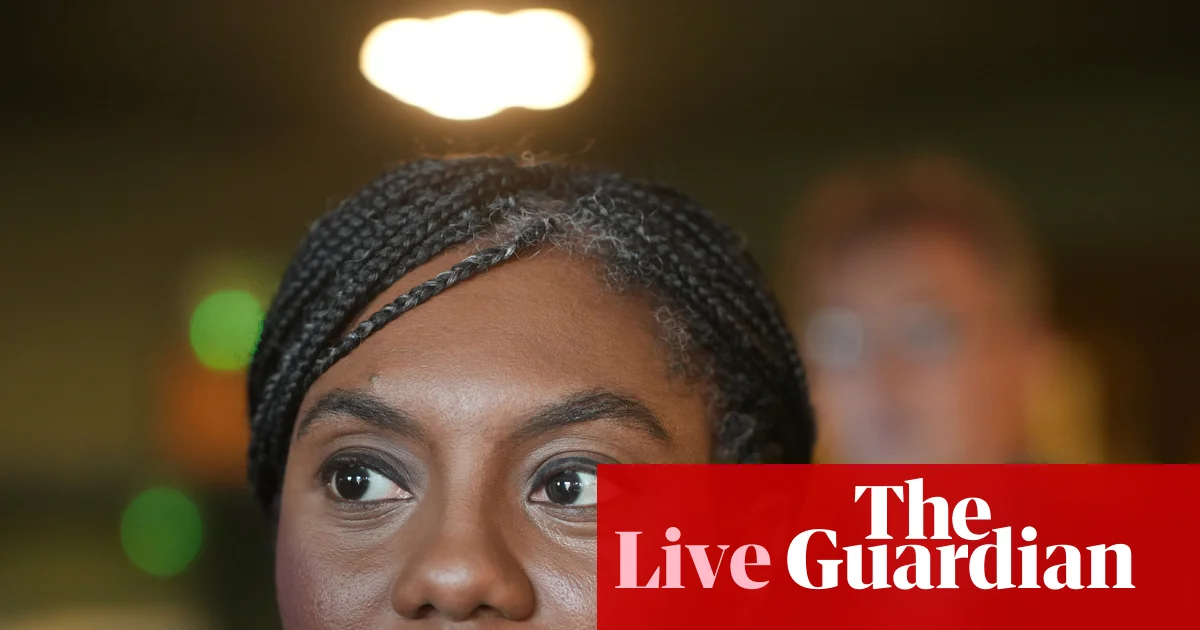
Kemi Badenoch says Trump’s Venezuela raid was ‘morally’ right, as she suggests faith in rules-based global order overrated
Good morning. Over the last three days it has been hard to find anyone in British politics willing to defend the US raid on Venezuela leading to the capture of its president, Nicolás Maduro. In the Commons last night, Yvette Cooper, the foreign secretary, engaged in a delicate balancing act – stressing the UK’s support for international law, while doing her best not to criticise the fairly blatant US breach of it – as MPs from all the main parties lined up to demand a more robust pushback against Donald Trump.
But this morning Kemi Badenoch has defended the US president. At the weekend, her initial response was much like Keir Starmer’s – noncommittal, and claiming that she could not give a proper view until more information was available. Even yesterday she was still broadly still sitting on the fence.
However, this morning, in a long interview with the Today programme (which is promising in-depth, start-of-year interviews with all the main party leaders), she declared that what Trump did was “morally … the right thing to do”. She also implied that faith in the rules-based international order, sustained by international law, was overrated because the world did not operate like that any more.
When it was put to her that Margaret Thatcher condemned the US invasion of Grenada in 1983, Badenoch said that Thatcher was right at the time, but that Trump’s action was different. She went on:
Venezuela was a brutal regime. We didn’t even recognise it as a legitimate government. I think that what’s happened is quite extraordinary. But I understand why America has done it.
And the reason why I say this is because, where the legal certainty is not yet clear, morally I do think it was the right thing to do.
Badenoch said she was saying this because she was different from other party leaders and MPs.
I grew up under a military dictatorship [in Nigeria], so I know what it’s like to have someone like Maduro in charge. I know what it’s like to have people celebrating in the street. So I’m not condemning the US.
Asked again if sending special forces in to seize Maduro was the right thing to do, Badenoch replied: “Morally, yes.”
Badenoch did say that the invastion raised “serious questions about the rules-based order”. But, in another shift from the position adopted by Keir Starmer, she went on to question how robust the rules-based international actually is any more. She explained:
As we all know, international law is what countries agree to. Once people decide they don’t agree, there is no international law. There’s no world police, no world government, no world court. These are agreements.
And when we look at what the opposition leader, María Machado, said, she said Venezuela had already been invaded. It had been invaded by Russia, by Iran, by Hezbollah. Where were the people talking about international law then?
Badenoch was then asked if she agreed with Stephen Miller, Trump’s deputy chief of staff, who said yesterday that “we live in a world … that is governed by strength, that is governed by force, that is governed by power.” Badenoch implied that she did. She replied:
The US has actually been saying this for a very long time. I remember as trade secretary, the US has basically walked away from the World Trade Organization saying that everybody else was breaking the rules, China in particular, and if people weren’t following the rules, there was no rules-based order.
And we go through the motions, we act as if it is still 1995, we were living off the peace dividend of the cold war and World War Two.
The world has changed. What I want to see is a strong Britain. We can’t control everything that the US does. Venezuela is very far away from here. It’s not Grenada, for example. But what they do respect is strength. And we are getting weaker.
This is quite a bold position to take, not least because it is at odds with what most Britons think.
I will post more from the interview shortly.
Here is the agenda for the day.
9am: Keir Starmer chairs cabinet. Most of the meeting will be devoted to a political cabinet, where civil servants leave the room and ministers focus on party political matters – such as the Scottish parliament, Welsh Senedd and English local elections in May.
10am: Dave Hinton, chief executive of South West Water, gives evidence to the Commons environment committee about the Tunbridge Wells water shortage last month.
10.30am: Stephen Doughty, a Foreign Office minister, gives evidence to the Commons foreign affairs committee as part of its inquiry into “Disinformation diplomacy: How malign actors are seeking to undermine democracy”.
Morning: Kemi Badenoch is on a visit in London.
11.30am: Ed Miliband, the energy secretary, takes questions in the Commons.
Noon: Downing Street holds a lobby briefing.
Afternoon: Keir Starmer joins other European leaders in Paris for a meeting of the “coalition of the willing” group willing to provide security guarantees to Ukraine in the event of a ceasefire. Volodymyr Zelenskyy, the Ukrainian president, and Donald Trump’s advisers Steve Witkoff and Jared Kushner are attending. A press conference is due at around 5.45pm.
2pm: The Commons business committee takes evidence from former post office operators, laywers, the Post Office, ministers, and others about progress in Post Office Horizon scandal compensation payments.
2.30pm: Craig Guildford, chief constable of West Midlands police and Mike O’Hara, an assistant chief constable at WMP, give evidence to the Commons home affairs committee about claims they misrepresented the intelligence they used to justify their call for a ban on Maccabi Tel Aviv fans attending the Villa Park match last year.
If you want to contact me, please post a message below the line when comments are open (normally between 10am and 3pm at the moment), or message me on social media. I can’t read all the messages BTL, but if you put “Andrew” in a message aimed at me, I am more likely to see it because I search for posts containing that word.
If you want to flag something up urgently, it is best to use social media. You can reach me on Bluesky at @andrewsparrowgdn.bsky.social. The Guardian has given up posting from its official accounts on X, but individual Guardian journalists are there, I still have my account, and if you message me there at @AndrewSparrow, I will see it and respond if necessary.
I find it very helpful when readers point out mistakes, even minor typos. No error is too small to correct. And I find your questions very interesting too. I can’t promise to reply to them all, but I will try to reply to as many as I can, either BTL or sometimes in the blog.