After months of escalating military action, the United States carried out a strike inside Venezuela to capture sitting president Nicolás Maduro and his wife, scrambling international norms – and potentially breaking national and international law.
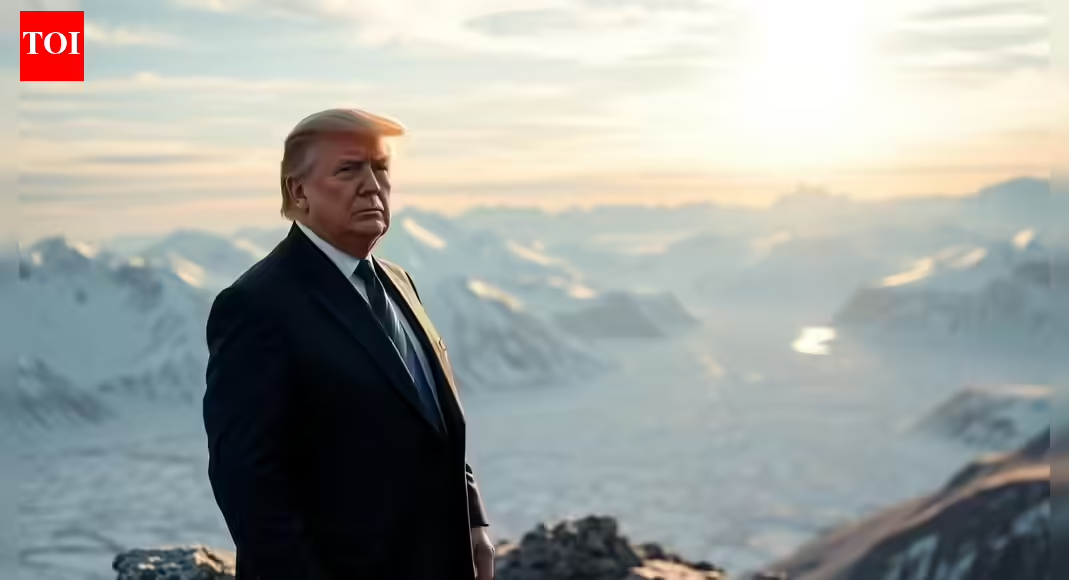
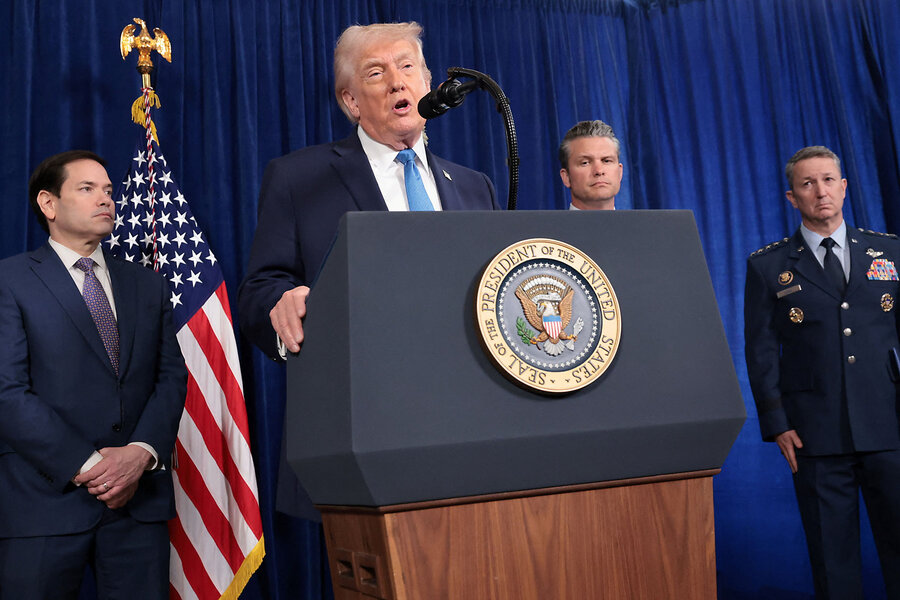
The U.S. hit Venezuela with a “large-scale strike” before dawn on Saturday, seizing the unpopular Mr. Maduro and flying him out of the country to face charges of “drug trafficking and narco-terrorism conspiracies” in the United States. President Donald Trump said during a Saturday morning news conference that the U.S. would now “run the country,” including its vast oil reserves, “until such time as we can do a safe, proper, and judicious transition.”
“This mission was meticulously planned” with interagency work starting months ago, said Air Force Gen. Dan Caine, the chairman of the Joint Chiefs of Staff, at the news conference. What appeared to be a photo of Mr. Maduro, blindfolded and wearing a grey sweatsuit aboard the USS Iwo Jima, was posted by Mr. Trump on social media.
Why We Wrote This
The U.S. ouster of Venezuela’s Nicolás Maduro deposes an unpopular world leader. It also raises important legal and geopolitical questions for the Western Hemisphere.
For more than a decade, Mr. Maduro has managed Venezuela’s deteriorating economy while increasingly clamping down on the political opposition and human rights. More than 8 million Venezuelans, nearly one-third of the population, have fled the country’s economic, humanitarian, and political crises since 2016. Mr. Trump discussed the possibility of military intervention in Venezuela during his first term, but he also campaigned in 2024 on ending U.S. involvement in so-called forever wars.
While many agree that Mr. Maduro was a repressive leader and increased suffering inside the country, the why behind the U.S. intervention is more contentious, and raises questions about its legality and geopolitical implications.
The U.S. has accused Mr. Maduro of being central to regional destabilization – from increasing drug trafficking and the flow of migrants to the U.S. to using Venezuela’s oil reserves to prop up other U.S. political foes, such as Cuba.
Last year, the U.S. raised the bounty on Mr. Maduro to $50 million, labeled Venezuelan gangs as terrorist organizations (and Mr. Maduro head of a narco-terrorist state), carried out military strikes on suspected drug-trafficking boats in the Caribbean and Pacific, and last month seized at least two oil tankers, all while building up a large-scale U.S. military presence off the Venezuelan coast.
“This extremely successful operation should serve as warning to anyone who would threaten American sovereignty or endanger American lives,” Mr. Trump said.
“Under our new national security strategy, American dominance in the Western Hemisphere will never be questioned again,” the president said, underscoring a resurgence of the 19th-century Monroe Doctrine in Latin America. The U.S. will have a presence in Venezuela “as it pertains to oil,” Mr. Trump said, using the “tremendous amount of wealth” underfoot in Venezuela – home to the largest proven oil reserves in the world – to reimburse the U.S. for damages Venezuela has caused.
The White House did not seek congressional approval before Saturday’s strike and capture, raising ire among Democratic lawmakers. Some analysts say the U.S. likely violated international law under the United Nations charter, and that the action could create a road map to be replicated by other nations facing stalwart political foes.
“If the United States asserts the right to use military force to invade and capture foreign leaders it accuses of criminal conduct, what prevents China from claiming the same authority over Taiwan’s leadership? What stops [Russian leader] Vladimir Putin from asserting similar justification to abduct Ukraine’s president?” asked Sen. Mark Warner of Virginia, the Democratic vice chairman of the Senate Select Committee on Intelligence, following Saturday’s operation. “Once this line is crossed, the rules that restrain global chaos begin to collapse, and authoritarian regimes will be the first to exploit it.”
The Trump administration argues it has a legal case for action. Over the past year, it laid the legal groundwork by declaring an “invasion” by Venezuelan gangs and by targeting what it considered to be terrorist groups there. This could bolster claims that the U.S. attacked Venezuela in self-defense. The administration describes the capture of the Maduros as a law enforcement action against indicted criminals.

“President Trump today changed the course of Latin America for a generation,” said Republican Sen. Bernie Moreno of Ohio. “By acting in America’s self-defense and self-interest … he eliminated an obvious clear and present danger to our nation.”
The Venezuelan diaspora has been vocal in its support for Mr. Maduro’s ouster, with revelers waving Venezuelan and American flags in support of Mr. Trump’s actions outside the president’s Mar-a-Lago estate in Florida on Saturday. But in the Venezuelan capital of Caracas “people are scared,” says Carlos Romero, a retired professor of political science at the Central University of Venezuela.
“People are staying inside; there aren’t demonstrations. It’s a moment of great uncertainty,” he says. The message from the Venezuelan regime has been clear, says Dr. Romero: “The Venezuelan armed forces have not ruptured and they continue to support Mr. Maduro and his political project.”
According to the Venezuelan Constitution, Vice President Delcy Rodríguez will step into power until new elections can be held. But even that is in question.
“The U.S. decapitated Venezuela, and I expect to see jockeying for power,” says Christopher Sabatini, a senior fellow for Latin America at Chatham House, a London-based think tank.
“This is not a democratic transition. It’s not even a regime change – yet,” he says.
Democratic Sen. Mark Kelly of Arizona, a former U.S. Navy combat pilot, compared the strikes in Venezuela and Mr. Maduro’s arrest with the events that led to U.S. war in Iraq.
“I want the people of Venezuela to be free to choose their own future, but if we learned anything from the Iraq war, it’s that dropping bombs or toppling a leader doesn’t guarantee democracy, stability, or make Americans safer,” he said in a statement. “I don’t trust that this administration has a plan, timeline, or price tag for what comes next” in Venezuela.
Mr. Trump has not ruled out a second, larger attack in Venezuela.
Global reaction has been mixed, but even among those who did not support Mr. Maduro, there has been outcry over Saturday’s operation. French Foreign Minister Jean-Noël Barrot wrote on social media that Mr. Maduro “gravely violated the rights” of Venezuelans, but “no lasting political solution can be imposed from the outside.” Spain offered to mediate a resolution to the military escalation.
Russia and China, which have invested financially and militarily in Venezuela, each condemned the U.S. attack, with neighboring Brazil calling it a dangerous international precedent.
Next door, Colombia began preparing for an influx in Venezuelan refugees.
Venezuelan opposition leader and Nobel Peace Prize winner María Corina Machado said the “hour of freedom” for Venezuelans has arrived and that Edmundo González Urrutia, whom the opposition says won the July 2024 presidential election, “must immediately assume his constitutional mandate” as president.
Staff writer Anna Mulrine Grobe contributed reporting for this article.