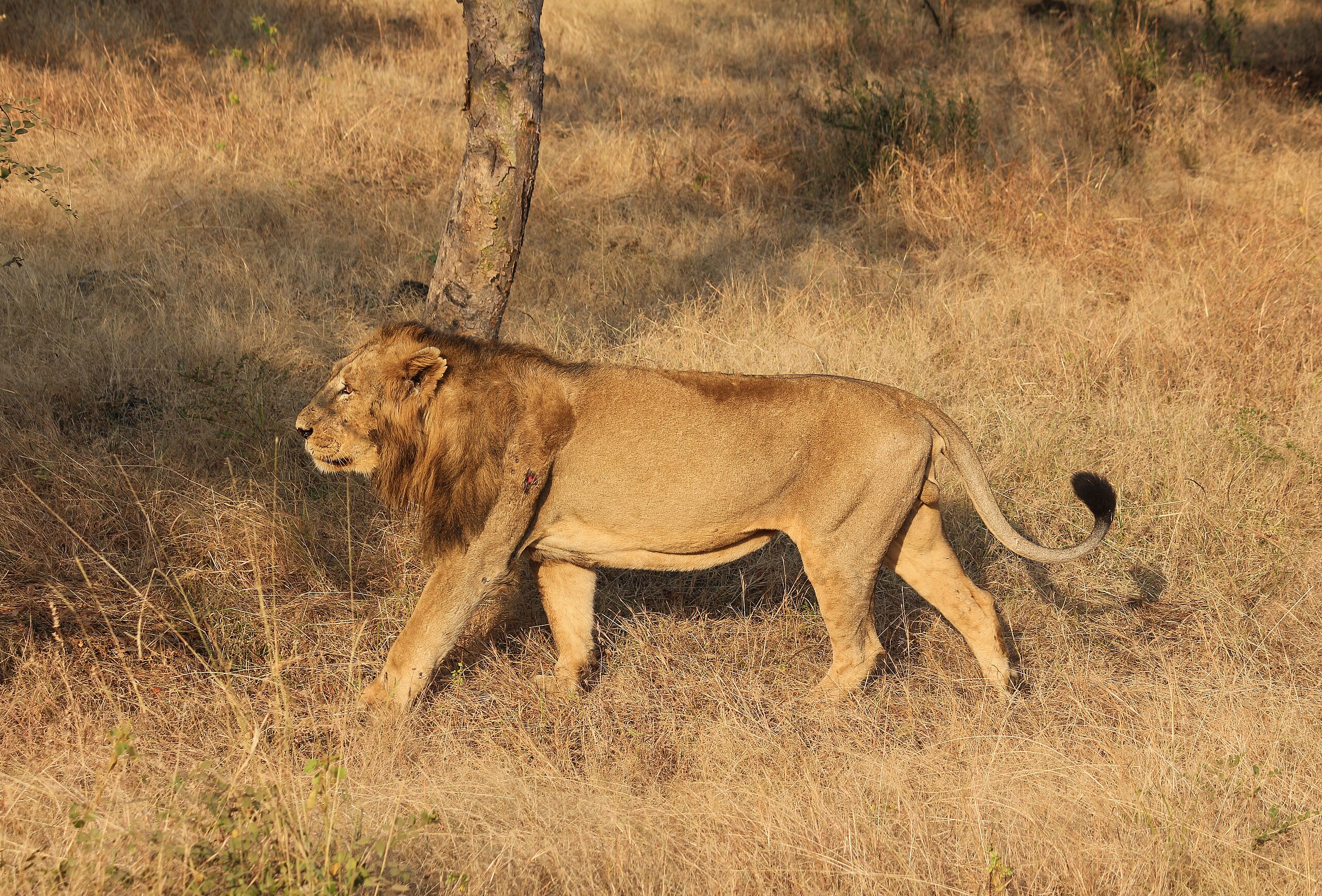
- The population of Asiatic lions in Gujarat has grown from 674 individuals to 891 between 2020 and 2025, according to the Gujarat Forest Department.
- From these, 394 were found in Gir National Park, Gir Wildlife Sanctuary, and its adjoining areas. The rest formed nine satellite populations outside the core zone, including along the coasts of Bhavnagar and southwest of Saurashtra.
- However, 669 lions died during 2020-2025 period due to old age, illnesses, injuries, cub mortality, accidents due to human pressures and other issues.
Asiatic lions in Gujarat are increasingly occupying a variety of different landscapes as their population grows, a census exercise by the Gujarat Forest Department found.
Between 2020 and 2025, the population of Asiatic lions increased from 674 individuals to 891, the census, published as a paper in the Global Ecology and Conservation journal, says. However, of these, only 394 were found in the core areas comprising the Gir National Park, Gir Wildlife Sanctuary, and its adjoining areas. A majority of lions formed satellite populations in several other regions outside the core zone.
Asiatic lions are found in Gujarat’s Saurashtra region, which is a semi-arid landscape hosting six protected areas and a diverse range of habitats, including grasslands, dry deciduous forest, and coastal ecosystems. As the population grew, the spatial distribution range of lions also increased, from 30,000 square kilometres in 2020 to 35,000 sq km in 2025, marking a 16.67% increase. “What we’re seeing is lions reclaiming their original habitats,” said Mohan Ram, a senior forest officer with the Gujarat Forest Department, and lead author of the study.
The growth of satellite populations parallels the recovery of other large carnivores from other parts of the world, such as wolves in Europe and cougars in North America, the paper notes. However, the implications of a growing lion population in India are different, particularly in the rapidly developing Saurashtra region. Emerging habitats “require a holistic management approach encompassing community engagement, conflict-safe cropping systems, awareness programs, and beneficiary-oriented schemes to foster coexistence,” says the paper.
Changing habitats
The Gujarat Forest Department study credits the increase in population to a mix of law enforcement, habitat protection, prey availability, political will, and scientific input. The revival of Asiatic lions in India led the International Union for Conservation of Nature (IUCN) to reclassify the species from “critically endangered” to “endangered” in 2008.
The Gir Protected Areas — comprising the Gir National Park, Gir Wildlife Sanctuary — are the [core] region where lions have always occurred. The study found the development of nine satellite lion populations outside this core zone. Outside the Gir Protected Area, the most number of lions were found in the Savarkundla-Liliya region of Amreli (125 lions), and Bhavnagar — both human-dominated landscapes.
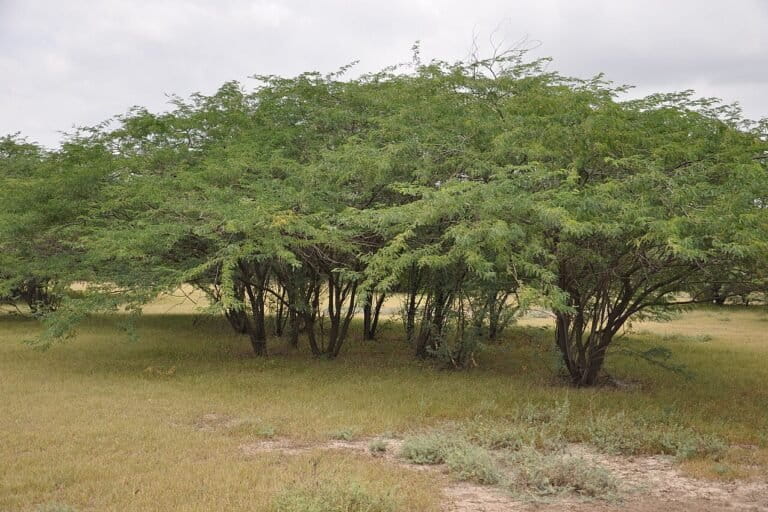
Lion populations have also increased along the coasts of Bhavnagar, southwest of Saurashtra, between Sutrapada and Veraval, and southeast, covering Rajula, Jafrabad, and Nageshree. “This growth can be attributed to the availability of dense vegetative cover in the form of Prosopis juliflora thickets and Casuarina plantations, coupled with the presence of prey species such as nilgai and wild pig, as well as relatively low levels of human disturbance in these forest patches,” says the paper.
Of note is the “recolonisation” of Barda Wildlife Sanctuary by lions, which were last spotted there in 1879. Today it hosts a population of 17 lions. “This suggests improved ecological conditions, especially in terms of protection, prey availability (including nilgai and wild pig), and potential corridors, which have facilitated natural dispersal into Barda Wildlife Sanctuary.”
New populations also were recorded for the first time in the Jetpur and Babra-Jasdan regions, with six and four lions respectively. “Understanding whether satellite populations represent stable demographic units or transient sink areas will be important for forecasting future population structure and dispersal pathways,” the paper says.
According to Ravi Chellam, a lion expert and CEO of the Metastring Foundation, satellite populations cannot be viewed as being distinct from the core population of Gir. “There’s not much geographical distance between these sites. Lions are very mobile, and their presence at a site doesn’t necessarily mean they stay confined to these sites,” he said.
The dispersal of lions from Gir area “indicate almost saturation of core habitats,” the paper notes. A number of experts, including Chellam, have called for lions to be translocated out of the region to support the long-term sustenance of lions in India.
Implications for lion population increase
Lions primarily preferred forest habitats, says the paper, followed by “wastelands,” an administrative term used to describe a variety of land types not hosting dense forest. Such lands are preferred because “they offer relatively reduced human disturbance and provide prey species like nilgai and feral livestock, making them suitable for lions both during day and night,” says the paper. Lions were also found in landscapes like agricultural fields, and to a lesser degree in built-up areas.
As lions increasingly occupy mixed-use habitats, particularly human-dominated landscapes, it risks “elevating the potential for human–lion interactions,” says the paper. Higher densities of lions “could lead to reduced territory sizes, increased overlap among prides and male coalitions, and greater competition for access to breeding females and high-density prey patches,” it goes on to say.
Human conflicts with lions are already on the rise in Gujarat, a 2024 study by researchers from Wildlife Institute of India found. Between 2012 and 2017, the cumulative number of villages reporting attacks on livestock increased by 105 per year, “suggestive of an expanding lion population.” Fear of lions and economic loss were the leading factors for intolerance towards lions.
“The expanding distribution of lions is pushing them into sub-optimal human-dominated habitats, because they now have to navigate barriers like highways, railway lines, open wells, and illegally electrified fences. Poor people often bear the brunt of these unwanted interactions,” said Chellam.
In March, the government revealed in Parliament that 669 lions had died between 2020 and 2025, due to old age, illnesses, injuries from fights, cub mortality, falling into open wells, electrocution and accidents, among other issues.
When asked, Ram of the Gujarat Forest Department said “conflict is a different issue from the census,” adding, “Based on this exercise, health monitoring and mitigation measures can be specifically targeted to reduce impacts. All of these factors can be helped with proper planning.”
Concerns about methodology
The lion census exercise used the minimal total count method to identify individual lions. The Forest Department drew maps of 13 administrative divisions where lion presence had been previously recorded, which were divided into 735 sampling units. Each sampling unit had an enumerator – a beat guard or forester – two assistant enumerators and a volunteer, who were in charge of collecting field data over a 24-hour period. This included recording sightings via photographs and a form specifying gender, markings, cub presence among others. The exercise included over 3,000 people.
Sightings were then cross verified at regional and zonal levels, and when required, artificial intelligence was used to ensure no duplicate findings.
However, this method is also prone to human error, said Chellam. “Unlike tigers and leopards, lions don’t have distinctive body markings that will enable identification of individual lions from camera trap photos. If a guard is to stay awake continuously for 24 hours, what guarantee is there that there will be no errors?” he said, adding, “Most wildlife population estimates provide a range, but this method provides a single specific number through an inexact method.”
Researchers have proposed other methods of calculating lion populations accurately, including capture-recapture methods, which includes capturing some animals, marking them, and recapturing them to see what proportion has been marked to estimate total populations. Lions can also be distinguished by their whisker spot marks.
Banner image: An Asiatic lion in Gir National Park. Image by Bernard Gagnon via Wikimedia Commons (CC BY-SA 3.0).