
- New initiatives take healthcare, social protection, climate awareness and migration support directly to migrant workers and families, overcoming barriers of distance, timing and access.
- Experts say climate-augmented migration is when heat stress, floods, insecure livelihoods and social exclusion overlap with other factors that force people to move, demanding social protection systems that explicitly account for climate risks.
- Multilingual alerts, community organisers, mobile clinics and locally adapted support systems help migrants access healthcare, disaster warnings, entitlements and education, especially where conventional systems fail.
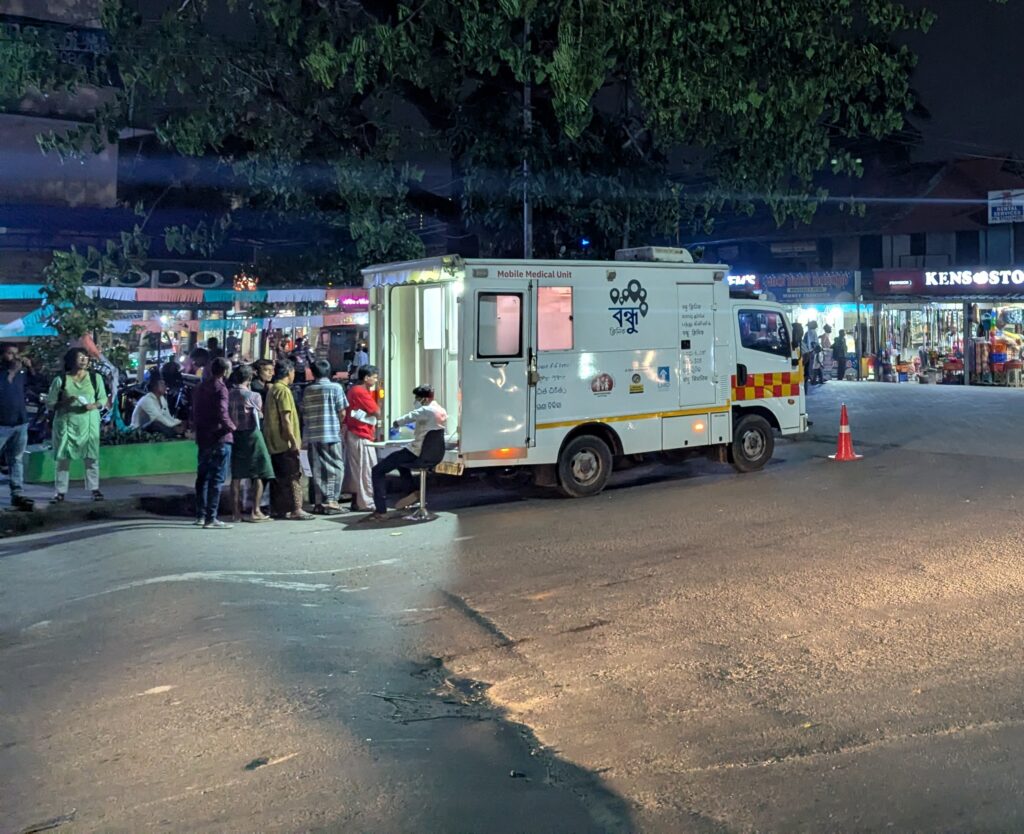
An ambulance-turned-mobile clinic pulls up along the kerb-side of the car park at the bustling Pathalam Junction in Kerala’s Ernakulam district on a March evening. The driver sets up a desk behind the van. This is one of the two Bandhu Clinics, a non-profit that provides primary healthcare services directly to interstate migrant workers and vulnerable communities at their workplaces or residences. Operated by the Kochi-based nonprofit Centre for Migration and Inclusive Development (CMID) and the National Health Mission (NHM), Bandhu Clinic offers a new model of service — mobile healthcare at migrant destinations.
Mohammed Mizanur Rahaman, in his 40s, from Murshidabad, West Bengal, is awaiting his turn outside the clinic for a free consultation. “The clinic comes every Monday. I know that I can get a free check-up,” he says.
Through the last decade, Rahaman has worked as a construction labourer in Kerala for 10 months every year. He lives in a small tin cabin, along with a dozen others, in a densely packed informal settlement that is hot most of the year. The heat is making him tired, Rahaman says, and expresses hope that the doctor could help him.
Reaching out to climate migrants
While India has several programmes to provide general support to migrant labour populations, such as food, subsidised education, and healthcare, “there is a critical need to add a layer that builds capacity specifically for climate risks,” explains Chandni Singh, associate professor, School of Environment and Sustainability, IIHS University.
The country’s social security systems are linked to domicile status — the place of birth or residence as per the Aadhar card. This makes the 600 million internal migrants — nearly 40% of the country’s population — struggle to access basic necessities, benefits and social security schemes. Singh points out that those moving due to climate shocks and those who face climate impacts at their destination are worse off.
When climate change impacts migrants, they face compounded vulnerabilities, where environmental stress at the source or destination overlaps with precarious living conditions, high-risk work that is often irregularly available, and systemic social exclusion, says Benoy Peter, co-founder and executive director of CMID.
The Climate Action Network South Asia projects that 45 million people in India could be compelled to migrate due to climate disasters by 2050.
Several experts whom Mongabay-India spoke to note that beneficiaries of services provided by the health, education and labour departments are expected to visit institutes and centres at central locations, often far away from where they live.
“There’s a lot to be done in adapting social protection schemes to different kinds of migration patterns,” says Singh. “Those who move with their families may have different needs when compared to stretched households, wherein only the earning member migrates while the others stay behind.” However, there are some initiatives, such as the CMID’s Bandhu Clinics, that are testing different ways of building resilience among migrant communities by taking the services to them.


Flexible opening hours
Rahaman has had several episodes of heat stress, with symptoms such as nausea, vomiting, headaches, skin infections, and tiredness, among others. But going to a private doctor means losing a day’s wage. He can’t afford that.
Government services are often inaccessible to migrant populations and daily wage labourers as they clash with working hours and are at centralised locations.
Peter says essential public health services “are inconveniently placed and ill-timed for the migrant workers. Outpatient departments of public health facilities do not work beyond 6 pm. Ideally, it should be done; that’s when most workers get free.”
Peter and his colleagues started Bandhu Clinics in 2020. These clinics are operated in partnership with the National Health Mission, Government of Kerala and various donors. In 2024, the World Health Organization recognised Bandhu Clinics as one of the 140 global experiences promoting refugee and migrant health. The two clinics cover 80 locations a month, and have provided 200,000 services in the last five years, including 70,000 COVID vaccine doses.
Migrants often ignore symptoms or use over-the-counter medication, CMID staff notes. The clinics fill an important systemic gap, providing basic health services and referring patients to hospitals.

Building awareness on climate impacts
The UN agencies International Organization for Migration (IOM) and the Food and Agriculture Organization (FAO) are piloting a similar project in climate-vulnerable districts in Odisha and Telangana. The Mobile Migrant Resource Centres (MMRC) are help-desks on the move, taking labour, agriculture, and rural development departments to people’s doorsteps. MMRCs focus on livelihood diversification, mental health support, and safe migration targeting families who stay behind. These are primarily women and the elderly managing households and farms, with responsibilities of child care and elderly care. It also helps potential migrant workers and families with information on safe migration.
In the drought-prone Nizamabad and Narayanpet districts of Telangana, a colourful minivan, called Valasa Sahaya Kendram of Mobile Migrant Resource Centre, does the rounds of villages that report high out-migration. Women, men and children gather around the large television screen at the back of the van.
The MMRC raises awareness about climate impacts and migrant workers’ rights through Telugu-language videos and dramas. It is staffed by multi-disciplinary teams, including community mobilisers and communication specialists, who provide pre-departure orientation, information on safe migration, and skill certification opportunities. “The MMRC reaches people who are often excluded from formal government systems,” says Amit Chowdhury, National Project Officer, India, for the IOM. “These mobile centres act as a bridge to the government.”
Local partners, along with IOM, work with state departments to strengthen the delivery of services and information in remote areas, facilitate interdepartmental coordination, and push for a climate lens in all policies.

Last mile connectivity
Beyond the glass towers and high-rise offices of multinational companies in Bellandur in Karnataka’s Bengaluru, is Kariammana Agrahara. Thousands of huts with blue tarpaulin and tin sheets for roofs stretch into the horizon. An uneven and broken path lined with garbage leads up to these informal settlements inhabited by families mostly from north Karnataka and north-east India.
K.S. Mala, a community organiser at the nonprofit Gubbachi Learning Centre, goes from hut to hut to check their documents, follow up on medical needs, and check if children had been to school. Most often, she assists people with translating government schemes into local languages and digital forms, she says. Gubbachi focuses on addressing the compounded vulnerability migrant families face, including those caused by climate impacts.
Language remains the biggest barrier while accessing essential services, says Irudaya Rajan, Chair, The International Institute of Migration and Development. Digitisation is the other issue, explains Somya Nand, co-founder and operations lead at Gubbachi.
Gubbachi also assists migrant families with language at six government hospitals. Nand says, “It’s a form of checks and balances. So the officer, doctor, teacher or principal in front of us does not evade or deny access to migrant families because of language.”

Focus on climate-augmented migration
Climate change is often not recognised as the primary reason for migration. It’s one of the many. Peter says, “It is not climate-induced migration, it is climate-augmented migration.”
This is why the IOM-FAO project focuses on high-outmigration zones in the four districts in Odisha and Telangana, Chowdhury says. MMRCs provide last-mile services and information on social security schemes; their field staff reach remote villages witnessing high levels of out-migration, and help families with remittance management, which includes redirecting finances toward productive, climate-resilient investments.
“This helps households build a saving culture to survive future climate shocks,” Chowdhury says. All of it is done in local languages.
Rajan points out that there’s no one-size-fits-all approach. “You have to modify (the programmes) according to the socio-cultural environment and literacy of the state and the migrant populations,” he notes.

Breaking language barriers
A clinic run by Gubbachi and the Azim Premji Foundation is a five-minute walk from Kariammana Agrahara, where there’s always one staff nurse who can communicate in Hindi, Bengali or Assamese, often spoken by inter-state migrants in this region.
In Bandhu Clinics, the materials and signage are also multilingual. The CMID also creates health- and weather-related alerts in Bengali, Assamese, Odia, Hindi and Tamil — languages spoken by more than 80% of the migrants in Ernakulam.
Finding the CMID’s health alerts useful, the Kerala government asked the organisation to develop certain materials for heat alerts and disaster warnings. Nand points out that extreme weather has worsened daily hardships at source as well as destinations such as Bengaluru. “Health is always at risk, hygiene is at risk, there is an impact on livelihood — say if it floods, they can’t leave their homes. The employment is not secure and is hugely impacted by the weather conditions.”
Nand says, “Any change in weather conditions, including those worsened by climate change, impacts them first.” It is imperative to communicate weather-related disasters with migrant communities in languages they understand.
Rahaman recalls the 2018 Kerala floods, when he was stranded on a construction site in Idukki. He didn’t receive any timely warnings, he says. “There were 20-30 of us living in that building without food or water. The road outside was completely flooded.”
Even today, the only early warning messages Rahaman sees in Assamese or Bengali are on the Bandhu Clinics. “We have a firefighting approach to migration policy,” Rajan adds, “where officials only react when there is a crisis rather than working on prevention.”
Mahima Jain is a resident fellow at the Climate Change Media Hub, Asian College of Journalism.
Banner image: The mobile Bandhu clinic at the Pathalam Junction in Kerala’s Ernakulam district. In 2024, the World Health Organisation recognised the Bandhu Clinics as one of the 140 global experiences promoting refugee and migrant health. Image by Mahima Jain.

