
Marwa Janini was 10 years old and growing up in Brooklyn on Sept. 11, 2001.
In the fallout of the Al Qaeda terrorist attack that killed almost 3,000 people and destroyed the World Trade Center’s twin towers, she remembers the beginning of intense surveillance, and fear in the Muslim and Arab community that followed. And, even as a young girl, she remembers thinking that the people who some were targeting in the wake of the attack needed a way for their voices to be heard.
Now, she leads an organization providing that representation – the Arab American Association of New York – and she is at the center of something that might have felt unthinkable to her and others 25 years ago: She’s part of the transition team for New York’s first Muslim mayor, Zohran Mamdani, who will be sworn in Jan. 1.
Why We Wrote This
Muslims in Bay Ridge, New York, remember the days of suspicion and fear that followed the 9/11 terror attacks. They could not have foreseen a day that has now arrived: The election of a Muslim as New York City mayor.
Mr. Mamdani got nearly 51 percent of the vote in a mayoral election that saw the highest turnout since 1969, winning a diverse mix of demographics and communities across the city. In Bay Ridge, a neighborhood in southwestern Brooklyn known for having the largest Arab community in New York City and a significant Muslim population, Mr. Mamdani won the majority of the votes, though the western portion voted largely for former New York Gov. Andrew Cuomo.
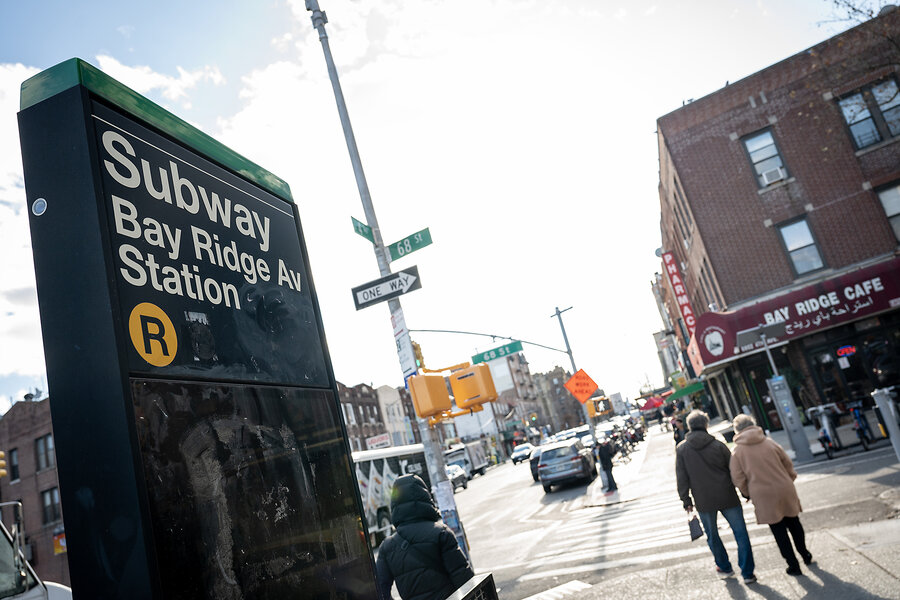
Over decades, the Bay Ridge neighborhood has transformed from a former hotspot of European immigrants to a place now known informally as “Little Palestine” or “Little Yemen,” especially around 5th Avenue between 67th and 75th streets. There, storefront signs are often in Arabic, not English; recordings of the Quran play on TVs and radios in neighborhood shops; and the call to prayer, or Adhan, rings out from the local mosque.
In Mr. Mamdani, many New Yorkers see a candidate willing to take on the city’s affordability crisis, even as some question whether he can deliver on his campaign promises. For many Muslims in the city, his victory has also prompted reflection on their community’s journey from political marginalization to one of their own becoming the top elected official in New York City.
“The story of Muslim New Yorkers and Arab New Yorkers isn’t one of linear progress,” says Ms. Janini. “There are a lot of complexities. It’s a community that has to continuously fight to feel safe and supported and seen.”
Mr. Mamdani, while vowing to be a mayor for all New Yorkers, made a direct promise to Muslims in his victory speech, saying the over 1 million Muslims in the city will now know that they belong, “not just in the five boroughs of this city, but in the halls of power.”
“The most … salient moment”
After 9/11, a covert counterterrorism program by the New York Police Department targeted Muslims and people of Middle Eastern descent in Bay Ridge and other communities in New York. The Arab American Association of New York, as well as mosques, student groups, and businesses were police targets.
A 2013 lawsuit accused the NYPD of civil rights violations by surveilling Muslims without cause. The settlement led to major reforms within the department, including a prohibition on investigations based on race, religion, or ethnicity; and increased oversight of rules that safeguard against discriminatory and unjustified surveillance.
Asad Dandia, one of the plaintiffs, had discovered that a charity he co-founded had been infiltrated by an NYPD informant. He says the case pushed him into community organizing.
“It was probably the most visible and salient moment in our history where we actually took a stand against discrimination and injustice perpetrated by city government,” Mr. Dandia says.
That momentum continued. In 2013, organizers launched the Muslim Democratic Club of New York to mobilize voters. Mr. Mamdani’s chief counsel on his transition team helped found the group. Four years later, Mr. Mamdani served as canvassing director for Khader El-Yateem, a Palestinian American and Lutheran pastor who ran for city council in Bay Ridge. Despite El-Yateem’s loss, the campaign helped activate people there, and Mr. Mamdani’s political career can trace its roots to the work he did in Bay Ridge.
Culturally, the community’s story continues to evolve. Just three years ago, a woman named Basma, who asked that only her first name be used for privacy reasons, arrived here from Algeria.
“I heard people speaking Arabic, and there was a store that had Algerian music playing and I was walking and crying and laughing at the same time,” she says. “It’s all the same [as Algeria] – the food, the language, the gossip.”
“At least hear us”
Amir Ali, a Yemeni business owner in Bay Ridge, says he is glad to have Mr. Mamdani representing Muslims in public life.
“It does matter to me to have a nice picture of Islam other than what the media shows,” Mr. Ali says. “That’s what we care about. He is showing the American Muslim as we want him to.”
But what matters most to Mr. Ali and others interviewed for this story is the issue Mr. Mamdani centered his campaign on: affordability. A poll in early 2025 found that almost two-thirds of New York City residents say meeting basic needs is increasingly difficult, and almost half of respondents have considered leaving the city. Mr. Ali has personal experience with rising costs: He says monthly rent for his shop has increased by around $2,000 in the past few years.
“A lot of people voted for [Mr. Mamdani], not just Muslims, not just Middle Easterners, because all these people are struggling for real with affordability,” Mr. Ali says. “They need somebody to at least – even if he’s not gonna fix it – look at it, and at least hear us.”
A democratic socialist, Mamdani’s agenda includes things such as city-owned grocery stores and rent freezes. His political opponents have seized on that. “Yes, he says he’s a socialist,” said Republican U.S. Rep. Nicole Malliotakis, whose district includes most of Bay Ridge. “But guess what, my friends, those are policies straight out of the communist playbook of Karl Marx.”
Mr. Mamdani also faces headwinds among other constituencies in the city, which is home to the largest Jewish population outside of Israel. Some of his public statements related to the war in Gaza have been criticized by Jewish organizations and leaders, including when he apparently declined to condemn the phrase “globalize the intifada” – a phrase they believe condones violence against Jews. Mr. Mamdani has said it is not language he uses. In an October debate, he said he recognizes Israel’s right to exist, but would not “recognize any state’s right to exist with a system of hierarchy on the basis of race or religion.”
Still, about one-third of Jewish New Yorkers voted for Mr. Mamdani, and he has said he will be a mayor “that protects Jewish New Yorkers.” His pro-Palestine stance, meanwhile, has earned support from many in New York City, where 44% of registered voters sympathized more with Palestinians while 26 percent sympathized more with Israel, according to a New York Times and Siena University poll.
Ms. Janini, a Palestinian American, says it was once unimaginable to her that elected officials in a country that aligns so closely with Israel would publicly express support of Palestinians. Mr. Dandia, an urban history tour guide in New York who is on Mr. Mamdani’s informal advisory team, says the mayor-elect’s stance reversed the feeling for many voters who had felt politically invisible on the issue.
Zareena Grewal, an associate professor of religious studies at Yale University, says that the post-9/11 period has been a politically transformative time for Muslims in New York City and led to a successful grassroots movement.
She says Muslims were the “canary in the coal mine” for issues such as affordability.
“It was the social welfare issues of poverty, surveillance, racism, unequal access, discrimination in schools, and health care that really got Muslim New Yorkers to come together despite their political differences and work in tandem with each other and see results,” Ms. Grewal says.