Steffan MessengerWales environment correspondent
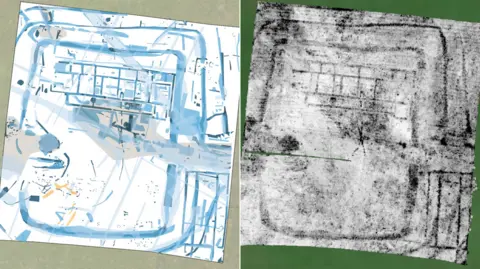 TerraDat Geophysics
Archaeologists have discovered the largest Roman villa ever found in Wales in an “amazing discovery” which they say has the potential to be “Port Talbot’s Pompeii”.
“My eyes nearly popped out of my skull,” said project lead Dr Alex Langlands, after ground penetrating radar revealed the “huge structure” in Margam Country Park.
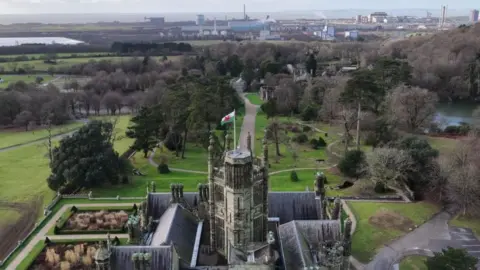
The location, in a historical deer park, is significant because the land has not been ploughed or built on, meaning the villa’s remains – less than a metre below the surface – look to be well preserved.
Those involved from Swansea University, Neath Port Talbot council and Margam Abbey Church said the discovery offered “unparalleled information about Wales’ national story”.
The team’s findings have been shared exclusively with BBC News ahead of an announcement.
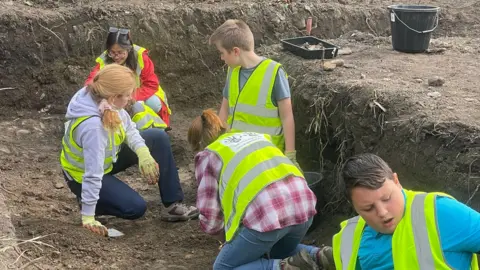
Geophysical surveys of the park – a popular visitor attraction in south Wales – were commissioned as part of a wider project involving school pupils and the local community to learn more about the area’s heritage.
Scanning devices helped map potential archaeological features hidden underground.
The team “struck gold” – discovering the footprint of a 572 sq m Roman villa surrounded by fortifications.

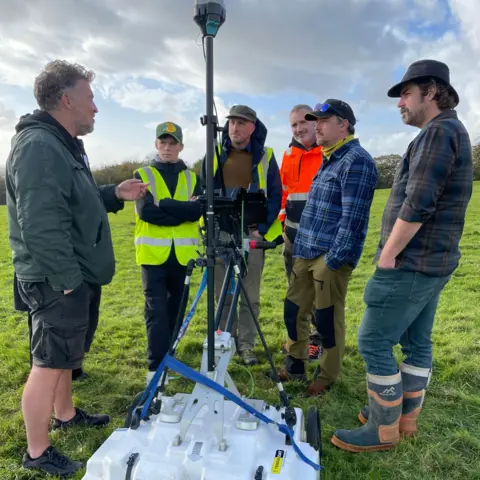 Swansea University
Langlands, co-director of Swansea University’s Centre for Heritage Research and Training, described it as a “really impressive and prestigious” building, likely to have been finely decorated with statues and mosaic floors.
“We’ve got what looks to be a corridor villa with two wings and a veranda running along the front,” he explained.
“It’s around 43m (141ft) long and looks to have six main rooms [to the front] with two corridors leading to eight rooms at the rear.
“Almost certainly you’ve got a major local dignitary making themselves at home here,” he added.
“This would have been quite a busy place – the centre of a big agricultural estate and lots of people coming and going.”
As a standalone structure, it is the largest villa yet to have been discovered in Wales.
Most of the known Roman remains in Wales are from military camps and forts, while grandiose estates like this are less commonly found.
The discovery would force experts to “rewrite the way we think about south Wales in the Romano-British period”, Langlands said.
“This part of Wales isn’t some sort of borderland, the edge of empire – in fact there were buildings here just as sophisticated and as high status as those we get in the agricultural heartlands of southern England.”
It also showed that Margam – “a place that may even have lent its name to the historic region of Glamorgan” – was “one of the most important centres of power in Wales”.

Christian Bird of TerraDat, the Welsh firm which carried out the surveys, said the images were “remarkably clear, identifying and mapping in 3D the villa structure, surrounding ditches and wider layout of the site”.
This includes a substantial 354 sq m aisled building to the south east of the villa – which the team believes was either some sort of barn or meeting hall.
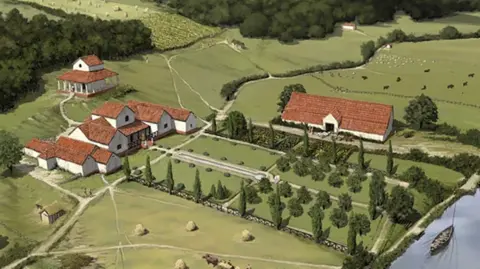 Peter Urmston/English Heritage
The villa’s exact location is being kept secret for now, over fears it could be targeted by rogue metal detectorists.
Langlands said conserving the site would be the first priority, before further survey work was carried out and funding sought for future excavation.
It had the potential to be “Port Talbot’s Pompeii”, he suggested, playfully referring to the ancient Roman city preserved by the eruption of Mount Vesuvius in 79 AD.
“A lot of archaeologists get wound up by connections made with Pompeii but I think it’s in part justified because of the levels of preservation here,” he said.
“We can see that in the survey data first and foremost, but we also know this has been a deer park for hundreds of years – it hasn’t been subject to the type of ploughing [that has damaged many other villa sites].
“There’s a really exciting prospect that we’ve got really good survival of archaeological evidence and the potential therefore to tell a huge amount about what life was like back in the first, second, third, fourth and maybe even into the 5th Century.”
 Swansea University
Further details of the team’s findings will be shared at an open day at Margam Abbey Church on 17 January.
Margaret Jones, a retired teacher from Port Talbot with a keen interest in local history, booked a ticket and said she cannot wait to find out more.
“I’m still a bit shellshocked at the thought that this place where I played, where my children and grandchildren have played – that under our feet was this incredible house,” she said.
“It’s out of this world.”
She added that Port Talbot had been through “so many disappointments” in recent years with major job losses at the local steelworks, but “this will put us on the map… and we’ll be proud”.
 Swansea University
The discovery was “just incredible” and “something we couldn’t dream of”, said Harriet Eaton who runs a Young Archaeologist Club as part of her role as Heritage Education Officer for Neath Port Talbot council.
“It would be fantastic if there was a community excavation here, [offering people] that hands on connection to the history unveiling beneath us,” she said.

Margam Country Park is owned and run by the local council and was already an important historical site, with an Iron Age hillfort, the remains of a 12th Century abbey and an impressive Victorian castle as just some of its attractions.
But the villa find helped fill “a big gap in our knowledge” about what was happening in Margam during the Roman period, according to park manager Michael Wynne.
“It’s a really unusual find this far west and of such a significant size – it will really add to our knowledge of Welsh and local history,” he said, and mean “more visitors to Margam Park, to Neath Port Talbot and to Wales generally”.
“It’s a really good news story.”